

Environmental, Social, and Governance (ESG) is the lens through which organizations assess their sustainability and ethical impact. It spans environmental stewardship, social responsibility, and corporate governance, providing a framework to guide decisions, strengthen accountability, and drive long-term performance.
At ESG Elevate Corner, we track ESG developments in Nigeria and around the world, one report at a time, delivering insights, updates, and analysis to help readers stay informed and make responsible, forward-looking decisions.
May 2026 marked a historic inflection point in the global Environmental, Social, and Governance (ESG) landscape. The market witnessed a definitive structural shift characterized by massive regulatory rollbacks, administrative cost-cutting, and institutional adjustments designed to temper the compliance burden on corporate entities. Led by a substantial 75% cost reduction in the European Union’s flagship deforestation framework and a formal initiative by the United States SEC to rescind corporate climate disclosure mandates, policymakers globally are pivoting toward administrative pragmatism. Concurrently, capital markets demonstrated deep structural resilience, routing billions into utility-scale clean infrastructure, carbon-market alliances, and newly formalized social impact reporting benchmarks.
In Nigeria, ESG adoption is increasingly shifting from policy discussion to practical implementation across both the financial and private sectors, as seen in recent coordinated efforts to strengthen sustainability capacity, access to green finance, and responsible banking practices. On May 8, 2026, the Nigeria Employers’ Consultative Association (NECA), in partnership with the International Labour Organization (ILO), launched an ESG Implementation Guide for MSMEs in Lagos to help small businesses navigate growing global requirements for verifiable ESG reporting, offering a practical toolkit for risk identification, governance improvement, and access to sustainable financing, alongside continued training and advocacy to support long-term integration into global value chains. In the financial sector, the Bank of Industry (BOI) was named Best Bank in Sustainable Finance (Nigeria) at the 2026 Global Sustainable Finance Awards by Global Finance Magazine, reflecting its leadership in embedding ESG principles into lending through its Sustainable Finance Framework and its role as Nigeria’s National Implementing Entity for the Adaptation Fund, with a focus on climate action, circular economy financing, and inclusive growth. However, a Fair Finance Nigeria assessment of Access Bank, Zenith Bank, United Bank for Africa, and Standard Chartered Nigeria shows that while Nigerian banks are making gradual progress in internal compliance areas such as anti-corruption and workforce policies, ESG integration remains largely reactive and compliance-driven, with an average score of 1.7 out of 10 and significant gaps in climate risk integration, biodiversity, tax transparency, and client-facing ESG practices, highlighting the need for stronger systemic alignment between regulators, financial institutions, and civil society to deepen sustainability adoption across Nigeria’s financial ecosystem.
On May 4th, the European Commission released its highly anticipated simplification review of the EU Deforestation Regulation (EUDR). Aimed at curbing global forest degradation via strict import/export value chain controls, the Commission introduced administrative updates that reduce overall compliance costs for corporate enterprises by approximately 75%.
The legislative landscape in the United States experienced a fundamental realignment. The Securities and Exchange Commission (SEC) took its definitive first steps to completely scrap and rescind its landmark corporate climate reporting rules. Citing concerns over structural authority and escalating administrative expenses, the Commission launched a formal notice-and-comment rulemaking framework to dismantle the 2024 mandates.
In parallel, regional polarization reached a peak as the Trump administration initiated high-profile litigation against major corporate media entities—most notably suing the New York Times over alleged Diversity, Equity, and Inclusion (DEI) policy frameworks. Meanwhile, state-level actions continued to diverge: New York Governor Kathy Hochul signed a state budget deal pushing back near-term emissions regulations and replacing the state’s aggressive 2030 economy-wide greenhouse gas target with a deferred 2040 target, openly labeling the previous goals “costly and unattainable.”
Aligning with the global trend of regulatory rationalization, the Australian government utilized the release of its 2026 Budget to propose landmark corporate transparency rollbacks. The reform raises minimum disclosure thresholds to completely exempt smaller companies—defined as operations generating under $100 million in revenue or holding less than $50 million in assets—from mandatory audited financial and sustainability reporting, shielding them from supplier information request costs.
Corporate governance standards faced severe disruption within the energy sector. Multinational giant BP abruptly removed its recently appointed Chair, Albert Manifold, following serious concerns brought to the board regarding internal governance standards, structural oversight, and general conduct. This dramatic ouster comes at a highly delicate juncture, as bp navigates a contentious strategic realignment aimed at scaling back low-carbon investments to redirect capital expenditures toward traditional high-yield oil and gas development.
A structural reality check rippled through corporate sustainability teams as major global conglomerates publicly acknowledged systemic bottlenecks. McDonald’s announced it will officially miss its interim 2030 value chain decarbonization targets, while Singaporean state investor Temasek signalled it is highly likely to miss its 2030 portfolio decarbonization goals. Both institutions pointed toward infrastructure constraints but maintained formal commitments to achieve absolute Net Zero by 2050.
Despite the immense grid strain generated by the explosive buildout of Artificial Intelligence infrastructure, technology titans aggressively expanded carbon-free procurement to defend their environmental targets:
The TISFD Framework Launch: On May 26th, the Taskforce on Inequality and Social-related Financial Disclosures (TISFD) achieved a major milestone by releasing the first operational draft version of its standardized disclosure framework. Modeled directly on the proven architectural components of the TCFD (Climate) and TNFD (Nature), the TISFD framework bridges the human capital reporting deficit. It provides organizations with actionable parameters to assess, manage, and audit corporate impacts, dependencies, and financial risks relative to human rights, labor standard vulnerabilities, workplace inequality, and consumer/community interactions.
International Carbon Pricing Cooperation: On the geopolitical front, the European Commission, alongside the sovereign governments of China and Brazil, formally collaborated to launch the Open Coalition on Compliance Carbon Markets. Recognizing that the global economy now features over 80 independent carbon pricing and emissions trading schemes across 50 nations, this cross-continental initiative aims to standardize global carbon credit criteria, lower transactional friction, and establish cost-effective compliance trading corridors.
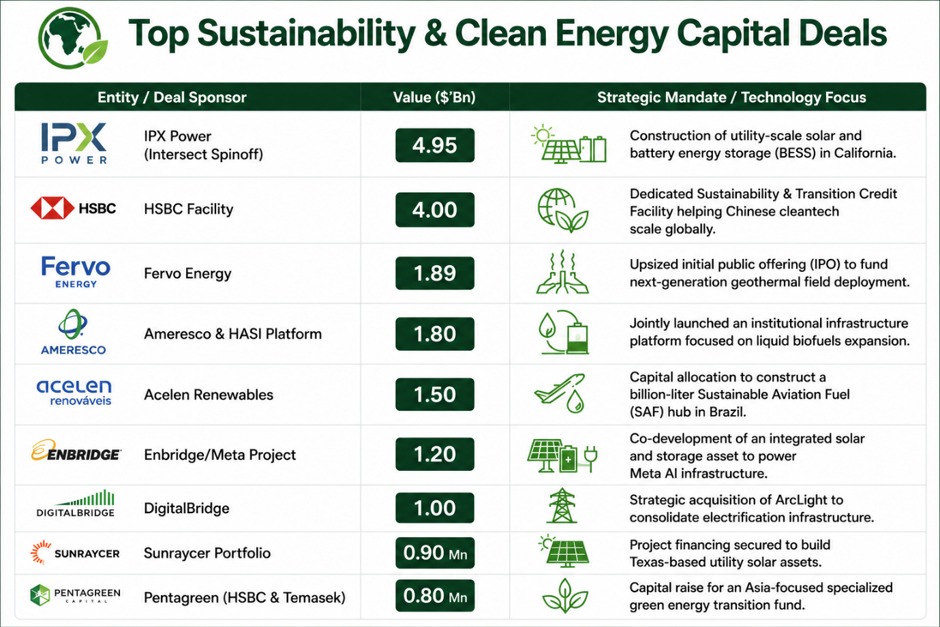
The sustainable finance sector experienced a powerful volume rebound in the opening months of 2026. Institutional capital continues to flow heavily into grid infrastructure, utility-scale battery storage, and localized transition facilities.