Nigeria Treasury Bills Market Review
Period: January – July 2026
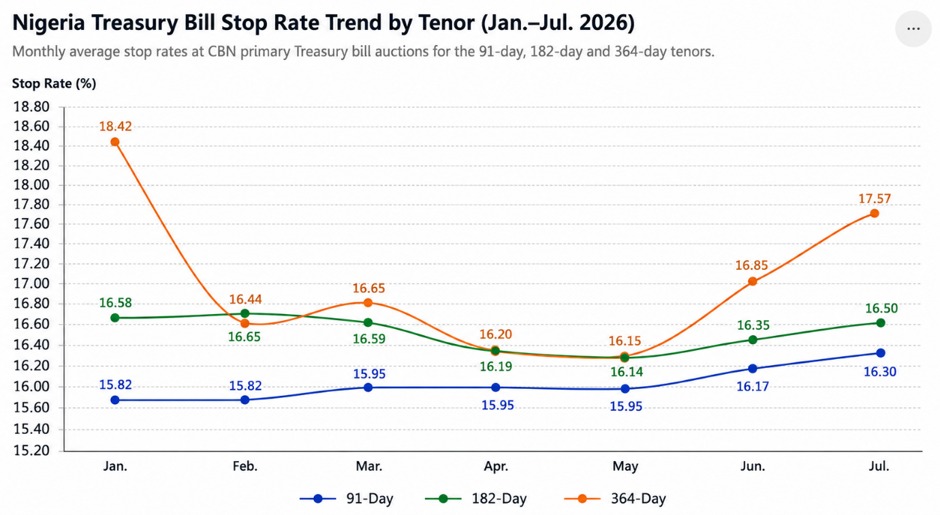
Based on the Nigerian Treasury Bill (NTB) primary market auction data, the market experienced three distinct phases in 2026: downward yield repricing in Q1, relative stability during Q2 following easing interest rate pressures, and renewed upward repricing in July amid improved liquidity conditions, rising inflation concerns, and evolving monetary policy expectations.
Despite fluctuations in stop rates, the Nigerian Treasury Bill market remained one of the most attractive segments of the domestic fixed-income market during H1 2026, supported by strong institutional demand. The 364-day bill consistently dominated investor preference, with several auctions recording subscriptions between ₦2 trillion and ₦4 trillion against offers largely ranging between ₦400 billion and ₦800 billion, reflecting sustained appetite for longer-duration risk-free assets and investors’ preference to lock in elevated yields amid macroeconomic uncertainty.
Key Market Insights
Strong Investor Preference for 1-Year Bills
The 364-day NTB remained the preferred instrument throughout the review period. Several auctions recorded subscription-to-offer ratios above 5x, with demand peaking at approximately 5.5x in early February (₦4.40 trillion in bids against an ₦800 billion offer).
The strong participation from pension funds, asset managers, banks and corporate investors reflected efforts to extend portfolio duration and lock in attractive sovereign yields amid inflation uncertainty and changing monetary policy expectations.
Q1 Yield Compression Reflected Improving Liquidity Condition
The first quarter witnessed a notable decline in NTB stop rates, driven by improved system liquidity (peaking as high as ₦8.89trn) in addition to aggressive investor bidding.
The 364-day stop rate declined from 18.47% in January to 15.90% by February, while effective yields moderated from 22.64% to approximately 18.89%, reducing the government’s borrowing cost and signalling stronger competition for sovereign instruments.
Q2 Stability Suggested Policy Anchoring
Between March and May, Treasury Bill rates stabilised across the curve:
- 91-day bills: around 15.95%
- 182-day bills: between 16.14% and 16.59%
- 364-day bills: between 16.15% and 16.65%
The relative stability reflected improved liquidity management by the Central Bank of Nigeria (CBN), stronger investor confidence, and a more balanced demand-supply environment despite inflationary pressures.
July Auctions Signalled Renewed Upward Yield Pressure
Beginning in June and becoming more pronounced in July, Treasury Bill yields resumed an upward trend.
The 364-day stop rate moved above 17.30%–17.70%, while effective yields approached 21.50%, indicating renewed investor demand for higher compensation amid surplus liquidity conditions, inflation risks and supply-driven price pressures, particularly from oil price volatility in an energy-dependent economy.
Liquidity and Demand Dynamics
Despite movements in stop rates, auction demand remained exceptionally strong throughout the period, highlighting the depth of Nigeria’s domestic fixed-income market.
The sustained demand reflected:
- Continued liquidity availability among institutional investors;
- Confidence in sovereign credit quality;
- Preference for government securities over higher-risk alternatives; and
- Strong demand for high-quality liquid assets.
The CBN maintained a measured issuance strategy by moderating allotments relative to subscriptions, balancing government funding needs with efforts to manage borrowing costs and avoid excessive accumulation of short-term debt.
Investment Implications
For investors:
- Short-duration bills remain suitable for liquidity management and tactical positioning.
- Medium-tenor bills provide reinvestment flexibility amid uncertain rate expectations.
- 364-day bills continue to offer attractive risk-adjusted returns, although July’s upward repricing suggests yields could remain elevated should inflation and liquidity pressures persist.
For policymakers:
The auction outcomes demonstrate continued investor confidence in Nigeria’s domestic debt market. However, sustaining this confidence will depend on further inflation moderation, exchange-rate stability, prudent liquidity management and a disciplined fiscal borrowing strategy.
Conclusion
As at July 2026, investor demand remained concentrated at the short and long ends of the curve, with the 364-, 182-, and 91-day Treasury Bills recording total allotments of ₦15.15 trillion, ₦1.13 trillion and ₦1.59 trillion, respectively, against subscriptions of ₦44.05 trillion, ₦1.61 trillion and ₦1.69 trillion, and offers of ₦10.70 trillion, ₦2.15 trillion and ₦1.90 trillion. The resulting barbell positioning strategy highlights investors’ preference for the one-year and 91-day maturities, while demand for the 182-day tenor remained relatively weaker.
Overall, the NTB market demonstrated resilience, supported by strong investor appetite, disciplined issuance and evolving monetary policy expectations. While yields stabilised during Q2, the July increase in stop rates indicates a market adjustment towards tighter financial conditions amid persistent inflationary pressures, including supply-driven risks from oil price volatility. Treasury Bill yields will remain largely influenced by inflation trends, CBN liquidity operations and the Federal Government’s domestic borrowing requirements.
Treasury Bill Stop Rate Trend
The chart below illustrates the stop rate trend during the first half of 2026, followed by a notable rebound in July as investors repriced risk amid changing liquidity conditions and inflation expectations.