

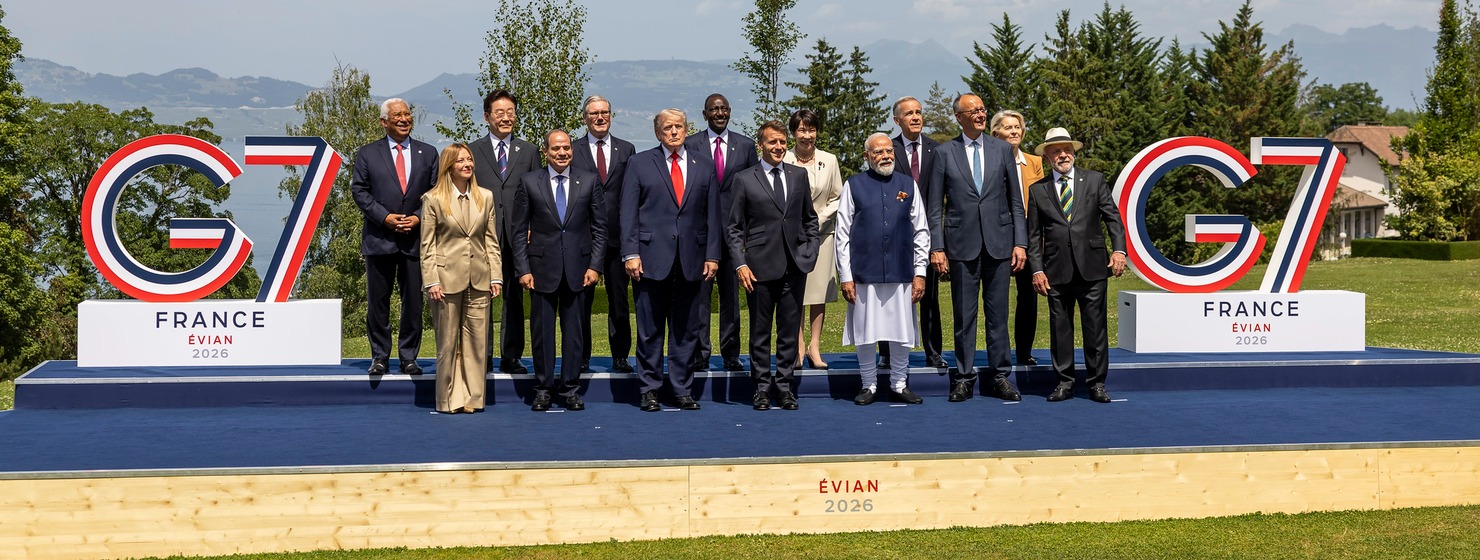
The 2026 G7 Summit held in Évian, France, may ultimately be remembered less for ceremonial diplomacy and more for its attempt to redefine how advanced economies respond to an increasingly fragmented world.
Hosted for 3 days, from June 15-17, 2026 under France’s presidency, introduced what leaders repeatedly framed as a model of “convergence,” expanding discussions beyond the traditional G7 circle to include partner economies such as Brazil, India, Kenya, Egypt, and South Korea, alongside multilateral institutions and private sector actors.
This broader coalition reflects a recognition that today’s most pressing challenges, geopolitical instability, energy disruptions, supply chain concentration, public health threats, artificial intelligence (AI), and development financing, cannot be addressed through isolated policy actions.
The result was one of the most declaration-heavy G7 meetings in recent years, producing coordinated commitments across security, trade, development, technology, health, and economic governance.
The summit’s strongest immediate market signal came from its geopolitical positioning.
On Ukraine, leaders reaffirmed support for sovereignty and committed to increased military capabilities, energy resilience support and stronger economic pressure on Russia, including additional sanctions targeting the oil and gas sectors.
At the same time, the summit welcomed diplomatic progress in the Middle East and supported efforts to secure unrestricted transit through the Strait of Hormuz, one of the world’s most critical energy corridors.
This dual approach matters economically.
The G7 effectively acknowledged that geopolitical shocks have become one of the largest sources of inflation volatility and financial market uncertainty.
Near-term impact: The policy direction may support investor confidence if geopolitical conditions continue to stabilize. Lower fears of energy disruption and could reduce energy-related inflation pressures as well as improve market sentiment if implementation holds. However, continued sanctions and elevated defence commitments suggest geopolitical spending will remain structurally high.
Perhaps the summit’s most consequential but underappreciated outcome was its focus on correcting global macroeconomic imbalances.
Leaders openly recognized that persistent current account gaps, uneven growth models, supply distortions, and excessive economic dependencies threaten long-term financial stability.
Rather than treating imbalances as isolated national issues, the summit elevated them into a collective policy concern to be monitored through international institutions and advanced further within the G20. This signals an emerging policy shift, from emergency stabilization toward coordinated economic adjustment.
Near-term impact: Expect greater scrutiny of fiscal deficits, external balances and industrial policy. Countries with persistent surpluses may face pressure to stimulate domestic demand, while deficit economies may increasingly pursue fiscal consolidation and savings-driven reforms. This could encourage closer policy coordination around external balances.
One of the summit’s clearest economic priorities was reducing dependence across strategic supply chains. Leaders advanced a comprehensive framework covering critical minerals, industrial capacity, recycling, transparency, stockpiling and investment coordination.
Targets were introduced to reduce dependency concentration in strategic mineral inputs while strengthening downstream industrial capability.
The shift reflects a broader reality: supply chains are increasingly treated as instruments of economic security.
Near-term impact: The declarations may strengthen policy support for investment in strategic sectors toward mining, refining, logistics infrastructure, battery inputs, industrial technology and resource processing. Emerging economies with mineral reserves and industrial policy readiness may attract stronger investment interest.
Another defining outcome was the repositioning of international partnerships.
Rather than emphasizing traditional aid architecture, leaders advocated for a development framework built around domestic resource mobilization, private capital participation, debt sustainability and blended finance. The summit also emphasized improving development efficiency and reducing fragmentation across financing institutions.
For developing economies, the message was direct: growth will increasingly depend on building investable environments rather than expanding concessional financing.
Near-term impact: Infrastructure financing, sovereign reform programs and public-private investment vehicles could receive renewed attention. Economies capable of demonstrating transparency, policy stability and execution capacity may become stronger beneficiaries of international capital flows.
The summit treated health and technology not as social issues but as pillars of resilience.
Leaders launched coordinated responses to the Ebola outbreak and expanded international commitments around cancer research, data collaboration and health system strengthening.
At the same time, discussions around AI evolved beyond innovation into deployment governance, financial stability implications and digital safeguards, particularly for younger users. The integration of business leaders into AI discussions signaled a stronger public-private model for technology governance.
Near-term impact: Expect accelerated investment in health systems, medical innovation, AI infrastructure and digital regulation. The summit positions health and trusted AI deployment as increasingly important policy priorities, positioned at the intersection of productivity enhancement and trusted technology deployment.
The summit broadened security beyond traditional defence.
Leaders adopted measures to combat drug trafficking through enhanced port coordination, reinforced anti-money laundering efforts, stronger disruption of illicit financial flows and expanded cooperation against migrant smuggling networks.
These outcomes point to a widening definition of economic resilience, one that increasingly includes logistics integrity, financial transparency and institutional security.
The Évian Summit successfully laid out a blueprint for a return to collective economic management. By treating interconnected risks, from macroeconomic imbalances to AI governance, with unified policy directives, it sent a strong signal to global markets: resilience is the new strategy.
Its success and true test will ultimately depend on implementation and execution.
But in the near term, the message is already influencing markets: policy coordination is back, resilience has become strategy and convergence, not fragmentation, increasingly being positioned as the path to durable growth.
Tags:





Subscribe now to keep reading and get access to the full archive.