


July 2026, Edition 4
Nigerian markets sustained a positive tone during the week, supported by strong liquidity, robust demand for fixed income assets, improving FX conditions, and resilient corporate earnings. Lower yields across Treasury bills and FGN bonds reflected sustained investor appetite, while the Central Bank of Nigeria’s (CBN’s) continued policy discipline reinforced confidence in macroeconomic stability. Equities remained resilient on the back of strong earnings, although elevated rates, geopolitical risks, and global policy shifts continued to shape investor positioning. Overall, markets remain supported by improving fundamentals but require cautious navigation of evolving domestic and external risks. Commodities priced risk closed high week-on-week (WoW), with Brent crude and West Texas Intermediate (WTI) at $98.38/bbl. (+11.67%) and $90.47/bbl. (+9.67%) respectively, while gold at $4,052.00/oz (+0.87%).
System liquidity remained robust through the week after opening at ₦1.81 trillion (capturing a ₦2.82 trillion CRR deduction at last week’s close), peaking at ₦3.86 trillion before closing at ₦3.78 trillion on Friday (+108.65%) week-to-date (WTD). Money market rates were stable, with the Open Repo Rate (OPR) at 22.00% and the Overnight (O/N) rate at 22.12% (WoW -1bps). In the FX market, the Naira traded within a range of $/₦1,359.00 and $/₦1,382.99, before closing at $/₦1,362.09 on Friday.
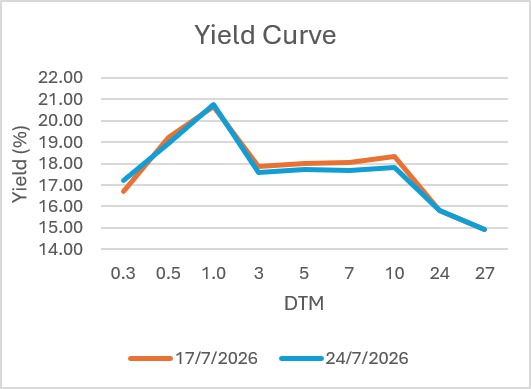
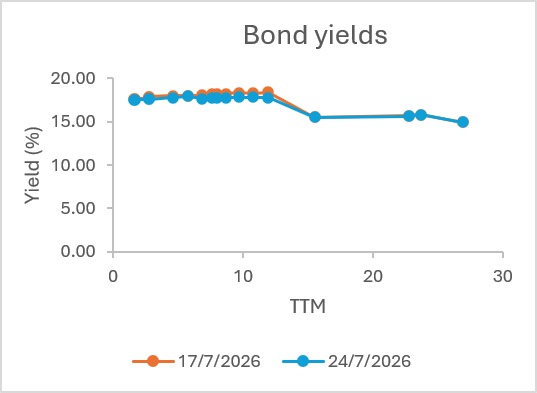
The fixed income market sustained a positive rally, supported by strong demand across money market instruments and bonds, despite a steady monetary policy stance. Average rates for Treasury bills declined by about 6bps from 16.73% to 16.67%, while Open Market Operations (OMO) bills eased by 5bps from 20.28% to 20.23%, reflecting sustained buying interest, particularly across mid-to-long tenor instruments. Demand in the FGN bond market was concentrated around the 2029–2038 maturities, as investors balanced global oil price volatility, central bank policy stance, and elevated risk premiums against attractive yield opportunities. Sustained buying interest pushed average bond yields below the 18% threshold to 17.18%, with the 2029–2038 maturity segment recording a sharper 39bps decline to 17.74% from 18.13%, reflecting renewed demand for sovereign securities. Overall, market sentiment remains supportive of fixed income assets, although investors continue to adopt a selective approach amid evolving macroeconomic risks.
Primary Market Issuance: The July 2026 FGN Bond auction highlighted a market characterised by strong liquidity but continued investor price discipline. Despite healthy demand, with subscription ratios of 1.38x, 1.66x, and 1.29x across the three maturities, investors remained selective, prioritising attractive yields over extending duration exposure. Stop rates held at 18.34% and 18.35% for the 2035 and 2037 bonds, while the 2038 bond closed at 18.40%, higher than its January 2024 auction close (16.50%), emphasizing persistent demand for higher duration premiums amidst evolving inflation, fiscal supply, and monetary policy. The Debt Management Office (DMO) reinforced its commitment to borrowing cost optimisation by allotting only 44%, 57%, and 59% of demand across the respective maturities, accepting 77.7% of the total offered amount. In general, the outcome signals continued institutional appetite for sovereign assets, but investors remain firm on attractive returns demand, suggesting that while yields may be approaching a cyclical peak, a sustained decline will depend on clearer evidence of durable disinflation and an eventual shift toward monetary easing.
FGN Bond | 22.60% JAN 2035 | 16.2499% APR. 2037 | 15.45% JUN. 2038 |
Maturity Date | 29-01-2035 | 18-04-2037 | 21-06-2038 |
Tenors | 10 | 20 | 15 |
Amount Offered (₦’B) | 400.00 | 400.00 | 400.00 |
Subscription (₦’B) | 555.47 | 665.19 | 518.00 |
Non-Competitive Bid (₦’B) | – | – | 50.00 |
Amount Allotted (₦’B) | 245.73 | 381.46 | 302.13 |
Stop Rates (%) | 18.3400 | 18.3500 | 18.4000 |
Last Auction Stop Rates (%) | 18.3400 | 18.3500 | 16.5000 |
The DMO released a revised Q3 2026 FGN Bond Issuance Calendar, marked by the reintroduction of the FGN 16.2499% APR 2037 bond, which was omitted from the previous schedule for August 2026. The revision reflects a broader issuance range of ₦50 billion–₦750 billion, compared with the earlier ₦500 billion–₦700 billion range, representing a 90% reduction in the minimum offer size and +7.1% increase in the maximum offer size, signalling greater flexibility in debt management operations. The reopened instruments include the FGN 22.60% JAN 2035 with an offer range of ₦200 billion–₦250 billion, the FGN 16.2499% JUN 2038 at ₦50 billion–₦100 billion, and the FGN 15.45% JUN 2038 at ₦650 billion–₦750 billion, reflecting continued efforts to optimise borrowing costs while managing investor demand across the yield curve. Notably, the September 2026 auction schedule has been streamlined to two instruments, comprising a new 10-year FGN bond maturing in September 2036, which replaces the January 2035 issue, alongside the existing June 2038 bond.
The Naira gained during the week in the Nigerian Foreign Exchange Market (NFEM), appreciating ₦18.02 (-1.31%) WTD, and ₦18.10 (-1.31%) WoW, closing at $/₦1,362.09 (WoW: ₦1,380.18). Foreign reserves increased to $52.03 billion (+0.22%) as of July 23, 2026, leading to a decline in blocked funds to $608.12 million (-1.87%) with a reduced blocked reserve ratio of 1.17% (-0.2bps), reflecting an improved foreign exchange condition despite external pressures.
The CBN maintained its cautious monetary policy stance at the 306th Monetary Policy Committee (MPC) meeting, retaining the Monetary Policy Rate (MPR) at 26.50% alongside unchanged reserve and liquidity requirements [the Cash Reserve Ratio (CRR) at 45.00% for Deposit Money Banks and 16.00% for Merchant Banks, the Liquidity Ratio at 30.00%, CRR on Non-TSA public sector deposits at 75.00%, and the asymmetric corridor at +50/-450 basis points around the MPR]. The Committee’s decision emphasizes its focus on anchoring inflation expectations, supporting FX stability, and preserving macroeconomic resilience amid global uncertainties. While easing inflation, stronger external reserves, improved FX market conditions, and steady growth point to improving fundamentals, the MPC remains attentive to risks from oil price volatility, geopolitical tensions, and global financial conditions. For investors, the stance sustains the appeal of Naira assets through elevated real yields and policy credibility, though high borrowing costs may continue to weigh on credit growth and private-sector investment. Largely, the MPC approach appears data-driven, with future easing dependent on sustained disinflation, FX stability, and reduced external vulnerabilities.
The Federal Government advanced its power sector reform agenda by deploying ₦501 billion under the first tranche of its Power Sector Multi-Instrument Issuance Programme, comprising ₦300 billion in cash and ₦201 billion in non-cash bond instruments, to settle legacy debts owed to electricity generation companies (GenCos). As part of the programme, ₦333 billion has been paid to eight participating GenCos covering 17 power plants, representing approximately 22% of verified settlement obligations, while the first Series I bond coupon of ₦63.5 billion was paid in full on July 14, 2026, reinforcing government credibility thereby boosting investor confidence. Building on the successful execution of Series I, which improved liquidity across the electricity value chain, the government plans to launch a ₦729 billion Series II bond to continue clearing outstanding legacy debts, strengthen the bank-ability of Nigeria’s power sector, and support long-term investment and operational stability.
The Senate passed the Insurance Regulatory Commission Bill, 2025, which seeks to repeal the National Insurance Commission (NAICOM) Act, 1997 and establish a modern regulatory framework for Nigeria’s insurance industry. If signed into law, the legislation will rename the National Insurance Commission (NAICOM) to the Insurance Regulatory Commission (IRC), strengthen the regulator’s independence and enforcement powers, and align the sector with global best practices. Key provisions of the bill includes enhanced authority to issue regulations, to collaborate with domestic and international regulators to intervene in distressed insurers, and to enforce stricter corporate governance standards, alongside tougher sanctions such as higher fines, licence suspensions, and disqualification of erring officials. The bill also expands the regulator’s mandate to promote the integrity, supervision, and development of the insurance industry, while introducing interim governance arrangements and stronger legal protections to improve policyholder confidence, financial stability, and overall sector resilience.
The Nigerian Exchange (NGX) recorded a positive week, with the ASI advancing from 246,183.96 points on Monday to 247,832.37 points by Thursday, supported by sustained investor demand and selective accumulation in fundamentally strong stocks. Closing Friday low at 247,103.84 points (WTD +0.37% and WoW +1.50%) and a year-to-date (YTD) return of 58.79% from 56.45%. Market activity remained healthy, with turnover multiples ranging from 1.03x to 1.82x, while market capitalisation was within ₦159.65 trillion – ₦161.22 trillion across trading sessions, reflecting continued participation despite a brief midweek correction triggered by profit-taking in select stocks. The upward momentum was driven by strong corporate earnings releases and expectations, improved investor confidence, renewed institutional interest in large-cap equities, particularly banking and industrial counters, alongside a relatively stable macroeconomic environment. Across key indices, performance was mixed WoW: Banking (+8.35%) Insurance (+3.86%), Industrial (+5.01%), Oil & Gas (+0.11%), Top 30 Index (+1.66%), Premium Index (+4.00%), and Consumer Goods (-3.76%). However, broader economic uncertainties continued to encourage cautious portfolio repositioning as investors balanced earnings optimism with prevailing market risks. Other H1, 2026 earnings release highlights include:
The global financial market navigated a risk-off environment marked by rising sovereign yields, sticky inflation, and divergent central bank actions. In key monetary policy decisions, the European Central Bank (ECB) kept its three benchmark interest rates unchanged on Thursday, holding its deposit facility rate steady at 2.25% (main refinancing rate at 2.40% and marginal lending facility at 2.65%) while citing energy price volatility from Middle East conflicts as a driving factor. Meanwhile, the Bank of Canada (BoC) held its key policy rate at 2.25%—marking its fifth rate decision of the year—noting a Q2 economic pickup to ~2.5% alongside sticky inflation. Elsewhere, the People’s Bank of China (PBoC) maintained its 1-year and 5-year Loan Prime Rates at 3.0% and 3.5%, respectively, alongside a rate ease by the Bank of Russia to 14.00% (-25bps), while South Korea posted a steady +0.6% (+0.2bps) QoQ GDP print and Japan’s Flash Composite PMI expanded to 53.1 points, signalling growth.
Macroeconomic and labour indicators showed mixed global health across major economies. U.S. Weekly Initial Jobless Claims dropped to 187,000—its lowest level since September 1969—signalling strong labour market resilience, while Canada’s CPI eased to 2.8% YoY and UK real wages registered slight gains. However, preliminary flash PMIs pointed to uneven private sector momentum: the U.S. registered at 53.6 points, the Eurozone posted a 5-month high of 51.9 points (up from 50.0 points), and India recorded 54.3 points, down 2.8 points driven by a slowdown in the service sector.
Driven by energy supply disruptions and extended “higher-for-longer” policy expectations, benchmark bond yields pushed higher across global markets. The U.S. 10-year Treasury advanced to 4.687% while the 2-year yield climbed to 4.33%. Combined with heavy capital expenditure guidance in mega-cap tech earnings, these elevated yields dragged down major equity indices despite relative outperformance and new 52-week highs across defensive, healthcare, financial, and industrial stocks.
Equities performance ultimately closed mixed week-over-week. In the U.S., the Nasdaq Composite fell to 24,975.82 (-2.10%), the S&P 500 declined to 7,411.98 (-0.60%), and the Dow Jones Industrial Average dropped to 51,947.25 (-0.38%). European markets gained ground, with Germany’s DAX 40 rising to 25,099.00 (+1.08%), the FTSE 100 advancing to 10,736.23 (+1.28%), and the Stoxx 600 finishing at 644.51 (+0.47%). Asian markets were varied, featuring gains in Japan’s Nikkei 225 at 64,611.15 (+0.73%), China’s Shanghai Composite at 3,814.20 (+1.33%), and Hong Kong’s Hang Seng Index at 24,963.23 (+1.63%), while South Korea’s KOSPI declined to 6,690.62 (-1.91%).
Africa’s financial landscape was defined by a broad preference for policy stability, with Ghana and South Africa all leaving interest rates unchanged at 7.0% and 14.0%, respectively, as central banks balanced inflation risks, fragile economic growth, and global uncertainty. Beyond monetary policy, the continent continued to attract strategic capital, as First Abu Dhabi Bank advanced plans to enter South Africa’s banking sector, signalling a shift in global banking investment toward Gulf institutions, while Absa expanded its East African footprint through a proposed Tanzania merger. Tanzania also tested international investor appetite ahead of a potential Eurobond issuance, reflecting improving sentiment toward African sovereign debt, while Zambia’s strong bond market outlook (delivering +36% in dollar terms so far in the year) remained closely tied to expectations of political continuity following its upcoming elections. Collectively, these developments highlight Africa’s evolving investment landscape, where policy credibility, regional expansion, capital market access, and political stability remain key drivers of investor confidence.
Global commodity markets experienced heightened volatility during the review period, driven primarily by escalating geopolitical tensions in the Middle East and growing concerns over disruptions to global energy supply chains. Crude oil rallied from $82.24/bbl. on Monday to a peak of $92.08/bbl. on Wednesday before easing to $90.47/bbl. on Friday, while Brent crude climbed from $88.16/bbl. to a high of $100.55/bbl. over the same period before settling at $98.38/bbl., remaining more than 12% high for the week. The sustained advance reflected mounting supply risks following continued US strikes on Iran, attacks by Iran-backed Houthi militants on Saudi oil tankers in the Red Sea, persistent disruptions to shipping through the Strait of Hormuz, and the suspension of crude loadings at the Caspian Pipeline Consortium terminal, which disrupted approximately 80% of Kazakhstan’s oil exports. Meanwhile, gold initially benefited from heightened safe-haven demand, rising from $4,012.13/oz on Monday to $4,159.77/oz on Wednesday, its highest level since early July, before retreating to $4,052.00/oz on Friday as surging oil prices reinforced inflation concerns and strengthened expectations of tighter US monetary policy. Market pricing reflected increasing expectations of Federal Reserve rate hikes, with the probability of a September rate increase exceeding 81%, underlining how geopolitical risks continued to shape commodity prices, inflation expectations, and the global monetary policy outlook.
Amid improving liquidity conditions and stronger investor appetite, market sentiment remains cautiously positive, with yields, FX stability, geopolitical risks, and global monetary policy as key drivers of near-term direction. Liquidity inflows are expected to exceed outflows by about ₦1.64 trillion amidst an inflow of over ₦2.34 trillion, comprising ₦2.19 trillion from OMO maturities and ₦145.47 billion in FGN bond coupons, alongside the scheduled ₦700 billion NTB auction offer split across the 91-day, 182-day, and 364-day bills in a 1:1:5 ratio. Globally, the US Federal Open Market Committee’s decision remains a key catalyst for market sentiment, yields, and capital flows.
By: Sandra A. Aghaizu
When storms circled distant seas,
Africa chose to steady her hands.
Not every journey needs a faster wind,
Sometimes the compass is the greatest wealth.
Banks crossed borders like birds seeking new seasons.
Capital followed the places where trust had taken root.
And the markets whispered an old truth.
The tallest tree is not the one that grows the fastest,
But the one whose roots remain firm when the winds arrive.





Subscribe now to keep reading and get access to the full archive.