


August 2026, Edition 2
In recent years, the proliferation of virtual assets across Africa has evolved from an emerging and largely unregulated frontier into a key area of fiscal governance, statutory oversight, and economic strategy. Nigeria, long recognised as one of the world’s leading markets for cryptocurrency and peer-to-peer (P2P) transactions, has previously operated under significant regulatory uncertainty regarding the tax treatment and compliance obligations applicable to crypto-asset market participants. However, with the enactment of the Nigeria Revenue Establishment Act 2025, Nigeria Tax Act 2025 (NTA) and the Nigeria Tax Administration Act 2025 (NTAA), the much-needed legal foundation for digital economy taxation was formally established.
To effectively administer this new development and to address potential issues that may be faced by stakeholders involved in virtual asset (VA) activities, the Nigeria Revenue Service (NRS) issued the “Guidelines on the Taxation of Virtual Assets” (“the Guidelines”) on 31st July 2026. The guidelines inter alia set out standardized administrative rules governing the classification, valuation, withholding, reporting, and enforcement of tax obligations arising from VA activities in Nigeria and how they affect relevant stakeholders.
This article seeks to analyse the key regulatory mechanisms introduced by the Guidelines, examine their statutory basis, operational mechanics, and legal implications for individual investors, Virtual Asset Service Providers (VASPs), P2P operators, and corporate institutions.
The Guidelines are intended to provide an administrative framework for the taxation of VAs in Nigeria, including: the tax obligations of persons engaged in VA transactions, as well as the registration, reporting, filing, and record-keeping requirements applicable to taxpayers and VASPs. They also provide guidance on the valuation and computation of taxable income arising from VA transactions, and clarity in the administration and enforcement of applicable tax laws.
These Guidelines apply to any person who:
(a) acquires, disposes of, exchanges, or otherwise deals in VA;
(b) receives income or any payment in the form of VA;
(c) operates as a VASP and P2P marketplace;
(d) derives income, profits or gains from VAs that are subject to tax in Nigeria; or
(e) provides services relating to VA.
According to the Guidelines, some of the applicable taxes may include income tax for individuals and companies, value added tax (VAT), and stamp duties depending on the nature of the activity or transaction.
A core innovation of the NRS Guidelines is the introduction of a six-part system that categorizes virtual assets based on how they are used rather than how they are technically designed. This replaces monolithic definitions with tailored tax treatments across distinct asset classes:
Category 1 – Cryptocurrencies and Exchange Tokens: Non-pegged native tokens functioning as stores of value or means of exchange (e.g., Bitcoin, Ether, Solana). These are subject to income tax on disposal gains and stamp duty on eligible token transfers.
Category 2 – Stablecoins and Payment Tokens: Fiat-backed digital payment instruments designed to maintain a stable value (e.g., USDT, USDC, PYUSD). Their disposals trigger income tax on fiat-pegged gains and stamp duty on transfers, while yield-bearing stablecoins fall under Category 4 for yield components.
Category 3 – Security and Investment Tokens: Tokens representing equity interests, revenue-sharing rights, or tokenized bonds under the Investments and Securities Act 2025. Their disposals are subject to income tax and stamp duty. Notably, the statutory capital gains exemption under Section 184(h) of the NTA applies exclusively to tokenized Nigerian stocks and shares, excluding foreign or non-equity asset-backed tokens.
Category 4 – Utility, Governance, and Staking Tokens: Tokens that provide access to protocol, voting power, or yield (e.g., DAO governance, liquid staking derivatives). Capital gains apply upon disposal, whereas staking rewards, DeFi yield, and liquidity incentives are treated as taxable income upon receipt.
Category 5 – Non-Fungible Tokens – NFTs: Unique digital assets representing collectibles, property rights, or other interests. Primary sales by creators are taxed as active business income (plus VAT), while secondary disposals by investors/traders attract income tax on dollar-referenced gains.
Category 6 – Sovereign Digital Currencies: Central Bank Digital Currencies (CBDCs) such as the eNaira and foreign CBDCs held by Nigerian residents. These are explicitly excluded from the virtual asset tax framework and treated identically to fiat currency.
An important legal and accounting framework established by the Guidelines is the Mandatory Dollar-Referenced Gain Computation Rule under Paragraph 9.1. Historically, taxpayers in high-inflation or depreciating fiat environments faced artificial tax liabilities caused purely by fiat currency devaluation rather than real economic capital appreciation.
To address this issue, the NRS mandates a five-step methodology for Category 1 and Category 3 asset disposals:
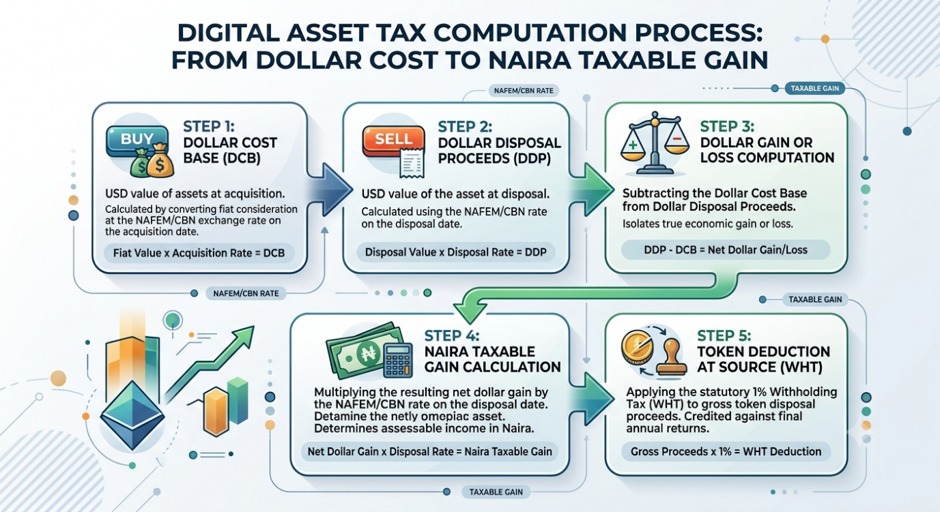
By neutralizing local currency depreciation, the framework ensures that taxpayers are only assessed on genuine economic capital gains.
Unlike traditional revenue models that require immediate conversion of asset sales into local fiat currency, the NRS Guidelines introduce a Token-Native Remittance mechanism under Paragraph 11. Licensed VASPs and P2P marketplace operators with escrow mechanisms (Category A P2P) are designated as statutory collecting agents.
Under this architecture, VASPs must directly withhold statutory obligations in the originating token units at source. To effect this, the NRS maintains a Token Treasury accepting major supported tokens. Where an unlisted token is remitted, conversion costs are borne by the NRS and do not reduce the taxpayer’s WHT credits. This approach represents a significant development in tax administration because it brings the collection mechanism closer to the underlying digital-asset infrastructure and potentially reduces the risk of tax leakage arising from the movement of assets across platforms and wallets.
Recognizing the technical nuances of decentralized finance (DeFi) and blockchain architectures, Paragraph 7.2 and Paragraph 10 establish explicit statutory safe harbours for technical transactions that do not involve a transfer of beneficial ownership. These include:
Conversely, taxable events crystallize immediately upon the receipt of staking rewards, mining yield, DeFi liquidity incentives, and airdrops with observable Fair Market Value (FMV), establishing a stepped-up cost base for future disposals.
The NRS Guidelines impose strict operational compliance standards under Paragraphs 12 and 13. VASPs and P2P operators are statutorily required to enforce Tax Identification Number (TIN) verification as a mandatory precondition for user account activation.
Non-compliance carries stringent financial and administrative penalties, which include:
The release of the NRS Guidelines on the Taxation of Virtual Assets represents a shift in Nigeria’s legal and economic infrastructure. By establishing clear classification rules, dollar-referenced valuation formulas, token-native remittance systems, and strict VASP compliance mandates, the framework provides needed certainty for institutional investors involved or interested in the VA while closing potential tax leakage gaps.
For individuals, maintaining detailed digital ledger records and declaring annual self-assessment returns are now essential to prevent statutory default.
For VASPs, fintech platforms, and market operators, immediate system audits and integration of automated token-withholding mechanisms are vital operational imperatives to ensure full regulatory alignment in Nigeria’s maturing digital economy.




Subscribe now to keep reading and get access to the full archive.