
NIGERIA CONSUMER PRICE INDEX – AUGUST 2026

Nigeria’s inflation picture strengthened modestly in August 2026, with headline inflation easing marginally to 15.39% year-on-year from 15.43% in July. Month-on-month inflation slowed sharply to 0.71%, while annual food inflation dropped to 19.57%. Core inflation moderated to 13.29% YoY and entered slight monthly deflation at -0.06%, highlighting a broader slowing in price momentum across key economic sectors.
Weekly Market Review: Restrictive Rates and Selective Repricing

Nigeria’s financial markets saw strong fixed-income demand drive yield compression across OMO and treasury bills despite a 43.07% drop in system liquidity. The Naira appreciated to $/₦1,326.52, while the equities market declined 1.88% due to pre-IPO repositioning. Globally, sticky inflation and higher yields pressured markets as crude oil surged on Middle East supply concerns.
EXECUTIVE BRIEF: NIGERIA FOREIGN TRADE PERFORMANCE (Q2 2026)

Nigeria’s total merchandise trade reached ₦41,444.89 billion in Q2 2026, marking a 5.61% year-on-year increase driven by strong domestic exports and reduced import costs. The country’s merchandise trade surplus doubled to ₦12,596.86 billion. Increased local refining capacity significantly lowered fuel import reliance, though agricultural trade deficits and persistent inflationary risks remain key macroeconomic concerns.
Weekly Market Review: Nigeria’s Financial Markets Gain Momentum on Stronger Growth, FX Stability and Investor Demand

Nigerian financial markets entered September 2026 with strong momentum, driven by 4.43% Q2 GDP growth, Naira appreciation to $/₦1,321.22, and rising foreign reserves. Easing fixed-income yields and sustained primary auction demand reflect high investor conviction. Meanwhile, the NGX ASI rose 2.36% WTD ahead of Nigeria’s return to the FTSE Russell Frontier Market index.
G20 2026: NAVIGATING GLOBAL GROWTH, DEBT AND FINANCIAL FRAGMENTATION

The G20 Finance Ministers and Central Bank Governors meeting in Asheville focused on boosting global potential growth, managing public debt, and strengthening fiscal resilience. With disinflation stalling and economic fragmentation growing, key discussions centered on debt restructuring frameworks, non-market trade policies, cross-border payment integration, and regulatory frameworks for emerging financial innovations such as artificial intelligence and digital assets.
NIGERIA’S Q2 2026 GDP: GROWTH ACCELERATES, BUT INDUSTRIAL WEAKNESS PERSISTS

Nigeria’s real GDP grew by 4.43% year-on-year in Q2 2026, up from 3.89% in Q1, driven by non-oil sector strength in agriculture and services alongside higher crude output. However, persistent contractions in electricity supply and sluggish manufacturing performance underscore ongoing structural challenges, highlighting the need for sustained industrial policy support to secure long-term stability.
Weekly Market Review: Naira Strengthens, Fixed-Income Yields Ease and NGX Rebounds on FTSE Reclassification
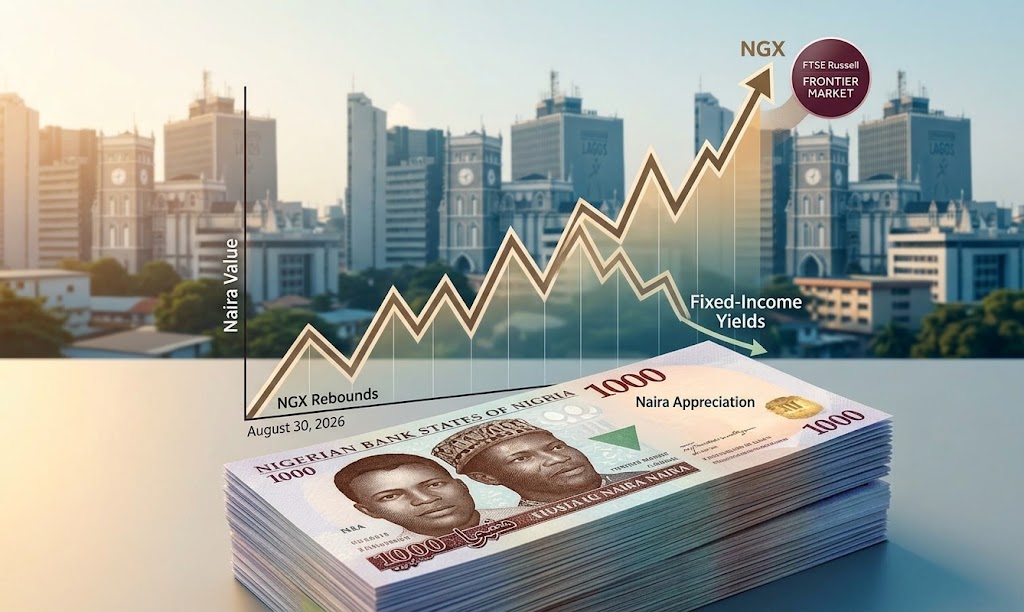
Nigerian markets saw a significant shift in August 2026. The Naira strengthened, while fixed-income yields eased on strong primary market demand. Concurrently, the equities market rebounded on news of Nigeria’s return to the FTSE Russell Frontier Market status. This combination of factors led to a more selective investor approach, moving towards defensive assets, liquidity, and yield in a cautious global environment.
Crypto at a Crossroads: Bitcoin’s $80K Breakout, Ethereum’s Surge and the Risks Ahead

Major digital assets surged alongside growing institutional adoption and corporate treasury demand, with Bitcoin approaching $80,000 and Ethereum gaining over 29%. However, security exploits across Cosmos EVM infrastructure and liquidation events in DeFi highlighted persistent systemic vulnerabilities. This market review examines macro drivers, core asset performance, and key infrastructure risks shaping current market dynamics.
Weekly Market Review: Fixed-Income Resilience Amid Easing Inflation and Global Risk Pressures

Nigeria’s domestic market showed cautiously constructive sentiment as easing headline inflation and strong FGN bond auction demand reinforced the case for gradual fixed-income yield compression. While food price acceleration and profit-taking in equities indicate an uneven recovery, improved foreign exchange stability and abundant liquidity provide a supportive foundation for local fixed-income assets amidst persistent global risks and oil price volatility.
Signals Beneath the Surface: Strong Demand Signals Yield Repricing, but Duration Risks Persist

Nigeria’s fixed-income market remained positive as heavy demand for short-term bills signaling a yield turning point and deep liquidity was evident. However, persistent duration risks linger at the long end, as highlighted by higher long-term NTB rates and increased FGN bond issuance. While short-term yields compress, the market remains cautious. Globally, soft US inflation data pushed down yields, supporting equities, despite mixed regional results and lingering geopolitical tensions.