Does a Low FDV Mean a Cryptocurrency is a Good Investment?
Not necessarily. A low FDV can be attractive because it may indicate a more modest, implied valuation and less potential dilution compared with a similar project.
However, valuation alone cannot establish investment quality.
Consider two hypothetical projects:
Metric | Project A | Project B |
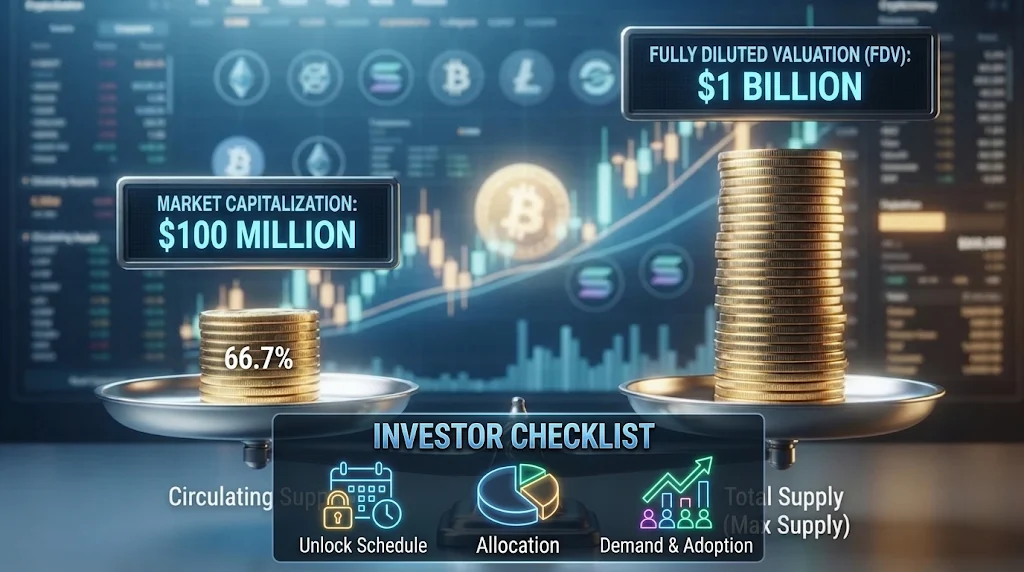
Market cap | $100 million | $100 million |
FDV | $150 million | $1 billion |
MC/FDV | 66.7% | 10% |
Circulating supply | 66.7% | 10% |
Project A has a smaller gap between its market cap and FDV. Project B has significantly more potential supply dilution.
But what if Project B has stronger technology, higher adoption, more active users, better revenue generation, and stronger ecosystem development?
It could potentially justify a higher valuation than Project A.
This is why investors should avoid judging a cryptocurrency solely by its market cap or FDV.
A good investment requires a combination of reasonable valuation, sustainable tokenomics, real utility, adoption, and long-term demand.
What Should Investors Investigate Before Buying?
When conducting your cryptocurrency research, we recommend examining these six areas alongside market cap and FDV.
Research area – What you should investigate
Circulating supply – How many tokens are currently available?
Total/max supply – How many tokens exist or can eventually exist?
Token unlock schedule – When will locked tokens enter circulation?
Token allocation – What percentage belongs to founders, investors, and the community?
Token utility – Does the token have genuine use within its ecosystem?
Demand and adoption – Are users, transactions, and ecosystem activities growing?
There are also three additional metrics worth considering:
- Trading volume: Is there enough market activity and liquidity to support buying and selling?
- Holder distribution: Are tokens concentrated among a few wallets or distributed across a wider community?
- Revenue and network activity: Is the project generating economic activity, or is its valuation mainly driven by speculation?
One important detail: distinguish between total supply and maximum supply when calculating FDV. Some data providers use maximum supply, while others may use total supply where a maximum is unavailable. Always verify the methodology and the project’s token documentation.
Key Considerations for Investors
Market cap and FDV should be approached this way:
- Market cap indicates the project’s current circulating valuation.
- FDV highlights its potential future supply dilution.
- Tokenomics explains how new tokens enter the market.
- Utility establishes the practical purpose and demand for the token.
- Adoption indicates whether the project’s users and market demand are growing.
The most important thing is to understand that a low market cap does not necessarily mean a cryptocurrency is undervalued, just as a low token price does not mean it is cheap.
A token trading at $0.01 with a 100 billion supply could have a $1 billion FDV. Meanwhile, another token trading at $10 with a 10 million supply could have a $100 million FDV. The number of tokens and the valuation matter more than the unit price alone.
Final Takeaway
Three questions every crypto investor should ask:
- What is the project’s current market cap compared with its FDV?
- How much additional supply will enter circulation, and when?
- Can the project’s adoption and demand justify its current and future valuation?
Remember: Market cap tells you what the circulating supply is worth today. FDV shows what the entire potential supply would be worth at today’s price. Neither tells you by itself what the project is fundamentally worth.