A cryptocurrency project may have advanced technology, real-world applications, a strong community, and an experienced development team, yet still deliver poor investment returns. This is because a project’s overall quality does not automatically translate into its native token’s financial performance.
Investors must distinguish between a project’s potential and its token’s actual value at the price they pay. A promising ecosystem does not mean its token is undervalued or offers good investment opportunities.
Cryptocurrency performance is influenced by several factors, including:
1. Overvaluation at Entry: Even a fundamentally strong project can become a poor investment when its token is purchased at an excessively high valuation.
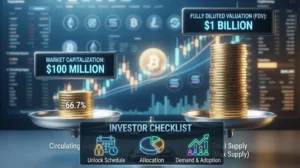
A project with a $100 million market capitalisation may have considerable room for expansion, while the same project valued at $10 billion requires substantially more capital to achieve another 10x return.
Key lesson: A promising project does not automatically represent a good buying opportunity. Entry price and valuation matter.
2. Tokenomics and Supply Dilution: A project may have excellent technology but an unfavourable token distribution or supply structure.
Investors should examine:
- Total and maximum token supply
- Current circulating supply
- Team and private investor allocations
- Vesting schedules and upcoming token unlocks
- Inflation and token emission rates.
For example, a token with 1 billion circulating tokens and a maximum supply of 10 billion has considerable potential supply expansion. As more tokens enter circulation, selling pressure may increase, particularly when early investors and team members unlock their allocations.
Key lesson: Strong project fundamentals can be undermined by poor tokenomics and excessive future supply.
3. Strong Utility Does Not Guarantee Token Demand: A project may solve real-world problems through artificial intelligence (AI), decentralised finance (DeFi), gaming, payments, or blockchain infrastructure. However, the success of its platform does not automatically translate into increased demand for its native token.
For example, a platform may attract millions of users, but if those users do not need to purchase, hold, stake, or use its token, the platform’s growth may have limited impact on token demand.
Key lesson: Investors should understand the economic purpose of a token and why people need it, rather than focusing only on the usefulness of its platform.
4. Market Timing and Investor Sentiment: Projects with strong fundamentals can experience significant price declines during bearish market conditions.
Cryptocurrency performance is influenced by several factors, including:
- Bitcoin’s overall market direction
- Global economic conditions
- Liquidity and capital inflows
- Investor confidence and market sentiment
- Regulatory developments.
A promising project launched during a bearish market may struggle to attract investment, while a weaker project launched during a bullish market may experience temporary price appreciation.
Key lesson: Strong fundamentals are important, but market conditions and investor sentiment also influence investment performance.
5. High Expectations and Weak Adoption: Some projects attract significant attention before their products are fully developed or widely adopted. They may have strong social media engagement, influential investors, impressive partnerships, large communities, and ambitious development roadmaps.
However, hype rarely guarantees sustained adoption. If a project fails to convert its attention into active users, revenue, transactions, or sustainable ecosystem growth, its token valuation may eventually suffer.
Key lesson: Investors should distinguish between marketing exposure and measurable adoption.
6. Early Investors and Token Unlock Pressure: Many cryptocurrency projects allocate significant portions of their token supply to private investors, venture capitalists, founders, and early contributors. These investors often acquire tokens at considerably lower prices than public market participants. When their allocated tokens unlock, some may sell to realise profits, increasing circulating supply and adding selling pressure.
Consequently, a token’s price may struggle even while the project continues to develop and expand its ecosystem.
Key lesson: Understanding token ownership, investor allocations, and unlock schedules is just as important as evaluating a project’s technology.
Final Investment Perspective
A common mistake in cryptocurrency investing is purchasing a token simply because its underlying project appears promising. A technologically advanced project can still have an overvalued token, weak demand, unfavourable tokenomics, or excessive future supply.
Therefore, effective crypto research should go beyond identifying innovative projects. It should also determine whether the token offers reasonable value at its current market price, considering its fundamentals, supply structure, adoption, and growth potential.
Three nuggets to keep in mind:
- A good project rarely guarantees a good token.
- A good token does not automatically mean a good entry price.
- A good investment requires the right combination of fundamentals, valuation, timing, and risk management.