


August 2026, Edition 4
The domestic market closed the week with a cautiously constructive tone, as easing headline inflation, stronger-than-expected demand at the August FGN Bond Auction, and improved foreign-exchange conditions reinforced the case for gradual fixed-income yield compression. While early-week repricing in Treasury bills reflected pockets of selling pressure, renewed demand across the curve and sharply lower bond auction stop rates signalled improving investor appetite for duration. However, the acceleration in food inflation, profit-taking across equities and persistent global commodity and geopolitical risks highlight that the broader market recovery remains uneven. Against this backdrop, abundant liquidity and moderating core inflation provide a supportive foundation for Nigerian fixed-income assets, although external rate expectations, oil-price volatility and domestic food-price pressures will remain key determinants of market direction in the near term. In commodities, prices closed higher Week-on-week (WoW), with West Texas Intermediate (WTI) and Brent crude rising by 5.66% and 6.63% to $87.06/bbl. and $94.39/bbl. respectively, while gold increased by 4.32% to $4,564.46/oz.
System liquidity opened at ₦3.38 trillion, before peaking at ₦4.97 trillion and closing at ₦4.47 trillion, resulting in an increase of 32.15% week-to-date (WTD) from the opening level. Money market rates were stable, with the Open Repo Rate (OPR) at 22.00% and the Overnight (O/N) rate at 22.11% (WoW: -14bps). In the Foreign Exchange (FX) market, the Naira traded within a range of $/₦1,340.00 and $/₦1,361.00, before closing at $/₦1,346.49 on Friday. Marking a daily close below the $/₦1,349.00 range, last seen on April 20, 2026.
The fixed-income secondary market traded on a broadly bullish note through the week, reacting to improved headline inflation amidst external pressure from global oil price volatility as well as the FGN Bond Auction outcome. Treasury bills (T-bills) market opened bearish on Monday, with average yield rising 10bps to 18.83%, driven by significant selling at the short end, before reversing into a marginally bullish trend from Tuesday, with yields declining by at least 2bp on each subsequent session to close at 18.74%. Buying interest was broad-based, particularly across the long end, with notable yield declines in the February–July 2027 maturities. Similarly, the FGN bond market maintained a bullish trend, with average yield declining from 16.73% on Monday to 16.67% by Friday, supported by sustained demand across the curve, particularly the Mar-2035 (-21bps), Mar-2036 (-17bps), Apr-2037 (-12bps), and Jun-2038 (-13bps), with 9 nine instruments remaining flat. Overall, the week reflected improving demand for fixed-income assets, with T-bill yields stabilising after early-week repricing and bond yields continuing to moderate.
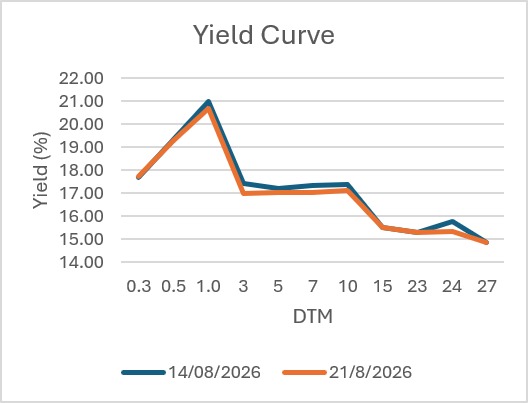
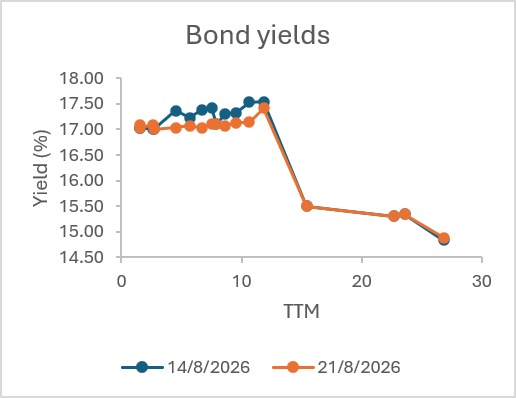
Primary Issuance: The August 17, 2026 FGN Bond Auction delivered a broadly bullish signal, with strong investor demand and a significant decline in stop rates reinforcing expectations that yields may have peaked. Total subscriptions stood at ₦1.73 trillion against ₦1.10 trillion offered, representing a 1.57x bid-to-cover ratio, with oversubscription noted for the 2035 and 2037 bonds at 2.05x and 3.92x, respectively, signalling short coverings and investors’ rebalancing for the securities as they cease to be auctioned in the coming month. The 2038 bond attracted the largest nominal demand at 1.09x, supported by a record in the year of substantial non-competitive interest of ₦742.29 billion, highlighting strong institutional appetite for assured allotment. Despite the robust demand, the DMO allotted ₦805.16 billion, below the total offer, indicating continued pricing discipline. Notably, stop rates declined sharply across all tenors, falling to 17.15% (-119bps), 17.19% (-116bps), and 17.79% (-61bps) for the 2035, 2037, and 2038 bonds, respectively, signalling stronger demand for duration amid improving liquidity and moderating inflation. Overall, the auction points to increasingly bullish fixed-income sentiment and gradual yield compression, although the higher clearing rate on the 2038 bond showcases a strong impact from the non-competitive bid.
FGN Bond | 22.60% JAN 2035 | 16.2499% APR. 2037 | 15.45% JUN. 2038 |
Maturity Date | 29-01-2035 | 18-04-2037 | 21-06-2038 |
Tenors | 10 | 20 | 15 |
Amount Offered (₦’B) | 250.00 | 100.00 | 750.00 |
Subscription (₦’B) | 513.61 | 392.48 | 821.32 |
Non-Competitive Bid (₦’B) | 10.00 | – | 742.29 |
Amount Allotted (₦’B) | 64.13 | 110.01 | 631.02 |
Stop Rates (%) | 17.1500 | 17.1900 | 17.7900 |
Last Auction Stop Rates (%) | 18.3400 | 18.3500 | 18.4000 |
The National Bureau of Statistics (NBS) reported a moderation in Nigeria’s inflation rate in July 2026, with headline inflation easing to 15.43% year-on-year (YoY) from 15.91% in June, significantly lower than the 24.94% recorded in July 2025. On a month-on-month (MoM) basis, inflation also softened to 1.57%, down 9 basis points, reflecting the continued impact of economic activities, improved foreign exchange (FX) stability, and favourable base effects. However, beneath the headline improvement, food price pressures intensified, with food inflation accelerating to 20.43% YoY from 17.52% and rising to 5.56% MoM from 3.75%, driven largely by higher prices of key staples including Rice, Tomatoes, Onions, Garri, Beef, and Pepper. In contrast, core inflation moderated to 14.97% YoY from 15.92% and slowed sharply to 0.15% MoM, suggesting a broad easing in non-food and demand-driven inflationary pressures. Urban inflation remained elevated at 16.12%, compared with 13.77% in rural areas, while state-level data showed notable disparities, with Adamawa, Yobe, and Anambra recording higher inflation rates. Overall, the report reinforces the view that Nigeria’s disinflation trajectory remains on course, although the renewed surge in food prices presents a significant upside risk that could temper the pace of future inflation moderation.
Recent developments across the economic and financial sector highlight both the progress and underlying fragilities of the ongoing reform cycle. The Federal Government’s newly released economic scorecard underscores key reforms implemented since 2023, including fuel subsidy removal, FX market liberalisation, fiscal consolidation, energy-sector reforms, and measures aimed at improving investment inflows and public finances, with authorities pointing to stronger revenue generation, improved reserves, enhanced business confidence, and a more stable macroeconomic environment as emerging outcomes of these policies.
However, regulatory developments in the insurance sector revealed the increasing enforcement of market discipline, as the National Insurance Commission (NAICOM) revoked Universal Insurance Plc’s operating licence and appointed a receiver/provisional liquidator following the company’s failure to meet the statutory minimum capital requirement, signalling a stricter post-recapitalisation framework designed to strengthen industry resilience and policyholder protection. Meanwhile, the pension industry’s Q1 2026 performance presents a mixed picture: total pension assets expanded by 7.53% to ₦29.52 trillion, largely driven by a ₦1.50 trillion equity market revaluation gain rather than fresh savings mobilisation.
While stronger equity valuations lifted domestic equity exposure to 18.50% of pension assets and supported real returns above inflation, total pension remittances declined sharply by 38.10% quarter-on-quarter to ₦559.42 billion following the normalisation of public-sector arrears payments. More importantly, the persistence of over 91% unfunded Personal Pension Plan accounts highlights a structural participation challenge within the informal sector, suggesting that sustaining long-term pension asset growth will depend less on market appreciation and more on converting registered contributors into active and consistent savers.
The Naira appreciated mildly during the week in the Nigerian Foreign Exchange Market (NFEM), gaining ₦3.05 (-0.23%) WTD and ₦11.12 (-0.82%) WoW, closing at $/₦1,346.49 (WoW: ₦1,357.61). Foreign reserves increased from $52.26 billion to $52.66 billion (+0.76%) as of August 19, 2026, while blocked funds eased to $552.76 million (-1.82%), with the blocked reserve ratio at 1.05% (-0.3 bps), indicating an improved foreign exchange condition amidst external pressures.
The Nigerian Exchange (NGX) ASI declined by 1.06% WoW to close at 240,196.64 points, extending its bearish streak amid profit-taking across large- and mid-cap stocks, particularly within the banking and oil & gas sectors. Market sentiment remained weak, with a market breadth below 1.00x, closing at 0.37x as 63 losers outpaced 23 gainers. TRANSEXPR (+16.20%), DANGSUGAR (+5.19%), CADBURY (+4.68%), and UACN (+4.62%) led the gainers, while INTENEGINS (-27.26%), ROYALEX (-18.49%), REDSTAREX (-18.33%), and NGXGROUP (-10.66%) posted the steepest losses WoW. Trading volume fell 18.05% WoW to 2.27 billion units, although turnover increased by 29.27% to ₦129.68 billion. Sector performance was mixed, with Banking (-2.92%), Insurance (-3.75%), and Oil & Gas declining, while Consumer Goods edged higher by 0.05%, supported by gains in DANGSUGAR, CADBURY, NB, and NESTLE. Industrial Goods remained largely flat as major constituents closed unchanged. HBM Nigeria Plc paid an interim dividend of ₦16.00 per ordinary share for the half-year ended June 30, 2026, on August 17, 2026, following a strong H1 performance.
Global financial markets navigated mixed economic indicators and active sovereign debt interventions, driven primarily by an aggressive move from the U.S. Treasury to double its buyback program for 10- to 30-year debt. Initial gains in long-dated U.S. Treasuries faded as structural deficit and supply concerns pushed yields back up, leaving the U.S. 10-year Treasury yield trading near 4.71% and the 30-year yield elevated near 5.25%. International fixed-income markets mirrored this upward pressure; the UK 10-year Gilt yield held around 5.05% following a hotter-than-expected UK July inflation print of 2.9% (prev. 2.60%), while Germany’s 10-year Bund yield lingered at a multi-year high of 3.25% as Eurozone final inflation rose to 2.9% (prev. 2.80%) amid energy price gains. On the data front, China’s July figures highlighted a split recovery: Industrial Production grew 4.5% (YoY) while Retail Sales lagged on muted domestic demand, and U.S. housing activity stalled further as July Existing Home Sales dropped 1.7% to a 4.06 million annualized rate due to high borrowing costs. The equities market performance closed negative WoW: the Nasdaq Composite at 26,180.45 (-2.10%), S&P 500 at 7,674.37 (-1.40%), and the Dow Jones Industrial Average at 53,277.01 (-0.85%). Across Europe, Germany’s DAX 40 was at 26,136.56 (-1.15%), while the FTSE 100 was at 10,816.56 (+0.62%), and the Stoxx 600 at 654.18 (-0.56%). Asian markets were varied, with Japan’s Nikkei 225 at 66,016.36 (-3.93%), China’s Shanghai Composite Index at 3,905.20 (-0.56%), Hong Kong’s Hang Seng Index at 26,009.46 (+3.55%), and South Korea’s KOSPI at 6,912.95 (-0.93%).
Africa’s economic landscape continues to present a mix of opportunities and emerging risks. In West Africa, agricultural exporters face increasing compliance pressures from the European Union’s deforestation regulations, while Nigeria’s Dangote Refinery is advancing plans for a proposed $5 billion IPO after securing a $1 billion underwriting programme, a move that could lead to Africa’s largest public listing and deepen regional capital markets. Ghana is signalling a policy transition from macroeconomic stabilization toward growth, investment and job creation, reflecting improving economic fundamentals. In Southern Africa, Chevron announced a significant oil and gas condensate discovery offshore Angola, reinforcing the region’s hydrocarbon potential, while Namibia continues to strengthen its position as a major frontier energy market with estimated oil resources of about 10 billion barrels. Elsewhere, South Africa’s Traxtion is expanding regional rail infrastructure through a $210 million investment programme, and corporate governance developments remain in focus as SPAR appointed an interim chair following the resignation of its chairman and deputy chairman. Across East Africa, the International Monetary Fund (IMF) is expected to resume discussions with Uganda on a new financial support programme, Airtel Africa and Starlink are extending satellite-to-phone connectivity in the DRC, Kenya’s KCB has cautioned that lower interest rates could compress banking sector margins, and Uganda–Vietnam trade has expanded to $95.4 million, supported by growing coffee exports and technology partnerships. North Africa continues to benefit from industrial and fiscal reforms, with Morocco’s budget deficit narrowing by 5.5 billion dirhams in July, the country accelerating investments in electric vehicle battery manufacturing, while Egypt is advancing a $1 billion phosphate fertiliser complex and targeting 50,000 tonnes of annual manganese production capacity by 2028, highlighting the region’s drive toward industrialisation and value-added exports.
Global commodity prices surged, with Brent and WTI crude oil recording strong gains amid escalating US-Iran tensions, uncertainty surrounding the Strait of Hormuz, shipping disruptions, and expanding US economic measures against Iran, which heightened concerns over global oil supplies. Brent crude rose from around $88.5/bbl. on Monday, to trade above $94/bbl. by Friday, posting a weekly gain of more than 5%, while WTI advanced from about $82/bbl. to above $87/bbl, gaining nearly 6% over the same period. Persistent geopolitical risks drove market sentiment, including reported attacks on vessels transiting Hormuz, tighter sanctions rhetoric from Washington, and concerns over energy infrastructure disruptions, although continued crude shipments from Gulf producers helped moderate fears of an immediate supply shock. Gold extended its bullish momentum during the week, rising from around $4,400/oz to above $4,607/oz, supported by easing expectations of a Federal Reserve rate hike, lower Treasury yields following increased US debt buybacks, safe-haven demand amid heightened geopolitical tensions, a weaker US dollar, and continued strong purchases.
Globally, market attention will centre on the 2026 Jackson Hole Economic Policy Symposium, scheduled for August 27–29, with focus on the Federal Reserve Chair’s keynote and policy signals ahead of the September FOMC meeting. These developments are expected to shape near-term market momentum. Domestically, the fixed-income market direction will also be influenced by the second August 2026 NTB auction, with ₦700 billion on offer. Expected liquidity inflows of over ₦2.45 trillion, comprising ₦2.32 trillion in OMO maturities and ₦165.97 billion in FGN bond coupons, alongside a $92.74 billion Eurobond coupon, should provide ample liquidity to sustain demand for fixed-income securities.
On August 27 and 28, Presco Plc. and Seplat Energy Plc. are expected to pay interim dividends of ₦10.00 and ₦0.05 per share, respectively.
By: Sandra A. Aghaizu
Across Africa, the markets stir,
New capital flows, new doors occur.
Oil beneath the ocean, rails across the land,
Factories rise with ambition in hand.
Refineries shine, new industries grow,
While cautious investors watch the flow.
Rates may fall, and margins may shrink,
Yet opportunity stands at the market’s brink.
From coffee fields to battery lines,
Africa’s future increasingly shines.
The risks are real, the road is wide,
With growth and capital moving side by side.
Africa is not waiting for the tide.
It is learning to become the tide.





Subscribe now to keep reading and get access to the full archive.