

October 2026, Edition 1
As global fault lines widen into canyons, the 81st United Nations General Assembly (UNGA) has exposed a world struggling to govern war, inequality, climate change and artificial intelligence. For Africa, the crisis is also a question of representation, capital, security and economic sovereignty.
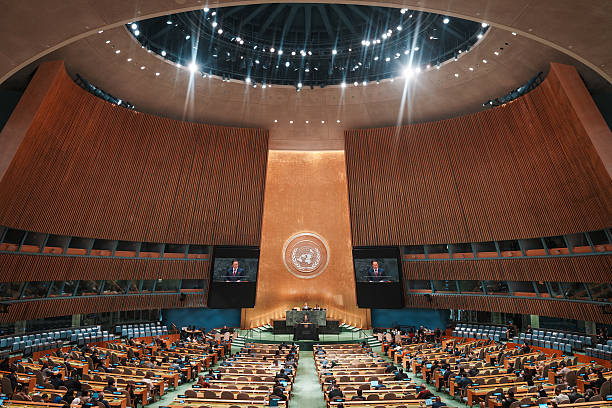
The opening of the 81st Session of the United Nations General Assembly (UNGA 81) presented an uncomfortable picture of the global order beyond the diplomatic corridors of New York. United Nations Secretary-General António Guterres warned that the world’s “fault lines” are widening into “canyons”, driven by war, rising inequality, the climate crisis and the rapid development of artificial intelligence.
His warning captures a broader systemic crisis: international law is under pressure, the UN Security Council is increasingly paralysed, and developing economies face an estimated $4 trillion annual financing gap for the Sustainable Development Goals.
The significance extends beyond diplomacy, as the issues confronting the global community are increasingly inseparable from capital, economic stability, investment, development and the distribution of power.
The central question is no longer simply whether the international system is changing. It is whether the institutions governing that system remain capable of responding to the realities of today.
Guterres framed the challenge around four great tests of power: war and peace, economic inequality, climate action and artificial intelligence. Each exposes a weakness in the existing global order.
Conflicts in Gaza, Ukraine, Sudan and Myanmar demonstrate the widening gap between military force, diplomacy and accountability. The persistence of these crises raises fundamental questions about the ability of existing institutions to protect international law and deliver meaningful collective security.
The structure of the UN Security Council itself has become part of the debate.
Leaders from Brazil, Japan and Sierra Leone highlighted the limitations of a system largely shaped by the realities of 1945. For many countries, particularly those outside the permanent membership, the continued structure raises questions about representation, legitimacy and the capacity of the Council to respond effectively to today’s geopolitical realities.
For Small Island Developing States, the stakes are equally direct. They have rejected becoming “collateral damage” in great-power rivalry, demanding that global competition must not come at the expense of international norms and international law.
The message is clear: multipolarity cannot become another name for arbitrary power.
The security crisis is occurring alongside a profound development and financing crisis.
Extreme poverty remains widespread, while high borrowing costs and debt burdens continue to restrict the fiscal space available to developing countries. The $4 trillion annual SDG financing gap represents more than a development statistic. It reflects the widening distance between what developing economies need to invest and the resources available to them.
For Africa, this problem is particularly consequential.
Unsustainable debt, expensive capital and illicit financial flows continue to constrain the ability of governments to invest in infrastructure, human development and sustainable growth.
This is why international financial-system reform cannot remain peripheral to the global governance conversation.
Debt relief, predictable concessional financing and measures to reduce illicit financial flows are not merely technical financial reforms. They are central to whether developing economies can create the fiscal space required for sustainable development.
The Sevilla Commitment and debt-relief frameworks therefore represent important elements of the way forward. But Africa must also strengthen its own policy architecture to confront tax evasion, money laundering and capital flight.
A continent seeking greater influence in global governance must also strengthen the financial foundations of that influence.
Perhaps the most consequential issue for Africa at UNGA 81 is the question of representation.
The message from African leaders and General Assembly President Khalilur Rahman was unmistakable: “Africa needs to be at the table, not on the menu.”
Africa’s continued absence from permanent representation on the UN Security Council remains a fundamental weakness in the legitimacy of global governance.
The continent is deeply affected by decisions on war, peace and international security, yet has no permanent seat in the institution with primary responsibility for maintaining international peace and security.
For Africa, therefore, Security Council reform is not simply about prestige. It is about having meaningful influence over decisions that directly affect the continent.
The Ezulwini Consensus and Sirte Declaration provide the foundation for a unified African position: permanent African representation on the Security Council, including the question of veto power or the abolition of the veto itself. But achieving reform will require more than repeating the demand.
Africa needs a unified diplomatic front and stronger alliances across the Global South, including with the G77, ASEAN and CARICOM, to push for structural reform of international institutions.
For Nigeria, this presents a clear diplomatic responsibility. Its influence must increasingly be deployed in support of a coherent continental position rather than treated solely as a national foreign-policy objective.
Climate change presents another contradiction at the heart of the global system.
African countries bear significant climate-related consequences despite contributing minimally to historical global emissions. At the same time, vulnerable countries continue to press for greater climate adaptation finance and fulfilment of Loss and Damage commitments.
The issue is therefore one of both climate justice and economic justice.
Africa cannot afford to remain primarily a recipient of climate-related consequences. At the same time, the global economy increasingly turns to the continent for the critical minerals required for the energy transition. The growing demand for transition minerals creates an opportunity, but also a risk.
Should African countries continue exporting raw minerals while value is created elsewhere, the continent risks repeating a familiar cycle of extraction without sufficient economic transformation.
A suitable strategic response must therefore be value addition, local processing and local content. The crucial objective should not merely be to extract more minerals, but to retain more of the economic value generated from them. That requires stronger policies on processing, industrial capacity, and local participation, while pressing major historical emitters to meet their climate-finance commitments, including operationalising Loss and Damage mechanisms and increasing adaptation finance.
Africa’s security challenges also have direct economic consequences.
The conflict in Sudan, instability in the Sahel and the activities of non-state armed groups, terrorists and illicit trafficking networks threaten not only lives and communities but also regional stability and economic integration.
For Nigeria and Africa, security therefore cannot be treated as a separate conversation from development.
The continent needs stronger African-led security interventions and a more effective African Union peace and security architecture capable of responding to regional crises without excessive reliance on external intervention.
At the same time, intelligence sharing and joint maritime and border-security mechanisms must be strengthened to confront transnational crime, piracy, insurgency and illicit trafficking.
Without security, investment suffers. Without investment, development weakens. And without development, insecurity can deepen.
The connection is structural.
The fourth major frontier is artificial intelligence, as the rapid development of AI is creating opportunities for productivity and innovation while introducing risks to human rights, labour markets, security and governance.
For Africa, the danger is not simply being left behind technologically. It is becoming a passive recipient of rules designed elsewhere.
The continent must therefore participate actively in emerging global AI-governance frameworks, including the UN Global Digital Compact and Global Dialogue on AI Governance, ensuring that African interests are represented in the rules governing an increasingly digital global economy. But participation requires capability.
Africa must invest in domestic digital infrastructure, STEM education, local technology and youth empowerment. Its demographic strength will become an economic dividend only if its young population has the skills, infrastructure and opportunities required to participate productively in the emerging economy.
UNGA 81 has presented Africa with a moment that requires more than diplomatic statements.
The continent must pursue a unified Pan-African position on global governance, build tactical alliances with the Global South, and maintain pressure for meaningful reform of the UN Security Council.
It must also champion international financial reform through debt relief, predictable concessional financing and stronger action against illicit financial flows.
On climate and minerals, Africa must demand climate justice while ensuring that the transition to a low-carbon global economy does not reproduce the extractive relationships of the past.
On security, the continent must strengthen its own peace, intelligence, maritime and border-security architecture.
And on technology, it must move from being a consumer of global innovation to an active participant in defining the rules and building the capabilities of the AI economy.
The View: The significance of UNGA 81 lies in what it reveals about the direction of the world, as the global system is being tested simultaneously by war, inequality, climate change, technological disruption, and institutional weakness.
For Africa, these are not distant geopolitical concerns. They affect the cost of capital, fiscal space, security, investment, natural resources, employment, and economic development.
The continent therefore cannot afford to remain on the receiving end of global decisions.
A permanent seat at the table matters, but so does the economic and institutional capacity to make that seat count. With a clear objective of stronger diplomatic influence, fairer access to capital, greater control over natural-resource value chains, stronger regional security and meaningful participation in the governance of emerging technologies.
The world is confronting a changing global order. Africa must not merely ask for a place within it. It must organise, negotiate and build the capacity to shape it.




Subscribe now to keep reading and get access to the full archive.