
Weekly Market Review: Restrictive Rates and Selective Repricing

Nigeria’s financial markets saw strong fixed-income demand drive yield compression across OMO and treasury bills despite a 43.07% drop in system liquidity. The Naira appreciated to $/₦1,326.52, while the equities market declined 1.88% due to pre-IPO repositioning. Globally, sticky inflation and higher yields pressured markets as crude oil surged on Middle East supply concerns.
Weekly Market Review: Nigeria’s Financial Markets Gain Momentum on Stronger Growth, FX Stability and Investor Demand

Nigerian financial markets entered September 2026 with strong momentum, driven by 4.43% Q2 GDP growth, Naira appreciation to $/₦1,321.22, and rising foreign reserves. Easing fixed-income yields and sustained primary auction demand reflect high investor conviction. Meanwhile, the NGX ASI rose 2.36% WTD ahead of Nigeria’s return to the FTSE Russell Frontier Market index.
Weekly Market Review: Naira Strengthens, Fixed-Income Yields Ease and NGX Rebounds on FTSE Reclassification
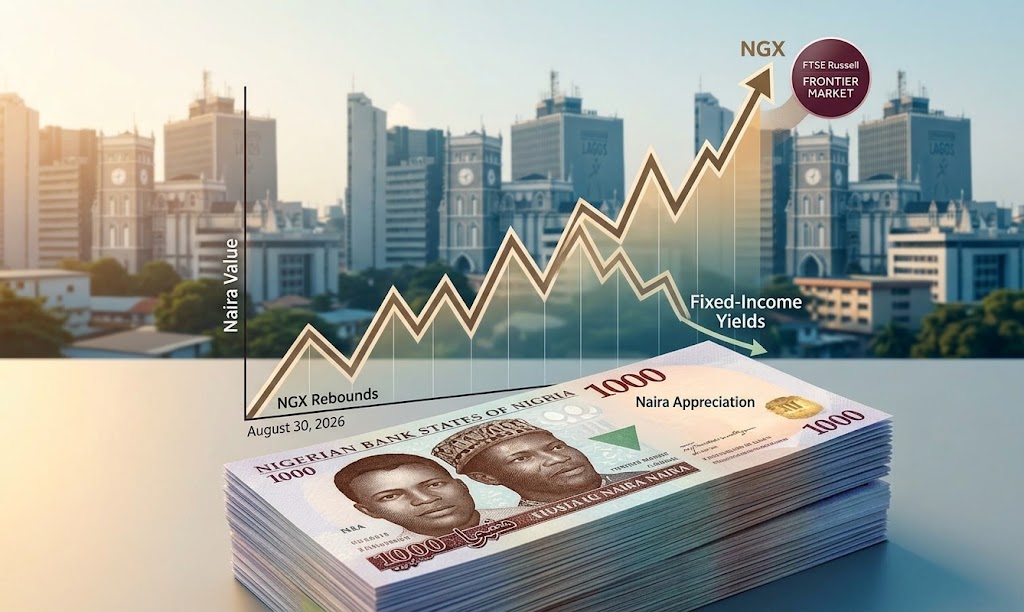
Nigerian markets saw a significant shift in August 2026. The Naira strengthened, while fixed-income yields eased on strong primary market demand. Concurrently, the equities market rebounded on news of Nigeria’s return to the FTSE Russell Frontier Market status. This combination of factors led to a more selective investor approach, moving towards defensive assets, liquidity, and yield in a cautious global environment.
Weekly Market Review: Fixed-Income Resilience Amid Easing Inflation and Global Risk Pressures

Nigeria’s domestic market showed cautiously constructive sentiment as easing headline inflation and strong FGN bond auction demand reinforced the case for gradual fixed-income yield compression. While food price acceleration and profit-taking in equities indicate an uneven recovery, improved foreign exchange stability and abundant liquidity provide a supportive foundation for local fixed-income assets amidst persistent global risks and oil price volatility.
Part 6: Profit Taking in Cryptocurrency Trading

This article breaks down essential profit-taking strategies in cryptocurrency trading to help you secure realized gains, minimize emotional decision-making, and protect your portfolio from market reversals. Learn how to implement fixed targets, partial exits, resistance zones, and trailing stops to build a disciplined risk management framework and lock in returns effectively.
Signals Beneath the Surface: Strong Demand Signals Yield Repricing, but Duration Risks Persist

Nigeria’s fixed-income market remained positive as heavy demand for short-term bills signaling a yield turning point and deep liquidity was evident. However, persistent duration risks linger at the long end, as highlighted by higher long-term NTB rates and increased FGN bond issuance. While short-term yields compress, the market remains cautious. Globally, soft US inflation data pushed down yields, supporting equities, despite mixed regional results and lingering geopolitical tensions.
Signals Beneath the Surface: Liquidity, Policy Shifts and Capital Flows Shape Nigeria’s Market Momentum

Nigeria’s financial markets show a story of cautious optimism. While the banking sector continues to anchor equities and fixed income investors lock in attractive yields, the Central Bank’s latest OMO auction and 2025 Annual Report provide fresh insights into the evolving liquidity and monetary policy environment. Simultaneously, the Naira remains broadly stable, foreign reserves strengthened, and a landmark tax framework for virtual assets was unveiled.
Markets in Transition: Liquidity Expansion, Yield Compression and Cautious Risk Repricing

Financial markets concluded July 2026 amid expanding domestic liquidity and resilient investor demand, despite global policy uncertainty. In Nigeria, fixed-income yields compressed following robust oversubscriptions at OMO and Treasury bill auctions. Equities posted mixed results despite strong H1 corporate earnings, while the Naira depreciated mildly. Globally, central banks held rates steady amid volatile commodity prices.
Market Pulse: Fixed Income Rally, Foreign Exchange (FX) Stability and Earnings Strength Drive Investor Confidence

Nigerian markets sustained a positive tone, driven by robust liquidity, a fixed income rally, foreign exchange stability, and strong corporate earnings. Meanwhile, the Central Bank of Nigeria maintained its disciplined monetary policy stance to anchor inflation. Evolving domestic fundamentals and external geopolitical risks continue to shape investor positioning and global market outlooks.
Investor Risk Profile Assessment Checklist

This comprehensive assessment helps investors identify their unique investment personality by evaluating financial behavior, emotional tolerance, and objectives. By answering ten specific questions, individuals can score themselves to determine whether they fit a conservative, balanced, or aggressive profile. The checklist emphasizes that understanding risk appetite and behavioral biases is essential for sustainable, long-term wealth building.