Polkadot, whose mainnet genesis block was produced on May 26, 2020, is more than another Layer-1 cryptocurrency. It is designed as a Layer-0 multi-chain protocol that provides shared security, interoperability, and infrastructure for specialized blockchains. Its architecture centres on the Polkadot Relay Chain, which coordinates security and interoperability for connected chains, while parachains can maintain their own specialised logic and applications.
Dot 🪙 is the native token of the Polkadot network. It is therefore important to distinguish native DOT from tokenised representations of DOT issued on other networks. DOT itself does not originate as an ERC-20 token running on Ethereum or a BEP-20 token on BNB Smart Chain. Polkadot has its own network architecture, with the Relay Chain coordinating security and interoperability for connected chains, and its contract address on the BNB Smart Chain (BSC) as a BEP-20 token is 0x7083609fce4d1d8dc0c979aab8c869ea2c873402
As of the latest CoinMarketCap data referenced in this update, the token has approximately 1.83million holders, a market capitalization of US$1.94 billion, with the circulating and total supply at approximately 1.7 billion DOT, while ranked 44th.
The core idea behind Polkadot is simple: “many specialised blockchains, one interconnected ecosystem.”
Rather than requiring every blockchain to perform the same functions, Polkadot enables application-specific chains to operate with their own logic while leveraging shared infrastructure and security. These may include networks focused on decentralised finance, gaming, artificial intelligence, real-world assets, or digital identity. Parachains can communicate through Cross-Consensus Messaging (XCM) while benefiting from Polkadot’s shared security architecture.
For example: DeFi chain → Gaming chain → AI chain → RWA chain → Identity chain
can operate as specialized chains while using Polkadot’s infrastructure for security and communication.
Parachains can have their own logic and potentially their own tokens, while benefiting from Polkadot’s shared security model.
This positions Polkadot within the broader interoperability, Web3 infrastructure, and multi-chain investment narrative.
What Gives DOT Utility?
- Staking and network security: DOT is used within Polkadot’s staking system to support network security, with validators and nominators participating in the network’s consensus mechanism. Stakers help secure the network and can receive staking rewards.
- Governance: DOT holders participate in Polkadot’s OpenGov, where token holders can vote on proposals affecting the network.
- Coretime: This has become an increasingly important utility. Projects requiring Polkadot’s computational resources acquire coretime, either through bulk or on-demand access on the network. Coretime is purchased in DOT and provides access to the computing resources required for parachain block production. Bulk coretime currently covers 28 days, while on-demand coretime allows more flexible, usage-based access.
This creates a direct relationship between demand for Polkadot’s infrastructure and utility for DOT.
Tokenomics: A Material Change in 2026
Polkadot’s token economics changed significantly in March 2026. Governance approved a 2.1 billion DOT hard supply cap, replacing the previous uncapped issuance model. Annual issuance was reduced from approximately 120 million DOT to about 56.88 million DOT initially, with further reductions scheduled every two years based on the remaining supply.
The change is important for investors because valuation should not be based solely on the price of one DOT, but rather with the consideration of market capitalisation, circulating supply, future issuance, and the maximum supply should all be considered when assessing the token’s investment profile.
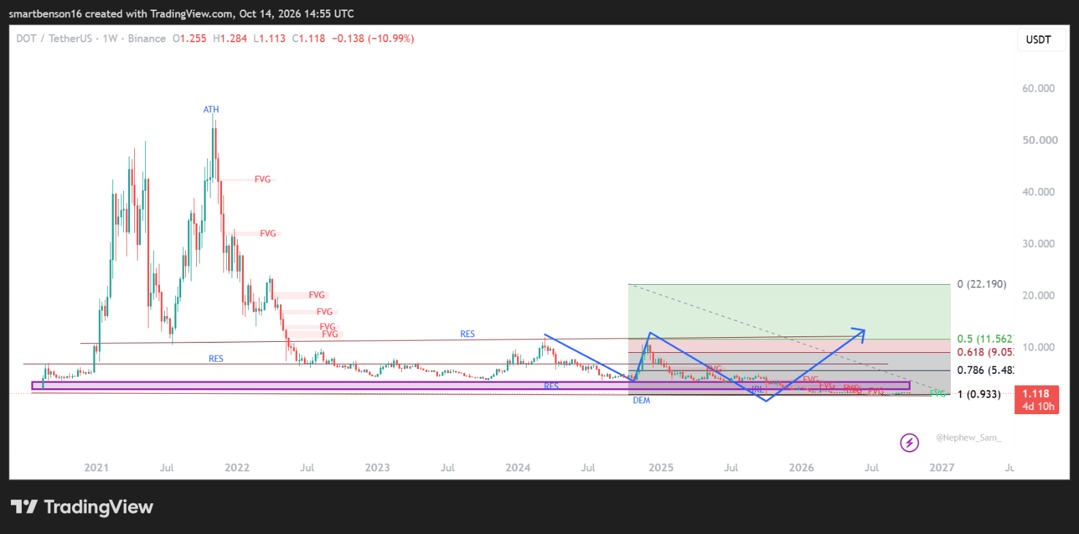
A look at the recent chart structure on the weekly timeframe, showing previous months and years supply and demand zone entries on spot and futures trading.
Market Cap: US$1.94 billion
All Time High: 55.090
Total Supply: 1.7billion DOT
Key Price Levels
Support/Demand: 0.9400, 1.050
Resistance/Supply: 2.180 – 3.400, 5.300 – 6.600, 9.200 – 11.500…
Should Dot break above the Fibonacci supply level after rebounding at 0.7270, the next resistance target with higher highs is expected. However, if it breaks below the demand at 0.9400, it risks creating a lower low. 0.8500 is expected to act as a stop-loss until price reclaims 0.8500 and retests the first entry level.
Investor Note: This is a long-term investment if you can hold; do not over-leverage. Investors may consider applying Dollar-Cost Averaging (DCA) as a risk management approach rather than attempting to time market movements.