Alternative Assets | Crypto Market Pulse
Period: May 20 – 27, 2026
The digital asset ecosystem experienced pronounced structural distribution and a definitive shift in institutional capital allocations over the past week. Total crypto market capitalization faced downward pressure, largely driven by a continuous seven-day streak of negative outflows from major U.S. spot Bitcoin (BTC) and Ethereum (ETH) ETFs.
Macroeconomic indicators and sudden geopolitical escalations in the Middle East reintroduced a risk-off sentiment across broader financial markets, putting pressure on digital assets.
However, a notable divergence appeared under the hood: while the structural heavyweights (BTC and ETH) bled capital through ETF redemptions, layer-1 “beta” assets like Solana (SOL) and Ripple (XRP) registered a counter-trend streak of green, positive inflows across their respective regulated investment vehicles. This indicates that while aggregate liquidity shrank, active market participants rotated down the risk curve into specialized altcoin plays.
Bitcoin (BTC)
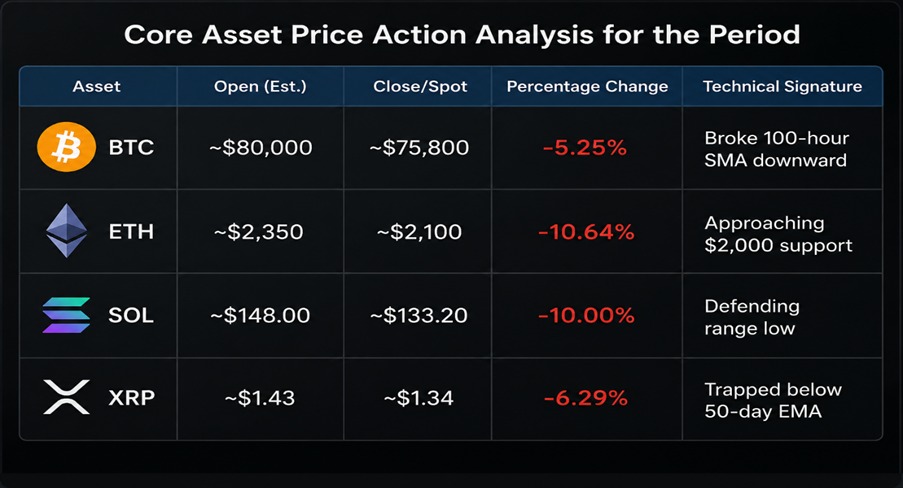
BTC started the session on May 20 confidently testing the $80,000 psychological milestone, bolstered by MicroStrategy’s record-breaking, aggressive accumulation streak. Though institutional demand hit a structural wall as institutional selling through ETFs accelerated, with over $2.1 billion exiting spot Bitcoin funds in less than seven trading sessions.
Exacerbated by Middle Eastern geopolitical tensions, BTC entered a sharp downside correction, slipping through the $77,000 support and breaking below a declining channel on the hourly chart. It currently prints a neutral-bearish posture under its 100-hour Simple Moving Average (SMA), consolidating weakly around $75,800 while trying to stabilize above the primary $75,500 support zone.
Ethereum (ETH)
ETH underperformed the broader index this week, dropping over 10% to trade at $2,100. The driving catalyst behind this aggressive repricing is a brutal seven-day streak of negative ETF flows, during which roughly $400 million was pulled from native spot ETH funds.
Despite stellar on-chain metrics, with ETH maintaining a dominant $43 billion in Total Value Locked (TVL) across decentralized finance (DeFi) protocols, the market is heavily discounting the asset ahead of the highly anticipated Glamsterdam hard fork scheduled for mid-2026. The technical structure is now dangerously close to testing a major line in the sand at the $2,000 structural support area.
Solana (SOL)
SOL mirrored ETH’s percentage drawdowns, sliding roughly 10% down to the $133.20 level. Interestingly, this downside was entirely driven by beta contagion from the majors rather than internal network weakness.
Solana’s institutional investment products registered net positive inflows throughout the week, confirming that allocators are actively accumulating the asset at a discount. The price remains locked in a well-defined consolidation block, and buyers are aggressively defending the mid-$130s range floor, waiting for an expansion in market-wide liquidity.
Ripple (XRP)
XRP showed relative resilience compared to its Layer-1 peers, losing 6.29% to sit at $1.34. The asset spent the last week locked inside a tight consolidation bracket between $1.32 and $1.45.
The asset’s structural floor is directly supported by massive multi-month institutional inflows into U.S. spot XRP ETFs (such as XRPR), which have crossed over $1.44 billion in cumulative net inflows since launching late last year. Regulatory tailwinds from the recent CLARITY Act framework continue to keep spot order books highly liquid, though the asset remains technically suppressed below its 50-day and 200-day Exponential Moving Averages (EMAs).
What Lies Ahead
In the near term, managing risk around BTC’s $75,500 level and ETH’s $2,000 level is paramount. A defensive posture is recommended until ETF flows flip positive or geopolitical risks stabilize. Accumulating structurally sound assets like SOL and XRP near their lower range support remains an attractive long-term strategy.
The market hinges on two divergent macro developments: a cooling of geopolitical tensions, combined with the materialization of the Trump administration’s directive to modernize digital asset regulations, will significantly deepen TradFi integration. Should spot BTC and ETH ETF outflows reverse into net positive inflows, it will trigger an immediate supply squeeze.
Conversely, escalating global macroeconomic risk may force the Federal Reserve to maintain an aggressive posture. This would drive yields higher and traditional equities downward, leading to a continued bleed in ETF pipelines that could completely deplete the spot bids on order books.
Market Mechanics Scenario
1. The Bull Case
- BTC: Reclaims the $76,500 area, forcing a short-squeeze back toward $78,800, opening the door to retest $80,000.
- ETH: Bounces firmly off the $2,050 liquidity pool, invalidating the bearish trend and targeting $2,250 on pre-Glamsterdam upgrade speculation.
- SOL: Regains the 20-day EMA to target a clean breakout toward $155.
- XRP: Reclaims the $1.45 resistance cap, activating a structural Cup-and-Handle technical pattern targeted at $1.70.
2. The Bear Case
- BTC: Fails to sustain $75,500, triggering a rapid liquidation cascade down to the structural demand block between $72,000 and $73,500.
- ETH: Breaks beneath $2,000, triggering a wider capitulation across the altcoin ecosystem and bringing $1,850 into play.
- SOL: Drops below its current range support at $130, seeking a deeper market floor around $115.
- XRP: Breaks down past the immediate $1.32 cluster low, leading to a retest of its strong structural floor at $1.27 – $1.28.
We are experiencing a classic, liquidity-driven correction within a structurally intact bull market cycle. The separation of altcoin ETF flows (SOL/XRP) from the majors demonstrates that smart money is looking for asymmetric risk-reward profiles rather than exiting crypto entirely.