
Weekly Market Review: A Tale of Two Realities Across Global and Local Frontiers

October 2026, Edition 1
Prologue
In the week ended October 2, 2026, Nigeria’s financial markets navigated a delicate balancing act, anchored by an improving currency market and robust foreign reserves, yet this was shadowed by sticky fixed-income yields and mid-week equities selling as investors digested GTCO’s H1, 2026 earnings performance and routine month-end portfolio rebalancing. Offshore, global equities staged a mixed rally behind artificial intelligence and technology mega-caps, powering past historic U.S. bond yield pressure and localized Middle Eastern energy disruptions. In commodities, prices eased after a volatile run, closing Week-on-Week (WoW) at $91.11/bbl. (-1.41%) and $102.25/bbl. (-1.98%) for West Texas Intermediate (WTI) and Brent crude, respectively, while gold was at $4,140.19/oz. (-3.38%).
System liquidity opened at ₦6.45 trillion, peaked at ₦8.84 trillion on Tuesday, and closed at ₦4.86 trillion on Friday, marking a decline of 24.71% WtD. Money market rates were in the 20.00% range, with the Open Repo Rate (OPR) and Overnight (O/N) rate closing WoW at 20.40% and 20.80% (+3bps). In the Foreign Exchange (FX) market, the Naira traded within a range of $/₦1,327.50 and $/₦1,333.00, before closing at $/₦1,330.10 on Friday. Dive into the editorial.
Nigerian Financial Markets
The fixed-income market recorded a mixed and largely range-bound performance, with Treasury bill (T-bill) yields remaining elevated around the 17.80% level, while FGN Bond yields stayed anchored around the 15.60%–16.40% range. T-bills initially strengthened on Monday, with the average yield declining to 17.87%, supported by buying interest around the mid-curve, before edging higher by 2bps to 17.89% on Tuesday amid renewed selling pressure and subsequently declined 4bps to 17.85% on Wednesday as demand returned to the long end, closing at 17.89%. The FGN Bond market remained under modest upward pressure, with the average closing yield moving from 15.68% on Monday to 15.69% on Friday, suggesting a marginal yield repricing rather than a broad-based sell-off. The pressure appeared concentrated in select mid-curve maturities, particularly the 2031–2038 segment, while demand at the long end, notably the 2053s, remained relatively minimal. The FGN JUN-38 also reflected significant activity, with offers moving from 16.15% on Monday to 16.45% on Friday, despite sustained trading activity. The marginal upward movement in yields appeared to have been driven less by a fundamental deterioration in the market and more by selective positioning, portfolio rebalancing around month-end, and specific selling in a few maturities. Overall, the market exhibited selective rather than systemic repricing, with investors rotating across the curve while remaining responsive to prevailing yield levels. The narrow movement in the average FGN Bond closing yield, within a 1bp range of 15.68%–15.69%, reinforces the view that the underlying market remained relatively well anchored, even as temporary supply pressure and month-end portfolio adjustments influenced individual securities.
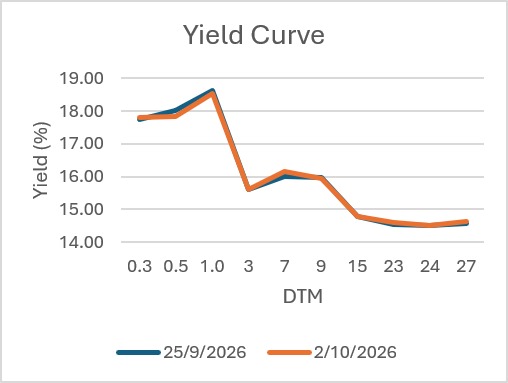
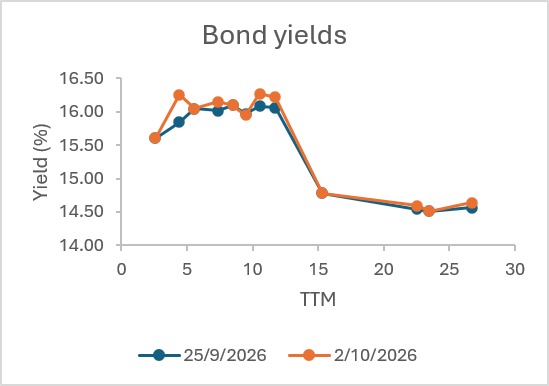
Money Market Issuance: The OMO auction held on September 29, 2026 strenghtened the market’s ongoing yield-compression trend, while revealing increasingly stronger demand for duration. Amidst the increase in total offer by 150%, the auction attracted 2.56x in total subscriptions, with allotment of 0.73x, representing 73.2% of subscriptions and a 107.9% increase from the previous sale. Stop rates declined by 5bps to 17.24% for 147-day and 16.94% for 182-day, while the new 266-day tenor cleared at 16.23%; effective yields also eased to 18.53% (-10bps), 18.50% (-4bps) and 18.41%, respectively. The concentration of demand in the 182- and 266-day tenors, compared with only ₦519.45bn of bids at 147 days, indicates a preference to lock in prevailing yields ahead of further compression, while the introduction of a 266-day OMO represents a gradual tenor extension of CBN’s sterilization tool. Although OMO yields have moved away from the high-18% area toward the mid-18% range, the yield curve remains negative rather than exhibiting a uniform downward slope. In the secondary market, the auction establishes a stronger lower-yield reference point, particularly around the 90-day and above tenor, and may sustain a selective bullish bias as investors reposition for further yield compression; however, the uneven curve and declining short-term money-market rates suggest that repricing is likely to remain tenor-specific rather than broad-based.
Open Market Operation (OMO) Auction – September 29, 2026
AUCTION DATE | TENOR | OFFER (₦’ B) | BIDS (₦’ B) | TOTAL SALE (₦’ B) | STOP RATES (%) | PREVIOUS TENOR RANGE STOP RATES (%) |
29-09-2026 | 147-DAY | 500.00 | 519.45 | 464.45 | 17.2400 | 17.2900 |
182-DAY | 1000.00 | 1,337.46 | 1225.46 | 16.9400 | 16.9900 | |
266-DAY | 1000.00 | 4,542.56 | 2,996.36 | 16.2300 | 0.0000 |
The Naira marginally gained during the week in the Nigerian Foreign Exchange Market (NFEM), appreciating by ₦1.23 (-0.09%) WtD and declining ₦0.58 (+0.04%) WoW, closing at $/₦1,330.10 (WoW: $/₦1,329.51). Foreign reserves increased from $54.86 billion to $54.93 billion (+0.13%) as of September 30, 2026, while blocked funds eased to $502.05 million (-0.24%), with the blocked reserve ratio at 0.91% (-0.1 bps), indicating improved foreign exchange conditions and receipts amidst external pressures.
According to the Debt Management Office (DMO), Nigeria’s total public debt stood at ₦166.79 trillion ($120.93 billion) as of June 30, 2026, comprising ₦91.59 trillion (54.91%) in domestic debt and ₦75.20 trillion (45.09%) in external obligations. Against this backdrop, the fiscal outlook is increasingly shaped by the interaction between financing requirements, declining market yields, and recent monetary easing amidst increased borrowing in Q3 2026. The lower domestic yield environment provides fiscal authorities with an opportunity to moderate the cost of new borrowing and optimise the refinancing of maturing instruments, potentially reducing debt-service pressures and creating additional fiscal space for priority capital expenditure and social programmes. However, the sustainability of this benefit will depend on the persistence of lower sovereign yields, revenue performance, borrowing discipline and expenditure management. With the election cycle approaching, maintaining this balance will be key to accommodating public spending priorities while limiting renewed deficit pressures and excessive domestic borrowing that may trigger upward pressure on sovereign yields.
All Share Index (ASI) Snapshot
The Nigerian equities market experienced mixed performance during the week ended October 02, 2026, opening on a bullish note on Monday, September 28, before succumbing to sustained selling pressure that trimmed market capitalisation down to ₦162.84 trillion. On Monday, the benchmark Nigeria Exchange (NGX) ASI gained +0.21% to reach 252,635.11 points (YtD: +62.35%), driven by strong advances in UPL (+9.89%), ABCTRANS (+9.80%), ETERNA (+9.62%), and FIDELITYBK (+6.48%), alongside broad sector strength led by Banking (+1.14%) and Insurance (+0.56%). Bearish momentum returned on Tuesday, September 29, as selling in UNILEVER (-8.55%), NEIMETH (-6.02%), and GTCO (-3.28%) dragged the NGXASI down -0.29% to 251,913.20 points (YtD: +61.88%). Profit-taking persisted through Wednesday, September 30, with the index falling -0.28% to close at 251,211.67 points (YtD: +61.43%) following pullbacks in LEARNAFRICA (-10.00%), FIDELITYBK (-6.07%), and MTNN (-3.01%), despite strong gains in HMCALL (+10.00%). This multi-day bearish tilt was notably triggered by the release of GTCO’s H1 2026 results, where a flat +0.4% year-on-year (YoY) pre-tax profit growth prompted investors to sell off as the result did not meet investors’ expectations and was further exacerbated by routine institutional end-of-month portfolio rebalancing across major equity funds. Following the October 1 Independence Day public holiday, trading concluded on Friday, with the market settling virtually flat to a marginal loss of 0.62% WtD at 250,808.30 points, YtD at 61.17% from 62.01% as market participants absorbed intermediate corporate disclosures against macroeconomic headcounts. Key NGX sector indices were mixed WoW: Oil & Gas (+0.05%), Banking (-1.33%), Industrial Goods (-0.26%), Consumer Goods (+0.91%), Insurance (-0.62%), Top 30 (-0.52%), and Main Board (+0.2%).
Other Developments:
- Wema Bank Plc’s MD/CEO, Moruf Oseni, acquired 16.22 million units of the bank’s shares through open-market transactions, marking his first direct equity disclosure since taking office. Regulatory filings with the NGX show the late-September purchases include a 3.09 million-share tranche worth ₦98.67 million and a subsequent 13.13 million-share tranche at ₦30.10 per share. While this trading activity directly expands WEMABANK’s daily market volume and turnover metrics on the exchange, it remains a capital market activity that does not alter the bank’s underlying operational earnings or financial performance.
- Guaranty Trust Holding Company Plc (GTCO) officially released its Audited H1 2026 financial results during the week, posting a marginal 0.4% YoY growth in Profit Before Tax (PBT) to ₦603.03 billion. Despite a strong 24.7% surge in trading income and a 7.5% rise in interest income, bottom-line expansion was heavily moderated by a ₦46.2 billion fair value loss recognized during the half-year window. The tighter risk discipline saw the Group’s Cost of Risk drop to 0.6% from 2.2%, GTCO expanded its balance sheet with total assets closing at ₦18.6 trillion and customer deposit liabilities strengthening by 10.3% to ₦14.19 trillion. To reward investors following the regulatory extension clearance, the Board of Directors approved an interim dividend payout of ₦1.00 per ordinary share.
Beyond the Nigerian Market
Global financial markets delivered mixed performance for the week ended October 2, 2026, as elevated sovereign bond yields and lingering central bank hawkishness pressured risk sentiment across Western equities, even as Japanese equities gained on expectations that the Bank of Japan will maintain a measured tightening pace. Fixed-income markets remained volatile; despite a minor late-week retreat, persistent “bond vigilante” dynamics kept global yields elevated near multi-year highs, with the US 10-year Treasury yields pushing past 5.1% (the 30-year yield easing to 5.59%) and UK 30-year gilts briefly crossing 6% before pulling back to ~5.87% alongside a 10-year gilt yield around 5.33%. Monetary policy trajectories dominated narrative flows, anchored by the Reserve Bank of Australia’s (RBA) unanimous decision on September 29 to hike its official cash rate by 25 basis points to 4.60%, its fourth hike of 2026, citing sticky domestic inflation, tight labour conditions, and rising energy costs. Reinforcing this “higher-for-longer” policy backdrop, robust US macroeconomic indicators, including firm Atlanta Fed GDP estimates and resilient capex spending, further dampened expectations for near-term global monetary easing. According to data released by the U.S. Bureau of Labour Statistics (BLS), the addition of just 29,000 nonfarm payrolls in September, coupled with a deceleration in average hourly earnings, signals a structural cooling in the domestic labour market, providing macroeconomic justification for the Federal Reserve to hold interest rates steady at its upcoming October monetary policy meeting. Meanwhile, broader commodity markets saw gold and iron ore ease under a firm US dollar and high real yields, while global energy markets navigated tight supply conditions amid ongoing diesel and trade disruptions. Equities market performance closed mixed WoW: the Nasdaq Composite at 27,179.86 (+0.45%), S&P 500 at 7,722.72 (-0.27%), and the Dow Jones Industrial Average at 51,176.96 (-1.26%). Across Europe, Germany’s DAX 40 was at 25,231.20 (-0.70%), while the FTSE 100 was at 10,461.95 (+0.32%), and the Stoxx 600 at 631.35 (+1.14%). Asian markets were varied, with Japan’s Nikkei 225 at 68,309.46 (+2.93%), China’s Shanghai Composite Index at 3,842.19 (-1.19%), Hong Kong’s Hang Seng Index at 23,972.29 (-2.19%), and South Korea’s KOSPI at 7,003.74 (-1.09%).
Commodities Statement
Oil markets remained highly volatile during the week as stalled U.S.–Iran negotiations and uncertainty over the reopening of the Strait of Hormuz kept supply risks elevated, although the resumption of Saudi Arabia’s East-West pipeline and improving Middle Eastern crude flows helped ease concerns over outright shortages; Brent traded within a weekly range of 98.70/bbl–107.69/bbl, while WTI ranged between 89.26/bbl–95.47/bbl, ending the week lower as European governments considered strategic reserve releases to ease fuel-market pressures. Meanwhile, gold traded between $4,119.55/oz and $4,146.22/oz, recovering from its sharp early-week decline as softer-than-expected U.S. inflation data reduced expectations of an imminent Federal Reserve rate hike, although elevated Treasury yields, a firmer dollar and persistent oil-driven inflation risks continued to weigh on the metal. Overall, the week highlighted the sensitivity of commodity markets to the interaction between geopolitical risk, energy supply disruptions and evolving U.S. monetary-policy expectations, with the direction of U.S.–Iran diplomacy and forthcoming economic data remaining key catalysts for both oil and gold.
What Lies Ahead
The market is expected to receive liquidity inflows of more than ₦2.88 trillion during the week, comprising ₦2.17 trillion from OMO maturities and NTB maturities of ₦705.73 billion. With Q3 macroeconomic updates and the Q4 issuance calendar for FGN bonds and NTBs underway, we expect investors to restructure their portfolios and re-position as the year runs to its close, while supporting substantial liquidity pool that could influence money-market rates, asset allocation, and the direction of fixed-income yields.
Share:
Quote
The Market’s Balancing Act
By: Sandra A. Aghaizu
The Naira held its ground,
While liquidity slipped away.
Interest rates stayed high,
As investors watched the day.
Oil and gold cooled,
While AI stocks climbed high.
Markets shifted with the tide,
Never still, never shy.
Behind every number,
A story waits to be told,
Of risk, belief and patience,
As money changes hands.
More Posts