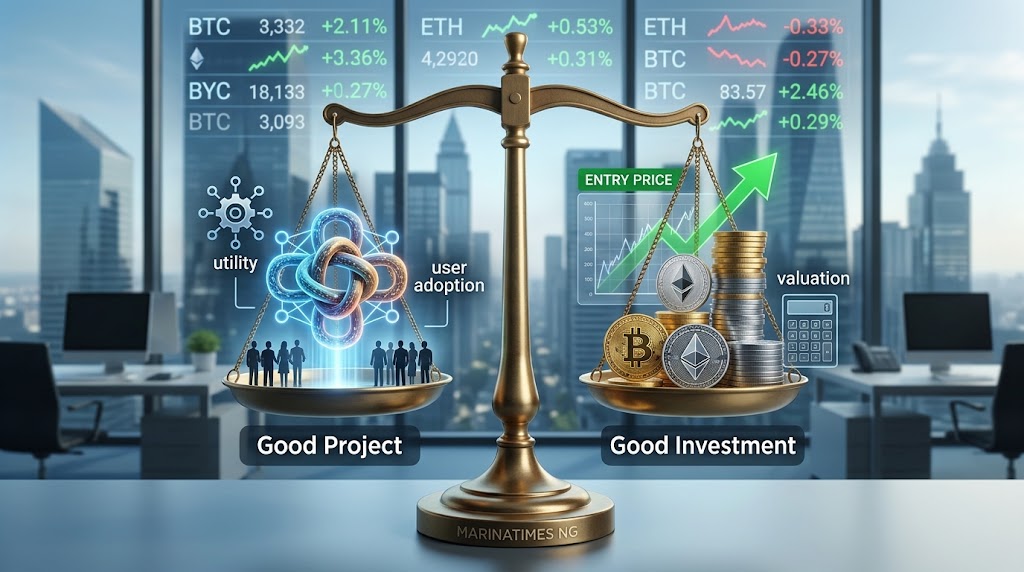
In the cryptocurrency market, one of the biggest mistakes investors make is assuming that a good project automatically means a good investment. While these two concepts are connected, they are not the same.
A good crypto project is one that solves a real problem, offers useful technology, attracts users, and has the potential to grow its ecosystem. A good crypto investment, however, is an asset purchased at a reasonable price with a risk-and-reward profile that fits the investor’s objectives.
What Makes A Crypto Project Good?
A strong project typically has:
- Real utility: It solves a problem or provides a service people need.
- Adoption: Users, developers, or businesses actively use its ecosystem.
- Strong fundamentals: It has credible development, a clear purpose, and sustainable growth potential.
- Reliable tokenomics: Its token supply, distribution, and incentives support its long-term objectives.
- Competitive advantage: It offers something valuable compared with competing projects.
However, even a project that possesses these qualities may still have a token that is overpriced.
What Makes A Crypto Asset A Good Investment?
Investment potential depends not only on the quality of the project but also on the price you pay.
Investors should consider:
- Valuation: Is the token reasonably priced relative to its adoption, utility, and potential?
- Supply and dilution: Could future token unlocks increase selling pressure?
- Demand: Is there a genuine reason for people to buy, use, or hold the token?
- Market conditions: Is the wider market supportive, or is speculation driving prices beyond fundamentals?
- Risk versus reward: Does the potential upside justify the possibility of losing money?
A strong project with weak token demand or an excessive valuation may deliver disappointing returns.
Simple Example
Imagine two crypto projects:
- Project A has excellent technology, growing adoption, and a strong team, but its token price already reflects extremely high expectations.
- Project B has a smaller ecosystem but a reasonable valuation, useful token economics, and room for adoption to grow.
Project A may be the better technology project, while Project B could offer the more attractive investment opportunity at that particular time. However, Project B is not automatically the better investment; its risks and fundamentals still need careful evaluation.
Using Bitcoin (BTC) as another example:
Bitcoin is widely recognized as a flagship decentralized digital asset with a limited maximum supply of 21 million BTC. Its established network, security, global recognition, and role as a peer-to-peer digital asset are important strengths.
However, these qualities do not guarantee profits for every investor. Someone who buys BTC at an extremely high valuation may experience significant losses if the market declines, while another investor who enters at a more attractive price may have a different risk-and-reward profile.
This demonstrates an important principle: the quality of an asset and the price you pay for it are two different things.
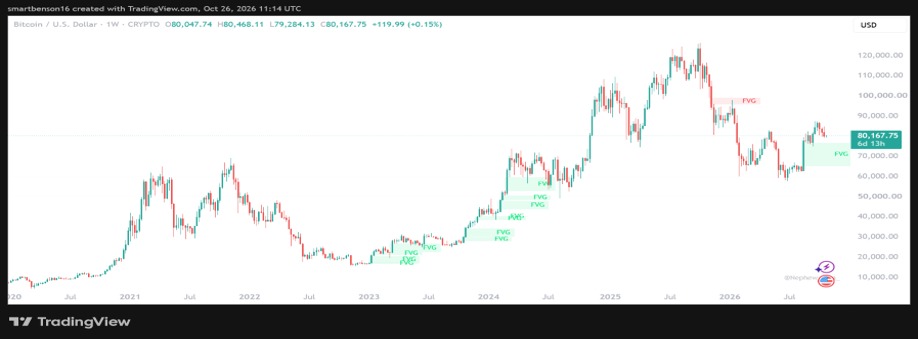
Bitcoin’s historical price movements illustrate the lesson: even an established asset with strong fundamentals can experience major rallies and corrections. Its all-time high was around $126,000 in October 2025, followed by a substantial decline.
A good crypto project does not automatically mean it is a good investment. A project may have strong technology, an experienced development team, real-world utility, and an active community, yet its token may still be overpriced or have weak investment potential.
A good project is measured by its technology, innovation, adoption, ecosystem growth, and ability to solve real problems.
A good investment goes beyond the project’s quality. It considers token valuation, market capitalization, supply and demand, tokenomics, liquidity, future growth potential, and the price at which an investor enters.
For example, BTC is a strong blockchain project, but buying it at an extremely high valuation does not automatically guarantee good returns.
The Lesson for Crypto Investors
Do not buy a token simply because it has a strong community, a popular narrative, impressive partnerships, or advanced technology. These factors can support a project’s growth, but they do not guarantee that its token price will increase.
Instead, investigate the relationship between project quality, token utility, valuation, supply, and market demand before making an investment decision.
Conclusion
A good crypto project creates value, but a good crypto investment depends on whether the price you pay offers an attractive opportunity relative to the risks involved.
Remember: A great project can be a poor investment at the wrong price, while a promising investment opportunity still requires research, patience, and effective risk management.