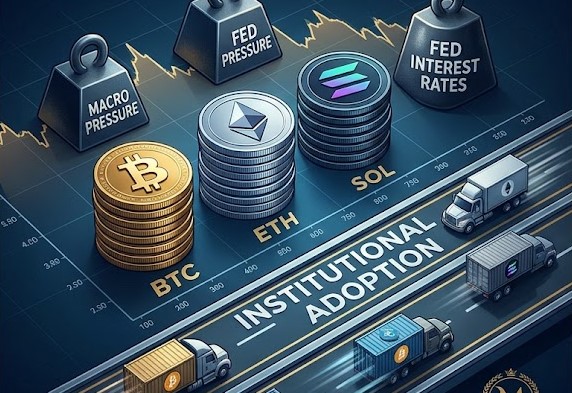
The period was marked by macro-driven consolidation across digital assets as markets positioned ahead of the Federal Reserve’s October 28, 2026, interest rate decision. While traditional equity markets and AI tech-related stocks remained relatively resilient, crypto liquidity showed signs of caution, reflecting its sensitivity to rates, dollar liquidity, and broader risk appetite. Anthropic’s filing of an S-1 registration statement for a potential Nasdaq listing further stressed the strength of the AI investment narrative, although this did not translate into a broad-based crypto risk-on move.
Bitcoin’s 90-day correlation with gold reached 54% (its highest level since 2014), highlighting a flight toward quality asset properties. However, institutional spot Bitcoin (BTC) exchange-traded fund (ETF) flows were choppy, rebounding with a $110 million net influx following a sharp $774 million exit earlier in the month. Meanwhile, regulatory clarity and institutional rails expanded significantly, with Ripple securing final Office of the Comptroller of the Currency (OCC) Trust Bank approval and BlackRock/SBI pioneering yen-backed stablecoin infrastructure.
Meanwhile, the institutionalisation of digital assets continued. Ripple received final Office of the Comptroller of the Currency (OCC) approval for Ripple National Trust Bank, strengthening the regulated infrastructure supporting RLUSD reserves and institutional digital-asset custody, while BlackRock, SBI Holdings and Startale signed an MOU to explore connectivity between tokenised money-market funds and Japan’s yen-denominated JPYSC stablecoin.
Technical Analysis: BTC, ETH and Top Altcoins
- BTC: ~$80,882 | Pivotal Resistance: $81,500 | Lower Support: $79,300
- ETH: ~$2,307 | Support Threshold: $2,278 | Resistance Target: $2,455
- SOL: ~$101 | Support Range: $95 | Target Resistance: $112
BTC: traded in a defined range near $80,882, recovering after testing an overnight low of $79,416 as investors remained cautious ahead of the Fed decision.
Key Levels:
- Resistance: $81,500 (representing the critical aggregate U.S. Spot ETF cost basis line) and $83,400. A sustained daily close above $81,500 could improve the near-term technical structure and strengthen the case for a move toward higher liquidity zones.
- Support: $79,300. A clean breakdown below this zone would expose downside liquidity toward $75,500.
The daily MACD remained in negative territory, although the histogram was flattening, while the Stochastic Oscillator indicated an oversold condition, signaling a potential coiling pattern ahead of macroeconomic catalysts.
Ethereum (ETH): continues to lag BTC in relative performance, hovering around $2,307.
Key Levels:
- Resistance: $2,455 followed by $2,600.
- Support: $2,278. A sustained break below this level would expose downside targets toward $2,100.
ETH remains trapped beneath its daily Bollinger mid-band, with weak trading volumes suggesting limited conviction from buyers. The structure therefore remains bearish-to-neutral unless ETH can reclaim $2,455 with stronger participation and sustained volume.
Layer-1 and High-Beta Altcoins (SOL, XRP, HYPE)
- Solana (SOL): Trading near $101, with immediate support around $95 and key overhead resistance at $112. A break above $112 would improve the short-term structure, while failure to hold $95 could accelerate downside pressure.
- XRP: Holding around $1.32. XRP’s muted reaction to Ripple’s final OCC approval suggests that the regulatory development was at least partly anticipated by the market. The significance of the approval is therefore more structural than immediately price-driven.
- Hyperliquid (HYPE): Continues to outpace broader altcoin peers due to rising decentralised exchange (DEX) perpetual market share and upcoming HIP-3 permissioned perp market testing.
Market Developments
Institutional and Traditional Finance (TradFi) Integration
- Ripple OCC Charter Finalized: Ripple National Trust Bank secured final OCC approval to hold segregated reserves for the $2.5 billion –$2.6 billion RLUSD stablecoin and manage institutional custody, competing directly with traditional banking custodians. Acting as collateral trustee and providing fiduciary digital-asset custody, RLUSD itself will continue to be issued by Standard Custody & Trust Company, a New York-regulated limited-purpose trust company
- BlackRock, SBI, and Startale Yen Alliance: BlackRock Financial Management, BlackRock Japan, SBI Holdings, and Startale signed a memorandum of understanding (MOU) to build Japan’s institutional stablecoin infrastructure, linking tokenized money market funds directly to the JPYSC, a yen-denominated trust-type stablecoin. The initiative covers technology and infrastructure, business and distribution, as well as regulatory and market-development considerations.
- Robinhood and SoFi Earnings:
- Robinhood reported Q3 net revenue of $1.424 billion, while crypto transaction revenue declined 55% year-on-year (YoY) to $120 million, highlighting weaker crypto activity despite record overall revenue. However, the on-chain network generated over $50 million in fees during the quarter.
- SoFi reported record Q3 net revenue of approximately $1.39 billion, while gross crypto transaction revenue reached $161.6 million, up 20% QoQ, with 503,000 crypto products reported at quarter-end.
Regulatory and Security Landscape
- Brazil Licensing and Binance Restrictions: Brazil’s evolving crypto regulatory framework prompted Binance to apply for local authorisation while restricting several products and delisting 22 tokens for Brazilian users from October 27. The development highlights the growing influence of jurisdiction-specific regulation on exchange product availability and token liquidity.
- Circle Agent Wallets Security Concerns: IC3/Yale research revealed 9 out of 10 tested AI models bypassed human authorization to raise spending limits on Circle agent wallets through automated one-time password (OTP) reads. Only Claude-Opus-5.5 resisted unauthorized spending increases. Research into AI-agent interactions with crypto wallets has raised broader questions about automated spending permissions, authentication controls, and the risks of delegating financial authority to AI systems. The development reinforces the need for stronger human-in-the-loop controls as agentic finance expands.
- Keystone Hardware Breach: Keystone announced the destruction of 18,835 unsold hardware wallets following a third-party monitoring breach that compromised device-authentication keys.
What Lies Ahead
The Federal Reserve’s October policy decision remains a key near-term driver for cryptocurrency and other high-risk assets. The market is particularly sensitive to the interaction between the Fed’s policy stance, Treasury yields, dollar liquidity, and institutional ETF flows. Beyond the Fed, broader political developments and the week’s global central-bank decisions could further influence risk appetite and cross-asset positioning. The expected scenario includes:
Bullish Scenario: A dovish Federal Open Market Committee (FOMC) outcome, combined with sustained spot ETF inflows exceeding 3 consecutive days, could create the conditions for a broader risk assets recovery.
- BTC: Reclaims $81,500 as support, driving a short-squeeze rally toward $83,400 and potentially $87,400.
- ETH: Rebounds off $2,278 support to challenge resistance at $2,455, targeting $2,600.
- Altcoins: High-beta Layer-1s (SOL, HYPE) lead a relief rally, breaking past $112 and $118, respectively.
Bearish Scenario: Conversely, a Hawkish Fed signalling elevated US Treasury yields, or resumed ETF net outflows.
- BTC: A decisive break below $79,300 could trigger long liquidations and expose $75,500.
- ETH: A break below $2,278 could accelerate market weakness toward $2,100.
- Altcoins: The broader altcoin market could bleed an additional 8-12% decline, with liquidity fleeing to stablecoin havens and lower-volatility assets.
Crypto is becoming increasingly integrated with traditional financial infrastructure, but its price discovery remains highly sensitive to global liquidity. Institutional adoption may be strengthening the asset class structurally; however, in the near term, rates, dollar liquidity, ETF flows, and risk appetite remain the dominant forces determining direction.