Bitcoin Cash is a decentralized, peer-to-peer cryptocurrency designed to make digital payments faster and cheaper. Its main goal is to function as electronic cash, allowing people to send money directly to one another without relying on banks or other centralized intermediaries. Unlike some blockchain projects that focus on smart contracts, decentralized applications, or artificial intelligence (AI), Bitcoin Cash primarily focuses on payments, low transaction fees, and everyday use as digital money.
BCH 🪙 was launched on August 1, 2017, following a hard fork from Bitcoin (BTC). This created a separate, independent blockchain with its own native cryptocurrency BCH whose contract address on the BNB Smart Chain (BSC) as a BEP-20 token is 0x8fF795a6F4D97E7887C79beA79aba5cc76444aDf.
As of the latest available data referenced in this update, the token has approximately 38,710 holders, a market capitalization of US$5.57 billion, with a total supply of 20.11 million tokens, and is ranked 18th on CoinMarketCap.
What Makes BCH Interesting to Investors?
- Payment adoption: Potential growth in merchant acceptance and everyday use.
- Scarcity: A fixed maximum supply of 21 million BCH.
- Transaction utility: Affordable transfers and practical payment use cases.
- Ecosystem growth: Opportunities through CashTokens and new applications.
- Established history: Operating as an independent cryptocurrency since August 1, 2017.
What Risks Should Investors Consider?
- Competition: BCH faces competition from Bitcoin, stablecoins, and other payment networks.
- Price Volatility: Its price can rise or fall sharply, leading to potential losses.
- Adoption Risk: Low transaction fees do not guarantee widespread usage.
- Market Sentiment: BCH’s price is influenced by Bitcoin’s movements and overall market trends.
- Development Risk: Long-term success depends on continued development, useful applications, and real-world adoption.
BCH may appeal to investors who believe decentralized digital payments will grow and who value a limited coin supply. Its potential depends on adoption, competition, and continued ecosystem development, not simply its similarities to Bitcoin.
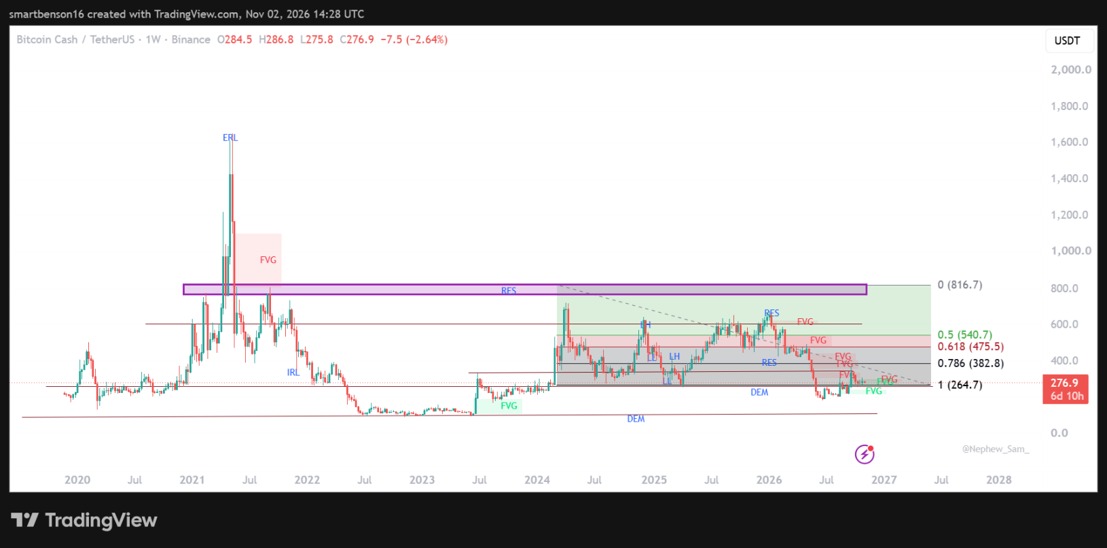
A look at the recent chart structure on the weekly TF, showing previous months and years supply and demand zones entries on spot and futures trading.
Market Cap: US$5.57 billion
All Time High ($): 4355.60
Total Supply: 20.11million
Key Price Levels
Support/Demand ($); 264.7, 254.5
Resistance/Supply ($); 341 – 382, 475.5, 547 – 620 …
Should BCH break above the Fibonacci supply level after rebounding at 341.0, the next resistance target with higher highs is expected. However, if it breaks below the demand at 254.5, it risks creating a lower low where 220.0 is expected to act as a stop-loss until price reclaims 254.5 and retests the first entry level.
Investor Note: This is a long-term investment if you can hodl, do not over leverage, investors may consider applying Dollar-Cost Averaging (DCA) as a risk management approach rather than attempting to time market movements.