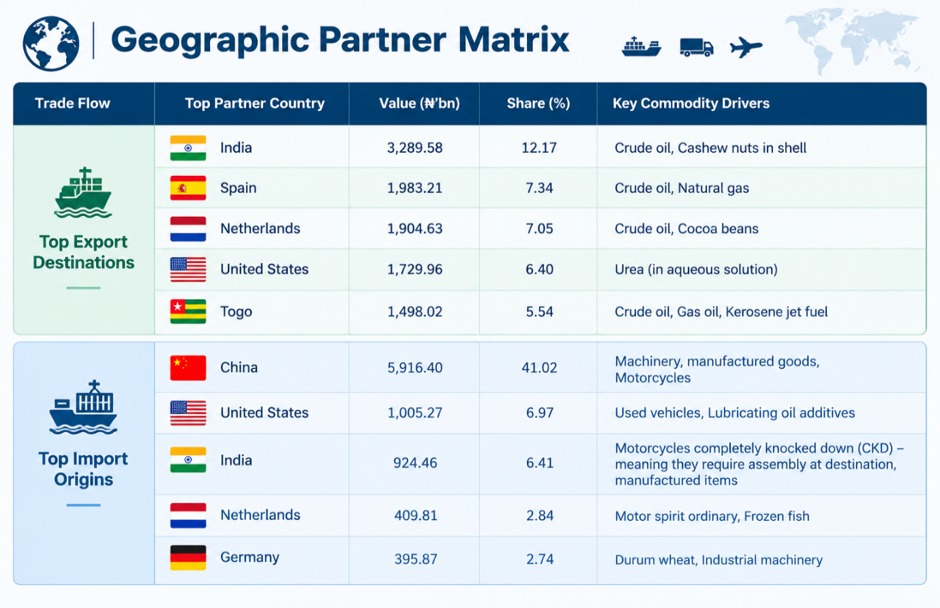
According to the National Bureau of Statistics (NBS), Q2 2026 Foreign Trade in Goods Statistics Report, Nigeria’s total merchandise trade reached ₦41,444.89 billion in Q2 2026. This represents a 5.61% year-on-year (YoY) increase from ₦39,244.42 billion in Q2 2025, and a 19.13% quarter-on-quarter (QoQ) increase from ₦34,788.59 billion in Q1 2026. The growth was driven by higher domestic export values alongside an aggregate contraction in import costs. As a result, Nigeria’s merchandise trade surplus doubled, rising by 101.32% YoY to ₦12,596.86 billion.
Total Trade: ₦41,444.89 billion (+5.61% YoY; +19.13% QoQ)
Total Exports: ₦27,020.88 billion (65.20% of total trade; +18.77% YoY; +27.64% QoQ)
Total Imports: ₦14,424.01 billion (34.80% of total trade; -12.55% YoY; +5.91% QoQ)
Trade Balance: Surplus of ₦12,596.86 billion (+101.32% YoY)
Trade Composition and Commodity Analysis
Crude and Refined Petroleum: Crude oil remained the dominant export driver at ₦12,914.33 billion (47.79% of total exports; +7.93% YoY). Non-crude petroleum products surged to ₦10,376.88 billion (+34.08% YoY; +53.05% QoQ), reflecting increased domestic refining throughput and regional fuel distribution.
Raw Materials and Solid Minerals: Raw material exports climbed 181.24% YoY to ₦2,305.40 billion, anchored by urea exports to the United States (₦1,069.37 billion). Solid mineral exports rose 90.03% YoY to ₦146.91 billion.
Agricultural Trade Contraction: Agricultural exports dropped 36.09% YoY to ₦802.99 billion (led by cashew nuts at ₦268.62 billion and cocoa beans at ₦154.31 billion). Conversely, agricultural imports rose to ₦1,203.76 billion, driven by durum wheat and food imports, keeping the agricultural sector in a net trade deficit.
Manufactured Goods: Manufactured imports dominated import demand at ₦9,511.36 billion (65.94% of total imports), primarily driven by industrial machinery, transport equipment, and vehicles. Manufactured exports fell 51.10% YoY to ₦393.03 billion.
Regional Distribution: Asia was the largest destination for exports (₦8,723.71 billion; 32.29%) and supplier of imports (₦8,563.63 billion; 59.37%). ECOWAS absorbed ₦3,751.49 billion (56.39% of total exports to Africa), led by energy supplies to Togo and Ivory Coast.
Macroeconomic Near Term
FX Reserve Consolidation and Exchange Rate: The ₦12.60 trillion trade surplus provides strong support for external reserves, improving foreign exchange liquidity and supporting naira stability near current clearing corridors.
Import Substitution in Refined Energy: The 73.08% YoY decline in refined petroleum product imports alongside expanding petroleum exports demonstrates the structural shift toward domestic refining, reducing long-term structural FX demand.
Inflationary and Supply-Side Risk: The combination of falling agricultural exports (-36.09% YoY) and expanding food imports highlights lingering security and productivity challenges in agrarian belts. Food inflation risks remain elevated, requiring ongoing monetary policy vigilance.
Capital Market and Fixed-Income Liquidity: Improved net foreign cash inflows bolster domestic market liquidity. However, high domestic inflation rates will keep monetary policy restrictive, preserving elevated yields across primary market Treasury bill auctions and sovereign bond issues.