


August 2026, Edition 3
The fixed-income market remained broadly positive but selective, with strong demand for the Nigeria Treasury Bill (NTB) and the Central Bank of Nigeria (CBN) Open Market Operation (OMO) bill signalling that yields may be approaching a turning point from current support levels, while the FGN bond market remained supported at the short-to-mid curve. The strong subscription of over 4.5x at the NTB and OMO auctions emphasizes deep liquidity, although the higher 364-day NTB stop rate and DMO’s heavier Jun.-2038 FGN Bond issuance point to continued duration and repricing risks. Overall, short-term yields appear positioned for gradual compression, while the long end remains more cautious. In commodities, prices closed higher Week-on-week (WoW), with West Texas Intermediate (WTI) and Brent crude rising by 5.51% and 5.95% to $82.40/bbl. and $88.52/bbl. respectively, while gold increased by 0.74% to $4,375.50/oz.
System liquidity ran surplus throughout the week, opening at ₦4.35 trillion and peaking at ₦6.81 trillion, amidst outflows of ₦4.06 trillion during the period, supported by inflows of ₦2.48 trillion, resulting in a net change (-38.8%). Consequently, system liquidity closed the week at ₦963.65 billion, representing a decline of 77.85% week-to-date (WTD) from the opening level. Money market rates were stable, with the Open Repo Rate (OPR) at 22.00% and the Overnight (O/N) rate at 22.25% (WoW: +15bps). In the Foreign Exchange (FX) market, the Naira traded within a range of $/₦1,356.00 and $/₦1,365.50, before closing at $/₦1,357.61 on Friday.
The fixed-income market traded mixed during the week as investors navigated uncertainty surrounding macroeconomic updates, the CBN’s revised liquidity-management framework, and primary market auction outcomes. In the Treasury bills market, average yields rose 53bps WoW to 18.73%, reflecting a generally weaker tone despite pockets of demand across key maturities, including the 29-Oct-26, 21-Jan-27, 29-Jan-27, and 12-Aug-27 bills. Meanwhile, OMO securities continued to attract selective interest, particularly in the Sep-26, Nov-26, Dec-26, and Jan-27 maturities, with yields largely trading within the 18.00%–20.00% range, highlighting investors’ preference for liquidity and shorter-duration instruments. In contrast, the FGN bond market remained relatively stable, with the average yield edging up 7bps WoW to 16.78%, as trading activity was concentrated in the mid- to long-tenor segment. Notably, yields on the 21-Jun-38 and 18-Apr-37 bonds rose by 37bps and 27bps, respectively, reflecting cautious sentiment toward longer-duration assets amid evolving policy and macroeconomic expectations.
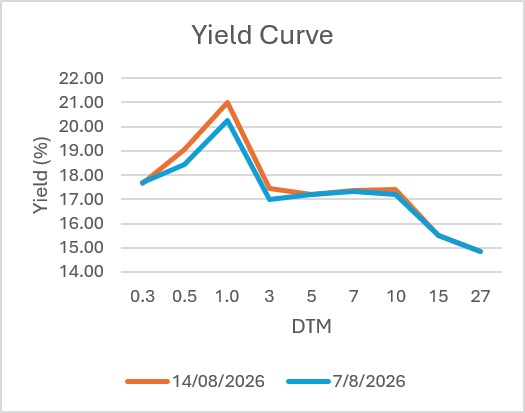
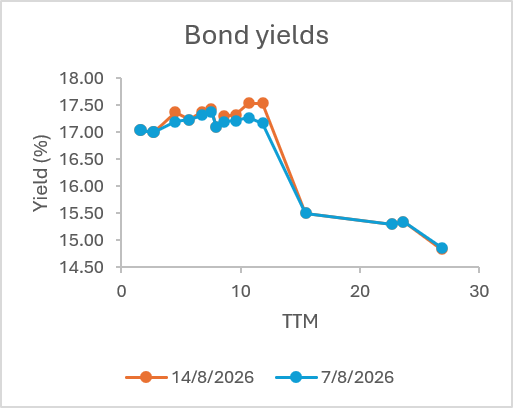
Updates: The CBN’s issued circular on August 12 for Review of Discount Window Restrictions and Open Market Operations (OMO) Participation Framework represents a targeted recalibration of market and liquidity-management rules rather than an outright easing signal: restrictions on Discount Window access arising from NFEM participation and primary government-securities auctions have been removed, while the restriction on banks accessing the Discount Window and participating in OMO on the same day remains; meanwhile, 4–90 day Tenored Repo Operations have been reinstated, and OMO participation has been broadened to individuals, corporates and non-bank financial institutions through Deposit Money Banks (DMBs). In the near term, the changes should give banks greater liquidity-management flexibility, broaden the OMO investor base and improve money-market functioning, but yield direction and system liquidity will remain dependent on how the CBN deploys repos and determines OMO volumes, tenors and frequency, meaning the circular itself should not be read as a definitive signal of monetary easing.
FX Liquidity Pulse: The August 13, 2026 OMO auction reinforced the growing narrative that yields may have peaked at the current threshold, as investor demand remained exceptionally strong despite the CBN’s aggressive liquidity sterilisation efforts. Total subscriptions surged by 123.6% to ₦4.93 trillion, the highest since the January 29, 2026 auction, while allotments increased by 19.8% to ₦2.61 trillion. Demand was heavily skewed toward the 138-day bill, which recorded over 12x subscription compared to 4.23x for the 103-day tenor, reflecting investors’ demand for both bills. Although the 103-day stop rate edged up by 4bps to 20.39%, the 138-day stop rate declined by 14bps to 20.01%, while effective yields on both instruments compressed by 8–10bps, signalling stronger pricing power and heightened competition among investors. The relative spread of bid ranges of 31–56bps, with allotments cleared at the upper bound, further reflects robust demand and increased ability to mop up over 6x. Overall, the auction suggests that liquidity remains ample, investor appetite for OMO securities is deepening, particularly following the CBN’s recent expansion of OMO market access, and yields are entering a gradual compression phase that could see rates trend lower in the absence of significant inflationary or liquidity shocks.
AUCTION DATE | TENOR | OFFER (₦‘ B) | BIDS (₦‘ B) | TOTAL SALE (₦‘ B) | STOP RATES (%) | PREVIOUS TENOR RANGE STOP RATES (%) |
13-08-2026 | 103-DAY | 300.00 | 1,268.44 | 449.74 | 20.3900 | 20.3500 |
138-DAY | 300.00 | 3,657.65 | 2,154.15 | 20.0100 | 20.1500 |
Primary Issuance Brief: The August 12 NTB auction highlighted an overwhelming preference for the 364-day instrument, with total subscriptions reaching ₦4.41 trillion against an offer of ₦700 billion, representing an overall 6.24x subscription. The 364-day bill accounted for 94.8% of total demand, attracting bids worth 8.27x its offer, while the CBN allotted 30.4% of the bids, equivalent to 2.52x the offer, indicating its willingness to absorb substantial demand. Despite the strong demand, the stop rate rose by 24bps to 17.59%, signalling renewed repricing pressure at the long end. In contrast, the 91- and 182-day tenors recorded more moderate demand at 1.62x and 0.64x, with allotments of 1.49x and 0.47x, respectively, while their stop rates remained unchanged at 16.30% and 16.50%. Effective yields settled at 16.99%, 17.98%, and 21.33% (+35bps) for the 91-, 182-, and 364-day bills, respectively. The combination of exceptionally strong demand and a higher 364-day stop rate suggests that investors continue to seek additional compensation for locking funds for 12 months amid liquidity and rate uncertainty. Notably, the effective yield on the recently issued 138-day OMO bill remains 32bps higher than the 1-year NTB, highlighting the premium investors continue to receive in the OMO market. Furthermore, the August 12th sale marks the second issuance of the year above the ₦1.45 trillion mark, reflecting sustained liquidity in the financial system.
AUCTION DATE | 12-08-2026 | 12-08-2026 | 12-08-2026 |
MATURITY DATE | 12-11-2026 | 11-02-2027 | 12-08-2027 |
TENOR | 91-DAY | 182-DAY | 364-DAY |
OFFER (₦) | 100,000,000,000 | 100,000,000,000 | 500,000,000,000 |
SUBSCRIPTION (₦) | 162,210,976,000 | 63,972,793,000 | 4,188,416,475,000 |
ALLOTMENT (₦) | 148,565,439,000 | 47,475,966,000 | 1,260,000,000,000 |
BID RANGE (%) | 15.9000 – 19.3000 | 15.8900 – 19.0000 | 16.5000 – 20.2700 |
STOP RATES (%) | 16.3000 | 16.5000 | 17.5900 |
PREVIOUS STOP RATES (%) | 16.3000 | 16.5000 | 17.3500 |
The August FGN bond offer circular reflects a clear shift in the DMO’s issuance strategy toward the long end of the yield curve, with the total offer size declining marginally by 8.3% to ₦1.1 trillion from ₦1.2 trillion in July, thereby becoming significantly more concentrated in the 2038 bond. Featuring 3 reopened papers (22.60% FGN JAN 2035, 16.2499% FGN APR 2037, 15.45% FGN JUN 2038, with tenors of 10-, 20-, and 15-year), offers declined markedly on the Jan-2035 paper by 37.5% to ₦250bn, while the Apr-2037 bond by 75% to ₦100bn. In contrast, the Jun-2038 bond was increased by 87.5% to ₦750bn, now accounting for 68.2% of the total auction size, up from 33.3% in July. This suggests the DMO is deliberately extending the government’s debt maturity profile, reducing refinancing risk and taking advantage of strong demand for longer-duration assets. The strategy also signals confidence that investors remain willing to absorb duration risk despite elevated interest rates. Consequently, demand is expected to be concentrated in the 2038 paper. However, the larger supply may require a modest yield concession to clear the market, potentially keeping long-end bond yields elevated in the near term.
The Naira appreciated mildly during the week in the Nigerian Foreign Exchange Market (NFEM), gaining ₦2.53 (-0.19%) WTD and ₦8.08 (-0.59%) WoW, closing at $/₦1,357.61 (WoW: ₦1,365.69). Foreign reserves increased from $52.03 billion to $52.26 billion (+0.43%) as of August 13, 2026, while blocked funds eased to $563.01 million (-2.60%) and the blocked reserve ratio at 1.08% (-0.4 bps), indicating an improved foreign exchange condition amidst external pressures.
The Nigerian Exchange (NGX) ASI closed the week on a bearish note despite a strong start on Monday, when the NGX-ASI gained 1.21% to 248,556.30 points, supported by buying interest in AIRTELAFRI and major banking stocks. However, sentiment reversed from Tuesday as sustained profit-taking in large-cap consumer goods and banking counters, including BUAFOODS, UNILEVER, ACCESSCORP, UBA and ZENITHBANK, weighed on the market. The index subsequently declined to 242,770.94 points (WTD -2.33% and WoW -1.14%) on Friday, reducing its year-to-date return to 56.01% from 57.81%. Market breadth remained below 1.0x, indicating persistent selling pressure, while trading activity was mixed, with lower volumes but relatively resilient transaction values. FIRSTHOLDCO consistently led value turnover, while key sectoral performance was largely negative, with the Consumer Goods Index recording the steepest decline (-6.72%), Insurance (-2.72%), Banking (-1.48%), Industrial (1.22%), and Oil&Gas (-0.06%). Overall, the market remained cautious, with profit-taking continuing to outweigh bargain hunting across key sectors.
The Securities and Exchange Commission’s (SEC) transition to a T+1 settlement cycle by 5:00 p.m. on trade date plus one marks a transformative shift for the Nigerian equities market, significantly accelerating capital turnover and reducing counterparty risk. By enforcing strict Delivery versus Payment (DvP) standards alongside established Central Securities Clearing System (CSCS) default guidelines, the regulatory framework instills enhanced market discipline while boosting overall trading liquidity. Critically, the decision to maintain the prefunding exemption for Foreign Portfolio Investors (FPIs), supported by mandated broker-dealer control mechanisms, mitigates foreign exchange operational friction and removes a key barrier for global capital. In the near term, this operational upgrade aligns Nigeria with international post-trade benchmarks, boosting international market competitiveness and driving increased participation from both institutional and domestic investors.
Global financial markets closed the week on a resilient note as eased U.S. inflation metrics, highlighted by both consumer and producer price data, tempered aggressive central bank tightening expectations, offsetting persistent geopolitical friction. In the United States, July headline CPI cooled slightly to 3.4% year-over-year while core inflation moderated to 2.5%, complemented by the U.S. Producer Price Index (PPI) coming in flat (0.0% MoM) in July, below expectations of a 0.2% rise, bringing the annual PPI rate down to 4.7% from 5.5% in June. These favourable price prints helped push the U.S. 10-year Treasury yield down to ~4.64%, dampening bets on near-term Federal Reserve rate hikes and propelling global equity indices toward strong weekly gains. In contrast, sovereign bond yields across other key markets remained firm due to local rate dynamics and energy price pressures: European benchmarks traced higher, with the German 10-year Bund yield hovering around 3.17%. The UK 10-year Gilt yield rose to near 4.99%, while Japan’s 10-year JGB yield edged up to 2.88% amid elevated Bank of Japan tightening expectations. On the policy front, central bank activity was dominated by hawkish pauses, with the Reserve Bank of Australia holding its cash rate target at 4.35% and Norges Bank maintaining its policy rate at 4.25%. The equities market performance closed mixed WoW: the Nasdaq Composite at 26,729.16 (+0.01%), S&P 500 at 7,785.76 (+0.36%), and the Dow Jones Industrial Average at 53,732.41 (-0.56%). Across Europe, Germany’s DAX 40 was at 26,440.31 (+0.46%), while the FTSE 100 was at 10,750.11 (-1.39%), and the Stoxx 600 at 657.86 (-0.30%). Asian markets were varied, with Japan’s Nikkei 225 at 68,713.80 (+4.74%), China’s Shanghai Composite Index at 3,927.18 (-0.33%), Hong Kong’s Hang Seng Index at 25,116.85 (-2.15%), and South Korea’s KOSPI at 6,977.94 (+11.49%).
Global commodity markets were shaped by a combination of geopolitical tensions and shifting monetary policy expectations during the week. Crude oil prices remained volatile but ended higher, with Brent crude rising from $86.62/bbl. on Monday to $88.52/bbl. on Friday, while WTI crude advanced from $81.10/bbl. to $82.40/bbl. over the same period. The gains were largely driven by persistent uncertainty surrounding the Strait of Hormuz, stalled negotiations between the U.S. and Iran, and concerns over potential supply disruptions despite the International Energy Agency’s (IEA) weaker demand outlook. Meanwhile, gold traded near multi-week highs before retreating, falling from $4,358.58/oz on Monday to $4,375.50/oz on Friday, as softer U.S. inflation data reduced expectations of a near-term Federal Reserve rate hike and prompted profit-taking. Nevertheless, ongoing geopolitical risks and sustained central bank purchases continued to provide support for bullion prices.
Globally, macroeconomic updates poised to drive market momentum in the week are: China Industrial Production and Retail Sales, UK Consumer Price Index (Jul.), Eurozone CPI (Final Jul.), US Existing Home Sales (Jul.) It is expected that the fixed-income market direction will be defined in the new week due to the scheduled August 2026 FGN Bond ₦1.10trn offer Auction. Expected inflows of over ₦3.16 trillion (OMO maturity ₦2.22 trillion, NTB Maturity ₦429.24 billion, FGN Bond Coupon ₦599.41 billion, and Eurobond Coupon of $59.06 billion) will provide ample liquidity to support continued demand for fixed-income securities.
By: Sandra A. Aghaizu
Money flows like a rising tide,
Finding bonds where returns reside.
₦3.16 trillion enters the stream,
Chasing yield, pursuing the dream.
As government paper meets eager hands,
Liquidity moves across financial lands.
The market watches, calculates, and waits,
While every yield negotiates.
The week ahead is a river in motion,
Liquidity, bonds, and investor emotion.





Subscribe now to keep reading and get access to the full archive.