

August 2026, Edition 5
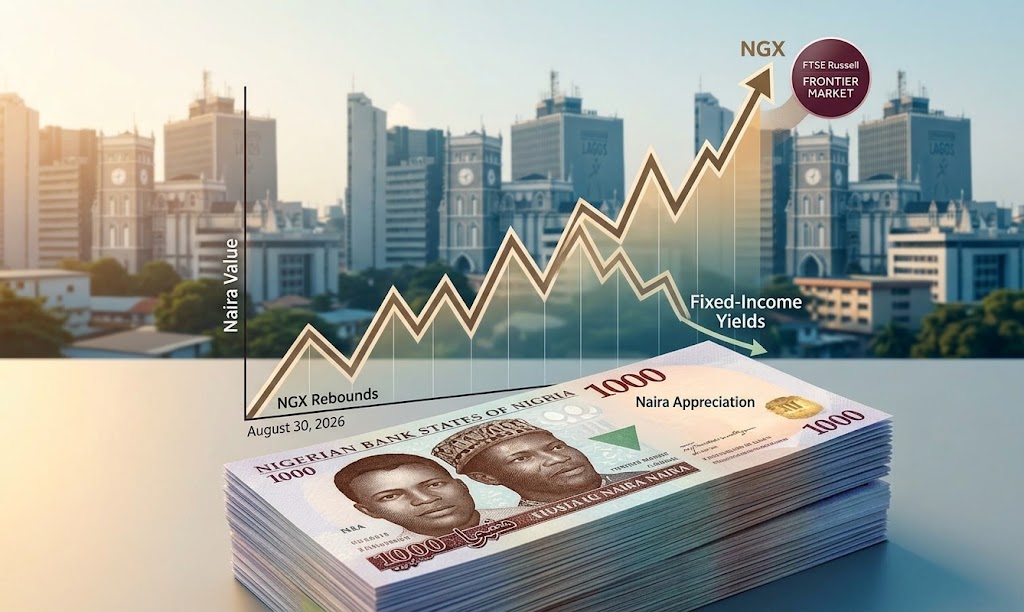
Nigerian markets closed the week with cautious risk appetite and selective repricing. Fixed-income markets showed easing pressures as T-bill average yields closed high, while FGN bond average yields breached the 17.00% level to the high-16% range; strong demand for primary market issuance at the Open Market Operation (OMO) and Nigeria Treasury Bill (NTB) auctions, particularly the 364-day bill attracted ₦3.63 trillion in bids and cleared low at 17.15%, reinforcing expectations of gradual yield compression. The Naira strengthened by 0.68% WoW, supported by rising reserves to $53.31 billion, while equities rebounded to a weekly close, with the NGX-ASI up by 0.93% WoW to 241,298.47 points amid a weekend bargain hunt following Nigeria’s official return to FTSE Russell’s Frontier Market status. Globally, elevated inflation, bond yields, and geopolitical risks kept sentiment reactive, with commodities retreating, highlighting continued preference for liquidity, yield, and defensive assets. In commodities, prices closed lower Week-on-week (WoW), with West Texas Intermediate (WTI) and Brent crude easing by 4.16% and 6.46% to $83.44/bbl. and $88.29/bbl. respectively, while gold fell by 3.33% to $4,454.08/oz.
System liquidity opened at ₦5.46 trillion, peaked at ₦7.40 trillion, and closed at ₦3.61 trillion, resulting in a decline of 33.87% week-to-date (WTD). Money market rates were stable, with the Open Repo Rate (OPR) at 22.00% and the Overnight (O/N) rate at 22.21% (WoW: +7bps). In the Foreign Exchange (FX) market, the Naira traded within a range of $/₦1,335.00 and $/₦1,350.00, before closing at $/₦1,337.29 on Friday.
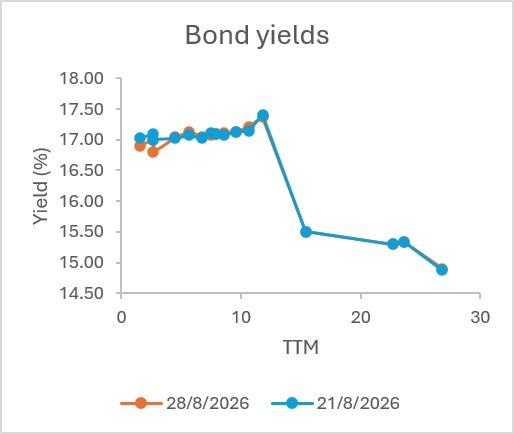
The fixed-income secondary market opened the week with mixed trends, as Treasury bills (T-bills) came under major traction after a pullback in the 1-year rates following auction close, particularly across the mid and short end, led by the 03-Sep-26, 03-Dec-26, and 7-Jan-27 bills, with average yield closing Friday at 19.21% from 19.05% on Monday. OMO bills breached the 19.00% level to trade in the upper-18% range. The FGN bond market, meanwhile, breached the 17.00% level to the 16.80-16.90% range, with a bullish run and average yield easing by 2bp to 16.64% from 16.65% on Monday, supported by demand for short and mid- tenor instruments. Notably, the short end traded at the 17.00% threshold, with an imminent lower break. Trading remained concentrated in benchmark FGN securities, with FGN JUN-38, FGN APR-37 and FGN JAN-35 among the most actively traded instruments. Overall, the trend reflected cautious positioning, with investors selectively rotating between short-term liquidity opportunities and changing demand dynamics.
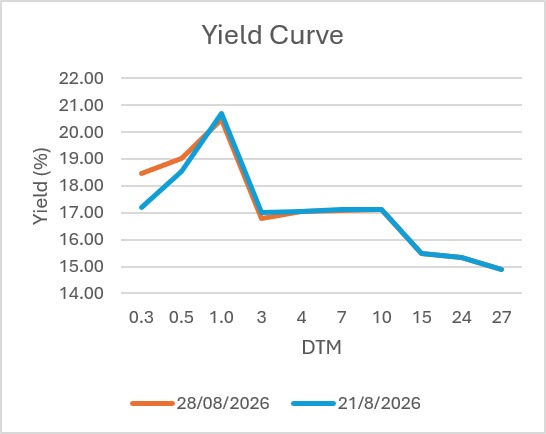
Money Market: The August 26–27 OMO market auctions showed strong demand alongside a clear downward repricing in stop rates, despite the CBN maintaining a ₦1.0 trillion daily offer, split evenly across the two tenors. On August 26, the 97-day and 132-day bills attracted 1.57x and 6.95x in subscriptions, respectively, with allotments to bids at 78.2% and 62.7%; stop rates fell sharply by 49bps to 19.90% and 36bps to 19.65%, respectively. Effective yields eased to 21.01% (-62bps) and 21.15% (-50bps). On August 27, demand remained robust, with an oversubscription of 2.13x and 6.58x for the 96- and 152-day (currently marks the highest tenor issued in Q3 2026) bills. Although allotments were more conservative at 15.0% and 53.7% of subscription, stop rates declined further by 5bps to 19.85% and 33bps to 19.32%, while effective yield eased to 20.94% (-7bps) and 21.01% (-14bps), demonstrating a downward progression from the 21.00% levels. Here, the key signal is that the CBN was able to absorb substantial liquidity at progressively lower rates, while investors showed a pronounced preference for longer tenors. Overall, total subscriptions stood at ₦4.26 trillion (-13.5%) and ₦4.36 trillion (+2.3%), against sales at ₦2.79 trillion (+7.4%) and ₦1.93 trillion (-31.0%), reflecting a more selective issuance approach despite strong demand.
AUCTION DATE | TENOR | OFFER (₦‘ B) | BIDS (₦‘ B) | TOTAL SALE (₦‘ B) | STOP RATES (%) | PREVIOUS TENOR RANGE STOP RATES (%) |
26-08-2026 | 97-DAY | 500.00 | 783.49 | 613.00 | 19.9000 | 20.3900 |
132-DAY | 500.00 | 3,477.69 | 2,183.10 | 19.6500 | 20.0100 | |
| 96-DAY | 500.00 | 1,066.68 | 160.46 | 19.8500 | 19.9000 |
152-DAY | 500.00 | 3,293.83 | 1,768.15 | 19.3200 | 19.6500 |
Primary Issuance: The August 26 NTB auction reinforced an explicit investor preference for the 364-day instrument, with the ₦700 billion offer attracting total subscriptions of ₦3.79 trillion. The 91-day bill demand was moderate at 1.03x, while the 182-day bill was undersubscribed at 0.53x, with allotments at 86.2% and 67.2%, respectively. Stop rates were steady at 16.30% and 16.50% for the 91- and 182-day bills. The 364-day bill dominated total demand by 95.9%, with an oversubscription of 7.26x against its offer. Despite the exceptional demand, the Debt Management Office (DMO) allotted 17.6%, highlighting its selective issuance approach, with a declined stop rate of 17.15% (-44bps). Effective yields settled at 16.99%, 17.98%, and 20.69% (-64bps). The combination of unchanged short-tenor rates, a significantly lower repricing of the 1-year tenor, and selective allotment signals strong investor appetite to lock in yields, while the DMO’s measured supply strategy could support further yield compression.
AUCTION DATE | 26-08-2026 | 26-08-2026 | 26-08-2026 |
MATURITY DATE | 26-11-2026 | 25-02-2027 | 26-08-2027 |
TENOR | 91-DAY | 182-DAY | 364-DAY |
OFFER (₦) | 100,000,000,000 | 100,000,000,000 | 500,000,000,000 |
SUBSCRIPTION (₦) | 103,315,675,000 | 52,934,396,000 | 3,630,702,174,000 |
ALLOTMENT (₦) | 89,100,826,000 | 35,594,382,000 | 638,190,857,000 |
BID RANGE (%) | 15.6500 – 19.3000 | 16.1500 – 18.4800 | 16.0000 – 19.0500 |
STOP RATES (%) | 16.3000 | 16.5000 | 17.1500 |
PREVIOUS STOP RATES (%) | 16.3000 | 16.5000 | 17.5900 |
The Naira gained during the week in the Nigerian Foreign Exchange Market (NFEM), appreciating ₦9.69 (-0.72%) WTD and ₦9.20 (-0.68%) WoW, closing at $/₦1,337.29 (WoW: ₦1,346.49). Foreign reserves increased from $52.66 billion to $53.31 billion (+1.24%) as of August 27, 2026, while blocked funds eased to $542.15 million (-1.97%), with the blocked reserve ratio at 1.02% (-0.3 bps), indicating an improved foreign exchange condition amidst external pressures.
The Nigerian equities market remained broadly bearish during the week, with the Nigerian Exchange (NGX) ASI declining 0.11% on Monday and 0.17% on Wednesday before staging a rebound following news of Nigeria’s official return to FTSE Russell’s Frontier Market status, recovering by +1.10% to close on Friday at 241,298.47 points, bringing the YtD return to +55.06%, +0.93% WoW and +0.46% WTD. Although mixed, sentiment improved as market breadth declined from 0.54x to 0.46x, with market capitalization in the ₦156.49 – ₦157.94 trillion range. Gains were led by UPL (+18.75%), FIRSTHOLDCO (+11.58%) and REDSTAREX (+9.86%), while INTENEGINS (-26.61%), FIDSON (-17.69%) and CAVERTON (-15.15%) recorded notable losses. Market breadth improved to 0.46x from 0.37x, although activity weakened, with volume and value traded declining by 13.86% to 1.95trn units and 6.37% to ₦121.42bn, respectively. Sectorally, Banking (+2.86%) and Oil & Gas (+4.54%) led gains, while Insurance (-1.27%), Industrial Goods (-0.15%) and Consumer Goods also closed lower, highlighting continued selective rather than broad-based investor participation.
Nigeria’s planned return to the FTSE Russell Frontier Market Index introduced a ray of hope following its planned reclassification of Nigeria from Unclassified to Frontier Market with effect from September 21, 2026. The transition from T+2 to T+1 settlement, including the removal of the pre-funding requirement for foreign investors, remains consistent with its Delivery versus Payment (DvP) market-accessibility criteria. However, the development primarily represents an improvement for foreign portfolio inflows, market visibility, and NGX liquidity, with T+1 settlement efficiency and reduced counterparty risk.
In the week ending August 28, 2026, global financial markets closed on a cautious, risk-averse footing as resilient economic activity, persistent inflation, and elevated sovereign bond yields reinforced expectations that major central banks may keep monetary policy restrictive for longer. In the U.S., the August flash Composite PMI rose to 56.0 from 54.5, marking the fastest private-sector expansion since April 2022, while July headline PCE inflation remained sticky at 3.7% YoY, pushing the 10-year and 30-year Treasury yields to 4.69% and 5.20%, respectively. US Q2 2026 GDP growth slowed to 1.50% from 2.10%, but resilient consumer spending (+3.40%) and business investment (+7.00%), particularly in AI-related technologies, indicate solid private-sector momentum, partly offset by weaker government spending and a widening trade deficit, with Q3 growth expected to remain positive but face risks from fiscal restraint, trade uncertainty and softer labour conditions. Elsewhere, Mexico’s Q2 GDP grew 1.4% while mid-month CPI accelerated to 3.26%, Singapore’s core inflation rose to 2.0%, and the Reserve Bank of Australia (RBA) minutes signalled a hawkish bias; Germany’s Q2 GDP expanded by 0.3%, and Ifo business confidence improved to 88.8 points, although weaker U.S. New Home Sales and Consumer Confidence highlighted the drag from restrictive financial conditions. Australia’s inflation moderated slightly to 3.5%, suggesting a gradual stabilization in economic activity. In Asia, the BOJ signalled potential further tightening, and the Bank of Korea raised its policy rate by 25bps to 3.00%, while the European Central Bank (ECB) maintained a mildly restrictive stance pending further progress toward its 2% inflation target. Against this backdrop, the Fed Chair’s hawkish tone at the Jackson Hole symposium, highlighting persistent inflation and a probable September rate hike, lifted the dollar and Treasury yields while triggering renewed risk-off pressure across gold and crypto assets. The equities market performance closed in the green WoW: the Nasdaq Composite at 26,402.42 (+0.85%), S&P 500 at 7,711.76 (+0.48%), and the Dow Jones Industrial Average at 53,559.99 (+0.53%). Across Europe, Germany’s DAX 40 was at 26,569.99 (+1.66%), while the FTSE 100 was at 10,824.26 (+0.07%), and the Stoxx 600 at 655.16 (+0.15%). Asian markets were positive, with Japan’s Nikkei 225 at 66,405.56 (+0.59%), China’s Shanghai Composite Index at 3,952.18 (+1.20%), Hong Kong’s Hang Seng Index at 25,584.79 (-1.63%), and South Korea’s KOSPI at 6,788.88 (-1.79%).
Global commodity markets were mixed during the week, with crude oil prices retreating as improving supply prospects were witnessed through the Strait of Hormuz, thereby easing concerns about immediate supply disruption, while gold remained elevated as investors weighed inflation, US monetary policy uncertainty, and concerns over dollar debasement. Crude oil declined for most of the week, with WTI falling from $84.80/bbl. on Monday to $83.44/bbl. on Friday, Brent declined from $92.32/bbl. to $88.29/bbl., reflecting expectations of improved Persian Gulf flows following diplomatic engagements between Iran and Oman and indications that shipments through the Strait of Hormuz were recovering. However, renewed disruptions to Russian refineries and ports due to the Russia-Ukraine conflict provided some support for prices and limited downside. Gold, meanwhile, consolidated around $4,600/oz, ending at $4,454.08/oz after briefly reaching a weekly high near $4,696/oz, as investors balanced hotter US inflation against expectations for a September Federal Reserve policy decision and persistent concerns over US debt, dollar weakness, and geopolitical risks. Overall, the commodity complex remains highly sensitive to geopolitical developments, policy direction, and the pace of energy flows through key global shipping corridors, suggesting continued volatility in the near term.
Globally, market direction remains sensitive to the Fed Chair’s hawkish tone at the Jackson Hole Symposium and evolving policy expectations ahead of the September Federal Open Market Committee (FOMC) meeting, which are likely to shape near-term risk appetite and asset-price momentum. Locally, September is expected to receive inflows of over ₦14.77 trillion in domestic maturities and coupon inflows, comprising ₦13.08 trillion in OMO maturities, ₦1.28 trillion in NTB maturities, and ₦405.15 billion in FGN Bond coupons, alongside $145.15 million in Eurobond coupons. Against these inflows, the DMO is scheduled to offer ₦1.70 trillion in NTBs, while the FGN Bond auction has a tentative upper-bound offer range of ₦1.40 trillion, including a potential new issuance. In the coming week, over ₦2.99 trillion is expected in liquidity inflows, ₦2.25 trillion from OMO maturities and ₦738.81 billion from NTB maturities; it is expected that this should provide ample liquidity to support fixed-income demand, amidst the scheduled ₦700 billion NTB offer.
The Initiates Plc (TIP) is scheduled to pay a ₦0.20 per share dividend on August 31, 2026, followed by Ikeja Hotel Plc, which is expected to pay ₦0.03 per share on September 4, 2026.
By: Sandra A. Aghaizu
Liquidity flows like a river,
seeking every waiting shore.
Bonds cast their nets in deeper waters,
while rates decide how far they’ll soar.
September brings a flood of cash,
but government waits with bills in hand.
Investors watch the tides carefully,
before they choose where money lands.
Markets may rise, markets may bend,
as global winds change their course.
But where liquidity finds a home,
capital gathers strength and force.





Subscribe now to keep reading and get access to the full archive.