September 2026, Edition 3
XRP token, created in June 2012, is the native digital asset of the XRP Ledger (XRPL), an open-source, permissionless, and decentralized Layer-1 blockchain. XRP is not the same as Ripple: XRP is the digital asset, while Ripple is a technology company that develops payment and financial-infrastructure solutions. It is also an important participant in the broader XRPL ecosystem.
The XRP Ledger uses a unique validator-based consensus mechanism rather than Proof-of-Work mining. Transactions are validated by independent validators through the XRPL’s consensus process, enabling relatively fast and low-cost settlement.
XRP also exists as a BEP-20 representation on the BNB Smart Chain (BSC) with a contract address of 0x1d2f0da169ceb9fc7b3144628db156f3f6c60dbe. This should not be confused with native XRP, which operates on the XRP Ledger itself.
As of the latest available data referenced in this update, the token has approximately 566,660 holders, a market capitalization of US$88.1 billion, a total supply of nearly 99.98 billion tokens, and is ranked 5th on CoinMarketCap.
Rather than looking at XRP purely as a cryptocurrency whose price could increase, investors can examine its underlying utility and ecosystem:
1. Cross-border payments
One of XRP’s most prominent use cases is the movement of value between different currencies. XRP can function as a bridge asset, potentially allowing value to move between currencies without requiring every currency pair to have a direct liquidity relationship. This is particularly important for international payments, where traditional settlement arrangements can involve several intermediaries, accounts, and liquidity pools. The broader proposition is that a digital bridge asset can help simplify the movement of value across markets.
2. Financial infrastructure
The XRPL was designed with financial applications in mind. Beyond XRP transfers, the network supports tokenized assets, decentralized trading, and other financial applications. The ledger can represent issued assets linked to fiat currencies, commodities, and other forms of value.
3. Built-in decentralized exchange
The XRPL has one of the longest-running native decentralized exchange (DEX) systems that allows users to trade XRP and issued assets directly on the ledger. This gives XRP an important role within the XRPL ecosystem because the asset can serve as a liquidity instrument between different issued assets. It also means that trading functionality is incorporated into the ledger rather than being entirely dependent on external applications.
4. Tokenization
The XRPL is designed to support tokenization of real-world and digital assets. Tokenization involves representing an asset or claim as a digital token that can be transferred and managed on a blockchain.
This creates a broader potential ecosystem around XRPL, extending its utility beyond simple XRP transfers to areas such as tokenized currencies, financial instruments, and other forms of digital value.
5. XRP has a real network function
Unlike digital assets whose primary proposition may be speculative, XRP has defined functions within the XRPL. It is used to pay transaction fees, provides protection against network spam, and can function as a bridge asset within the ledger’s decentralized exchange. Importantly, transaction fees are destroyed (burned) rather than distributed to validators as revenue.
However, investors should distinguish between XRP’s network utility and its investment performance. Utility does not automatically translate into price appreciation.
6. Growing institutional focus
The XRPL ecosystem is increasingly being developed around financial-market infrastructure, including tokenized financial assets and institutional trading applications. This creates a potential long-term narrative around both XRP and the broader XRPL ecosystem.
The major proposition behind XRP is speed + low cost + liquidity.
XRP is the native cryptocurrency of the XRP Ledger, an open-source, permissionless, and decentralized public blockchain. Unlike Proof-of-Work networks, the XRPL uses a unique validator-based consensus mechanism rather than mining, enabling fast, low-cost, and energy-efficient settlement. Its built-in decentralized exchange and tokenization capabilities make the XRPL more than a simple payment network, providing infrastructure for payments, asset trading, and tokenized value.
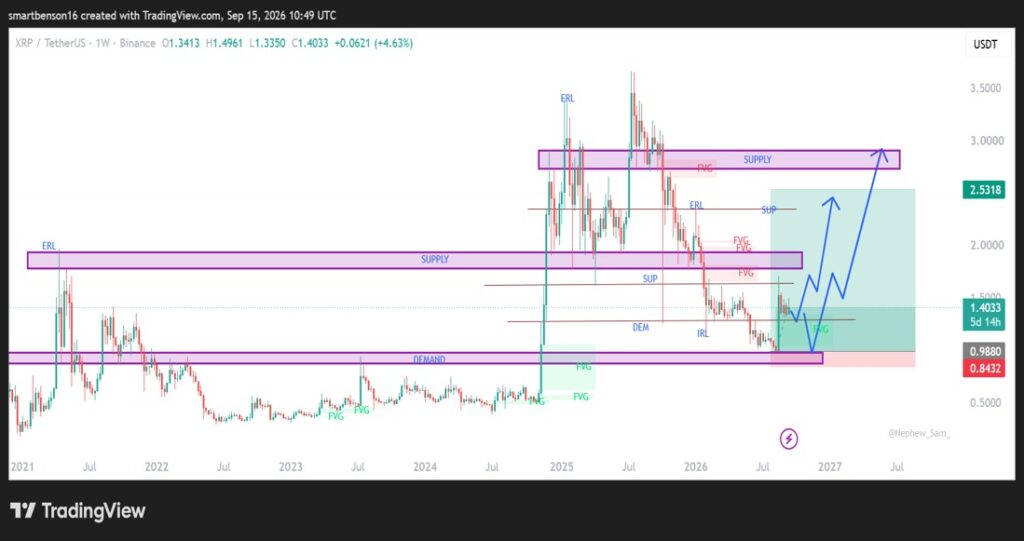
A look at the recent daily timeframe (TF) chart shows previous supply and demand zones that may be relevant to spot and futures traders. These levels are presented for technical analysis purposes only and should not be interpreted as guaranteed entry or exit points.
Market Cap: US$88.1billion
All-Time High: US$3.841
Community votes indicator: 84% bullish, 16% bearish
Key Price Levels
Support/Demand ($): 1.2967, 1.1327, 0.9800
Resistance/Supply ($): 1.6345, 1.9239, 2.3485, 2.9660…
Should XRP break above the supply level after rebounding at US$1.5380-1.6345, the next resistance target with higher highs is expected. However, if it breaks below the demand at $0.9800, it risks creating a lower low. 0.8500 is expected to act as a stop-loss until price reclaims $0.8500 and retests the first entry level.
Investor Note: This is a long-term investment if you can hodl; do not over-leverage. Investors may consider applying Dollar-Cost Averaging (DCA) as a risk management approach rather than attempting to time market movements.