Cardano (ADA) is a decentralized, open-source, proof-of-stake blockchain designed to support cryptocurrency transactions, smart contracts, decentralized applications (dApps), native tokens, and on-chain governance. Cardano is the blockchain/network, while ADA is its native cryptocurrency. Its development began in 2015, and the network went live in September 2017.
Its native cryptocurrency is ADA, named after Ada Lovelace, the 19th-century mathematician widely recognized as an early pioneer of computer programming. The Cardano name originates from Italian polymath Gerolamo Cardano. Jeremy Wood and Charles Hoskinson (one of Ethereum’s co-founders) founded the project through Input Output (IOHK/IOG), which was developed around a research-driven approach to blockchain engineering.
ADA contract address 0x3ee2200efb3400fabb9aacf31297cbdd1d435d47 refers specifically to the Binance-Peg Cardano Token (ADA), a BEP-20 representation on BNB Chain, rather than Cardano’s native ADA asset
As of the latest available data referenced in this update, the token has a market capitalization of US$9.71 billion, a total supply of 44.99 billion tokens, a maximum supply of 45 billion, and is ranked 14th on CoinMarketCap. Its circulating supply is approximately 36.78 billion ADA.
Cardano is a decentralized Layer-1 blockchain designed around research-driven development, security, scalability, and decentralized governance. ADA is the native cryptocurrency that powers the Cardano network. Unlike tokens that operate on another blockchain through smart contracts, ADA is built directly into the Cardano protocol. It is used for transaction fees, staking, network participation, and governance. Cardano’s key differentiators include its Ouroboros proof-of-stake consensus mechanism, extended UTXO (eUTXO) architecture, native-asset system, research-driven development, and increasingly decentralized on-chain governance.
One of Cardano’s major distinguishing features is its Ouroboros Proof-of-Stake consensus mechanism. Unlike Bitcoin’s Proof-of-Work (PoW), which requires miners to use significant computing power to secure the network, Cardano’s PoS system allows ADA holders to participate in network security through staking and delegation. Because block production is based on stake rather than computational mining, the system is designed to require substantially less energy than PoW.
Cardano also takes an unusual academic and research-oriented approach to blockchain development. Its core technologies have been developed from formal research and subjected to peer review before implementation.
The philosophy is essentially:
Research → Peer Review → Testing → Implementation → Continuous Improvement
The objective is to identify potential weaknesses before technologies are deployed at scale. This approach aims to improve the security, reliability, scalability, and long-term sustainability of the network.
Beyond the use of the token for transfers, ADA plays several roles within the Cardano ecosystem, including:
- Payments: ADA can be transferred between users and used as a cryptocurrency.
- Transaction fees: ADA is used to pay transaction fees on Cardano.
- Staking: ADA holders can delegate their stake to stake pools and participate in network security while potentially earning rewards.
- Governance: ADA ownership provides a mechanism for participating in Cardano’s governance system, directly or through delegation. Cardano’s current governance framework involves ADA holders, Delegated Representatives (DReps), Stake Pool Operators, and the Constitutional Committee.
- DeFi and dApps: Cardano supports smart contracts and decentralized applications, allowing developers to build financial applications, marketplaces, NFTs, and other blockchain-based applications.
- Ecosystem transactions: ADA also interacts with Cardano’s native-asset ecosystem and architecture, and can be held alongside other assets in Cardano transactions within its eUTXO model
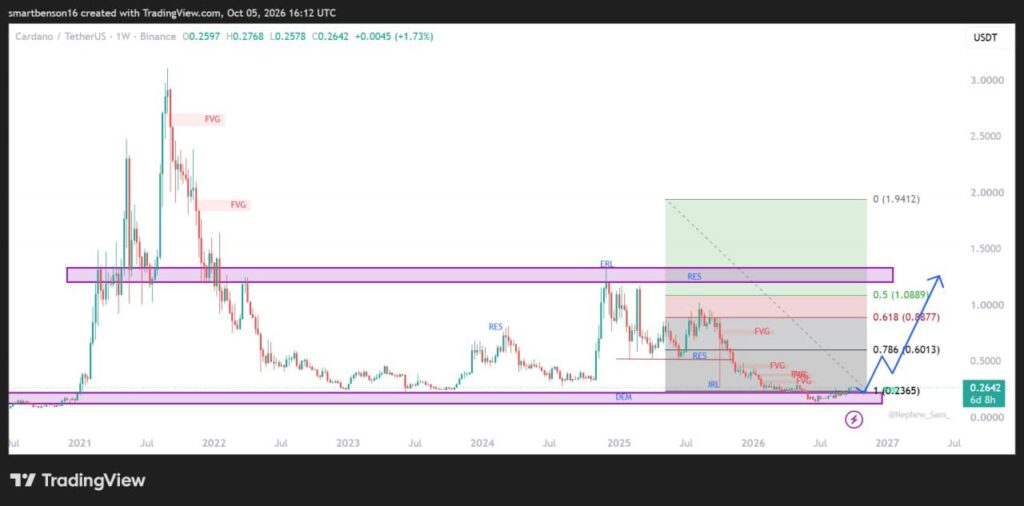
A look at the recent chart structure on the weekly TF, showing previous months and years supply and demand zones, providing potential reference points for spot and futures trading.
Market Cap: US$9.37billion
All-Time High: US$3.10
Total Supply: 44.99 billion ADA
Key Price Levels
Support/Demand: 0.2100, 0.1900
Resistance/Supply: 0.3400, 0.5100-0.6013, 0.8900, 1.0800…
Should ADA break above the supply level after rebounding at 0.3400, the next resistance target with higher highs is expected. However, if it breaks below the demand at 0.1900, it risks creating a lower low. Meanwhile, 0.1750 is expected to act as a stop-loss until price reclaims 0.1750 and retests the first entry level.
Investor Note: This is best viewed as a long-term investment for investors who are prepared to HODL, with high tolerance for crypto-market volatility, rather than investors seeking predictable short-term returns. Avoid excessive leverage, as it can significantly increase risk. Investors may also consider using Dollar-Cost Averaging (DCA) as a risk-management strategy, rather than trying to predict or time short-term market movements.