

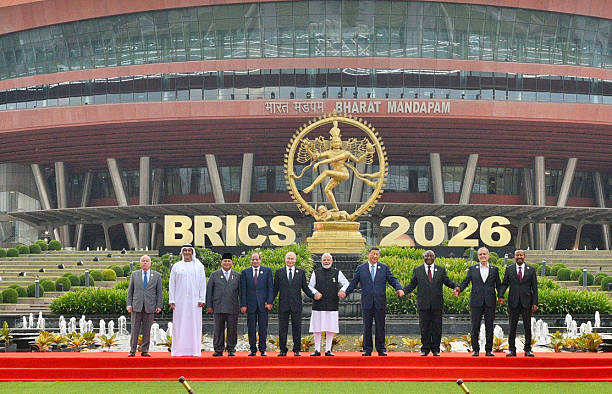
XVIII BRICS Summit | September 12 – 13, 2026
The XVIII BRICS Summit in New Delhi, held under the theme “Building for Resilience, Innovation, Cooperation and Sustainability,” marked two decades of BRICS and reinforced the bloc’s evolution from a political grouping into a broader platform for financial cooperation, trade resilience, development finance, technology and Global South representation.
The New Delhi Declaration advances cooperation on cross-border payments, local-currency settlements, development finance, food security, critical minerals, digital public infrastructure, artificial intelligence (AI) and climate resilience. Its significance is less about an immediate replacement of the existing global financial system and more about the gradual construction of alternative channels for trade, capital and economic cooperation among emerging economies.
For Africa and Nigeria, the opportunity is substantial, but access alone will not create value. The strategic priority is to build the productive capacity, bankable projects, financial infrastructure and institutional credibility required to convert BRICS-linked opportunities into investment, trade and industrial growth.
BRICS renewed its call for reform of the United Nations Security Council and Bretton Woods Institutions, seeking greater representation for Emerging Markets and Developing Economies (EMDEs), particularly Africa, Asia and Latin America.
The Declaration specifically recognised African aspirations under the Ezulwini Consensus and Sirte Declaration. It also highlighted the underrepresentation of developing countries in international institutions and called attention to the absence of a woman ever having served as UN Secretary-General.
The broader message is that BRICS is seeking greater influence over the institutions that shape global security, trade, finance and development policy. While BRICS pushes for greater representation, translating diplomatic advocacy into actual multilateral reform requires overcoming complex procedural and geopolitical hurdles
Africa needs a coordinated position on institutional reform rather than fragmented national advocacy. Nigeria can strengthen its role by combining diplomatic engagement with stronger economic credentials, regional leadership and sustained participation in multilateral institutions. This requires Nigeria to move beyond supporting reform in principle and actively contribute to developing common African positions on representation, development finance, trade governance and the restructuring of international financial institutions.
The Declaration advances work by the BRICS Payment Task Force on cross-border payment interoperability and encourages greater use of local currencies for trade and investment settlements. This does not establish a BRICS common currency or a completed alternative global payments system. Instead, it represents an incremental attempt to reduce payment friction, diversify settlement options and strengthen financial connectivity among emerging economies.
The New Development Bank (NDB) remains central to the bloc’s development-finance ambitions, with continued emphasis on infrastructure, sustainable development and local-currency financing. BRICS also advanced the Multilateral Guarantees (BMG) initiative, which could help mobilise private capital by reducing project and credit risks.
Nigeria/Africa strategic angle: Nigeria should monitor and participate where appropriate in emerging payment and settlement infrastructure while strengthening the domestic systems required to support cross-border trade. The greater opportunity may lie in combining local payment rails, development finance and private capital to finance infrastructure and productive-sector expansion.
BRICS advanced discussions around a BRICS Grain Exchange and supported cooperation through the BRICS AGRIN network, reflecting growing concern over food security, agricultural supply chains and commodity-price volatility.
The Declaration also reinforces cooperation around critical minerals, supply-chain resilience and industrial development.
For Africa, this is significant. The continent possesses substantial agricultural resources and critical minerals but often captures a relatively limited share of the value generated beyond the extraction or production stage.
Africa should use expanded market access to move from commodity supply to value-chain ownership through:
For Nigeria, this is particularly relevant to agriculture, energy, solid minerals and industrial manufacturing.
The Declaration addressed major geopolitical conflicts, including Gaza and Sudan, calling for ceasefires, humanitarian access and political solutions. It reiterated the principle of “African solutions to African problems” in relation to Sudan.
Beyond diplomacy, these conflicts have direct economic consequences through their effects on energy prices, shipping routes, insurance costs, commodity markets and global supply chains.
For investors and policymakers, geopolitical developments are therefore increasingly an integral component of market, trade and infrastructure-risk assessment.
BRICS is expanding cooperation around Digital Public Infrastructure (DPI), digital public goods and AI. Proposed DPI repositories and pilot initiatives could support digital transformation across developing economies.
The Declaration also promotes AI cooperation focused on accessibility, safety, inclusiveness, and the development needs of the Global South.
For Nigeria, the strategic opportunity is to build on existing digital infrastructure, including national identity and payment systems, to create more interoperable platforms for financial inclusion, public services, commerce and SME productivity.
On climate, BRICS reaffirmed Common but Differentiated Responsibilities and Respective Capabilities (CBDR-RC) and opposed unilateral trade measures such as Carbon Border Adjustment Mechanisms (CBAMs) that members argue could disadvantage developing economies.
The Declaration also welcomed the Tropical Forest Forever Facility, creating potential relevance for African countries seeking long-term climate and forest-finance mechanisms.
The New Delhi Declaration is not an overnight replacement for the existing global financial architecture. Its strategic importance lies in the gradual development of alternative payment channels, development-finance mechanisms, commodity platforms, technology partnerships and diplomatic coordination that could increase the economic bargaining power of emerging economies.
For Africa, the opportunity is therefore not simply to participate in BRICS-linked initiatives. It is to build the capacity to extract value from them.
For Nigeria, the agenda cuts across capital markets, infrastructure finance, energy, agriculture, digital payments, AI and commodity value chains. The decisive advantage will come from converting diplomatic access into bankable projects, productive investment, trade and domestic value creation.
The question is no longer simply whether the Global South is gaining influence. It is whether African economies are prepared to convert that influence into capital, industrial capacity and sustainable economic growth.





Subscribe now to keep reading and get access to the full archive.