September 2026, Edition 5
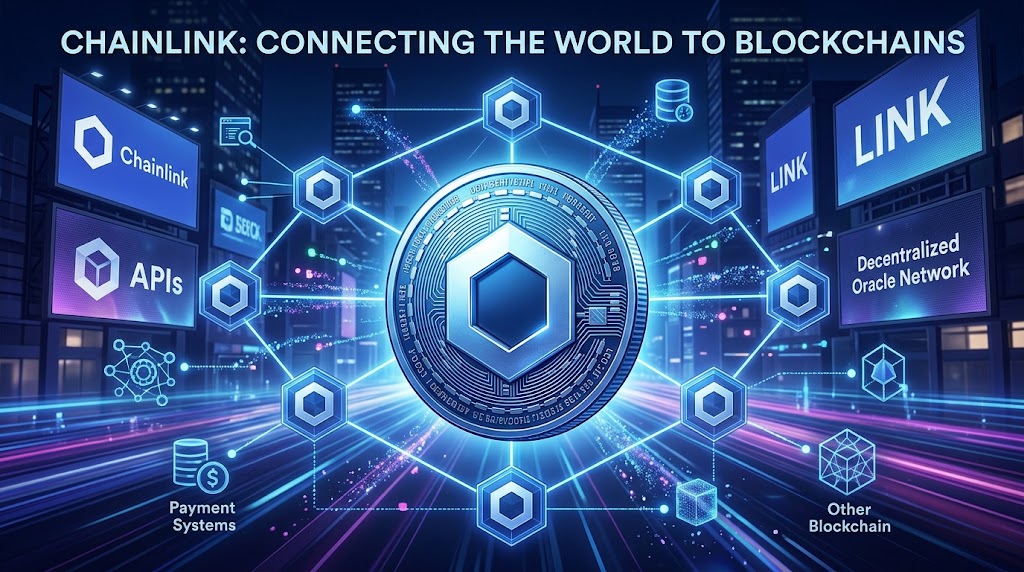
Chainlink (LINK) is a decentralized oracle and blockchain infrastructure network founded in 2017. Its core purpose is to enable smart contracts to securely access information, computation, and services that exist outside their own blockchain. Rather than operating as a conventional standalone blockchain, Chainlink provides infrastructure that connects blockchains with external data and with one another.
Link 🪙 was originally launched as an ERC-20 token on Ethereum (ETH). Its Ethereum Mainnet contract address is 0x514910771af9ca656af840dff83e8264ecf986ca. ETH remains central to important parts of Chainlink’s economic architecture, including staking and the Chainlink Reserve. However, Chainlink services operate across multiple blockchain ecosystems. Its Cross-Chain Interoperability Protocol (CCIP) technology, for example, supports cross-chain applications across networks including Ethereum, involving ecosystems such as EVM chains, Solana, Aptos, Sui, TON, Canton, and other supported ecosystems. Chainlink’s current CCIP documentation lists dozens of supported mainnet networks.
As of the latest available CoinMarketCap data referenced in this update, the token has approximately 904,000 holders, a market capitalization of US$10.7 billion, a total supply of 1 billion LINK, a circulating supply of nearly 748.09 million LINKs, and a market ranking of #12th. Market capitalization, ranking, and circulating supply are dynamic and should be treated as point-in-time data rather than fixed fundamentals.
What is the LINK token used for?
LINK is the native token of the Chainlink ecosystem and serves several important functions:
1. Payment for Chainlink services
Organizations and applications can pay for Chainlink services and infrastructure, including;
Data Feeds, Data Streams, CCIP, Automation, Verifiable Random Function (VRF), Functions, Other Chainlink infrastructure.
Through Payment Abstraction, users can pay for certain Chainlink services using supported assets, including stablecoins and other digital assets, with payments programmatically converted into LINK. This mechanism reduces payment friction while strengthening the economic connection between Chainlink service usage and LINK.
2. Network security
LINK is also connected to Chainlink’s staking system.
Participants can stake LINK to help provide cryptoeconomic security for certain supported Chainlink services and earn rewards for helping secure oracle networks. Chainlink states that staked LINK may be subject to slashing when predefined performance requirements are not met.
3. Node-operator rewards
Chainlink node operators provide data, computation, and other services to the network. LINK forms part of the economic mechanism through which service providers can be compensated and incentivized to maintain reliable infrastructure.
4. Chainlink Reserve
This is one of the most important developments in the LINK economic thesis.
In August 2025, Chainlink introduced the Chainlink Reserve, an on-chain reserve designed to accumulate LINK using revenue generated from Chainlink’s services. Through Payment Abstraction, eligible offchain enterprise revenue and onchain service revenue can be converted into LINK and deposited into the Reserve.
This creates a potentially important economic connection: More Chainlink usage → more service revenue → more revenue converted into LINK → potential growth of the Chainlink Reserve.
However, this mechanism should not be interpreted as a guaranteed increase in LINK’s market price. The Reserve creates a potential source of structural LINK demand, but price ultimately remains dependent on market conditions, token supply, adoption, liquidity, investor expectations, and broader crypto-market dynamics.
KEY - NOTES
Important risks before buying LINK: a credible investment analysis must also examine the downside.
Competition
Chainlink operates in a competitive market alongside other oracle, data, and interoperability protocols. Its continued adoption depends on maintaining technological relevance, security, and network effects.
Token economics
Growth in Chainlink usage does not automatically mean LINK price increases. Investors need to examine how service revenue, LINK conversion, staking, reserve accumulation, token demand, circulating supply, and market demand interact.
Institutional adoption risk
Enterprise partnerships, pilots, and integrations do not necessarily translate into large-scale production usage or recurring revenue. The commercial significance of adoption therefore needs to be assessed beyond announcements.
Crypto market risk
LINK remains a crypto asset and can experience substantial price volatility regardless of underlying technological adoption of network activity.
Valuation
A strong infrastructure project can still represent an unattractive entry point if market expectations are already reflected in the token’s valuation.
Centralization/governance considerations
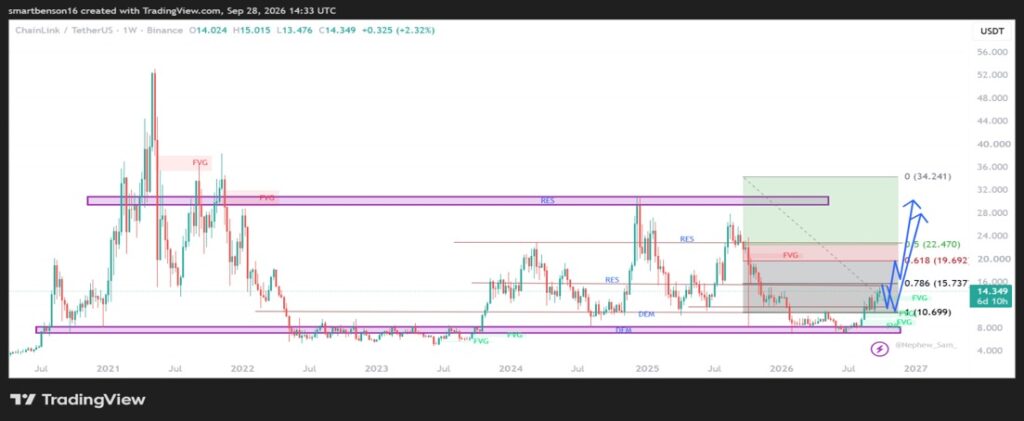
Although Chainlink uses decentralized oracle networks, investors should continue to examine node architecture, staking design, governance mechanisms, data-provider relationships, network concentration, and the distribution of economic incentives. A look at the recent chart structure on the weekly TF, showing previous months and years supply and demand zone entries on spot and futures trading.
Market Cap: US$10.7b
All-Time High: US $52.88
Total Supply: 1billion LINK
Key Price Levels
Support/Demand: 11.800, 10.700
Resistance/Supply: 15.400, 19.100, 22.841, 27.900…
Should Link break above the supply level after rebounding at 15.400, the next resistance target with higher highs is expected. However, if it breaks below the demand at 10.700, it risks creating a lower low. US$8.850 is expected to act as a stop-loss until price reclaims 8.850 and retests the first entry level.
Investor Note: LINK represents a long-term infrastructure thesis rather than simply a short-term price trade. This is a long-term investment if you can hodl; do not over-leverage. Investors may consider applying Dollar-Cost Averaging (DCA) as a risk management approach rather than attempting to time market movements.
Ultimately, the central question is not simply “Can LINK go higher?” but rather: Can Chainlink’s growing infrastructure footprint translate into durable economic demand for LINK?
That distinction is critical when evaluating the token beyond the chart.