


November 2026, Edition 1
Financial markets closed the week amid significant global developments, including global central-bank decisions, political shifts, reports of the European Central Bank (ECB) president’s resignation, and mixed global equity performance. Locally, primary market auctions delivered divergent rate signals, with the later money-market auction providing a modest correction to the repricing triggered by the earlier sale. Despite abundant system liquidity of over ₦7.00 trillion, the Central Bank of Nigeria (CBN) and Debt Management Organisation (DMO) maintained selective sterilisation, limiting allotments across primary market auctions. The Naira appreciated ₦21.35 WtD, alongside marginal reserve accretion and record Q2 diaspora remittances. Equities extended their rally, with the NGX All-Share Index (ASI) reaching a record 254,299.29 points, as strong nine-month performance results sustained buying interest. The Federal Government’s pursuit of approval for additional external borrowing kept debt financing in focus. Overall, the week reflected improving domestic market sentiment and continued uncertainty over global policy, funding conditions and the sustainability of asset valuations. In commodities, prices closed higher Week-on-Week (WoW) at $104.12/bbl. (+0.82%) and $113.43/bbl. (-2.82%) for West Texas Intermediate (WTI) and Brent crude, respectively, while gold was at $3,875.84/oz (-2.96%).
System liquidity rose 0.89% WtD, from ₦7.31 trillion to a peak of ₦9.35 trillion on Tuesday, before closing at ₦7.37 trillion. Liquidity built up on ₦2.13 trillion in OMO maturities, ₦329.79 billion in NTB maturities, and ₦392.11 billion in coupon payments, partly offset by about ₦316.09 billion in OMO and NTB sales. Money market rates eased modestly, with the Open Repo Rate (OPR) and Overnight (O/N) rate closing at 20.00% (0bps) and 20.38% (+2bps), respectively. In the Foreign Exchange (FX) market, the Naira traded within a range of $/₦1,342.00 and $/₦1,380.00, before closing at $/₦1,346.26 on Friday.
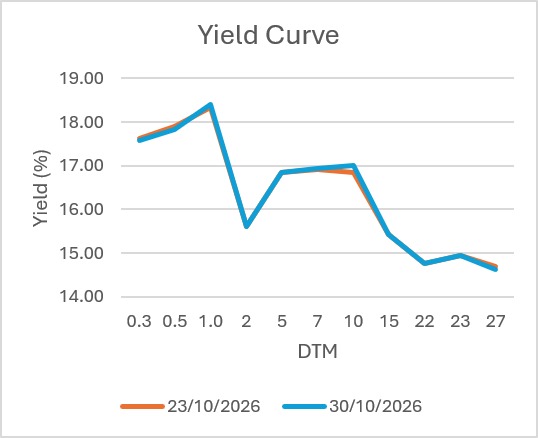
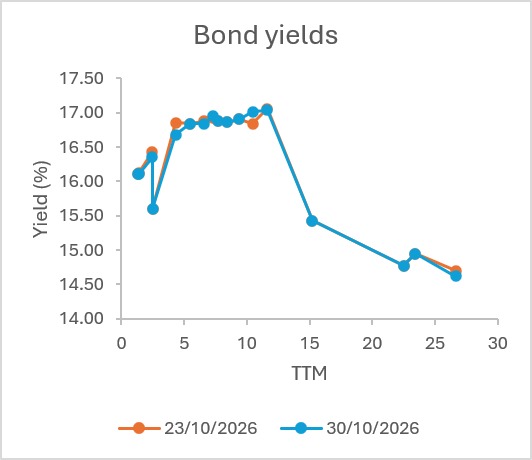
The fixed-income secondary market sustained a bearish-to-range-bound bias during the week, following the NTB and OMO auction result release reflecting shifting liquidity conditions, and cautious investor repricing with selling pressure concentrated in mid-to-long-dated FGN bonds, particularly the 2033–2038 maturities, as offers initially climbed towards 17.05% before moderating to 16.95%–17.00% by Friday. The late-week recovery in selected bonds, particularly the 2036 and 2038 maturities, suggests selective demand emerging at more attractive entry levels rather than a broad market reversal. The OMO and NTB instruments also traded at high yields, with short-dated OMO offers including the 24-Nov.-26 bill reaching 19.15%, while the long-day bill, particularly the 09-Sept.-27 bill was at 15.85%, reflecting investors’ continued preference for attractive yield and liquidity-sensitive positioning. Overall, the market remained supply- and yield-sensitive, with selective preference towards the close, offering some price support, although elevated yield expectations continued to constrain a sustained bullish repricing.
NTB Issuance: The October 28, 2026 auction showed a mixed and highly selective demand, with total subscriptions of ₦1.91 trillion against ₦800 billion offered. The performance translated to bid-to-cover ratios of 2.31x, 1.94x, and 47.85x for the 91-, 182-, and 364-day bills, respectively, while allotment ratios came in at 0.43x, 0.52x, and 0.02x. At ₦71.16 billion, total sales marked the lowest in 2026, driven by selective allotment despite demand being heavily skewed toward the 364-day bill, which was oversubscribed by over 3.6x, compared to weaker interest in the 91- and 182-day bills at 0.52x and 0.20x of the offer, respectively. Stop rates eased across the curve to 15.40% (-10bps), 15.79% (-1bp), and 15.80% (-10bps) for the 91-, 182-, and 364-day bills, respectively, signalling a mild bullish repricing for the secondary market, though not sufficient to trigger an aggressive rally. Overall, the auction highlights the issuer’s continued selective allotment strategy, maintaining its rate threshold amid strong demand at the long end.
AUCTION DATE | 28-10-2026 | 28-10-2026 | 28-10-2026 |
MATURITY DATE | 28-01-2027 | 29-04-2027 | 28-10-2027 |
TENOR | 91-DAY | 182-DAY | 364-DAY |
OFFER (₦) | 100,000,000,000 | 100,000,000,000 | 600,000,000,000 |
SUBSCRIPTION (₦) | 51,556,394,000 | 20,268,623,000 | 1,836,141,540,000 |
ALLOTMENT (₦) | 22,331,664,000 | 10,447,786,000 | 38,376,759,000 |
BID RANGE (%) | 14.9000 – 19.0000 | 15.3000 – 16.6500 | 15.0000 – 18.2400 |
STOP RATES (%) | 15.4000 | 15.7900 | 15.8000 |
PREVIOUS STOP RATES (%) | 15.5000 | 15.8000 | 15.9000 |
Money Market Issuance: The 29 October 2026 OMO auction outcome was a clear demonstration of the CBN’s preference for selective liquidity sterilisation rather than full absorption, with important implications for the secondary market. Against a combined 50% reduction in total offer at ₦1.00 trillion, demand peaked at ₦2.28 trillion in bids, yet allotment was just 24.5% of the offered volume and approximately 10.7% of total bids, leaving about ₦2.03 trillion of bids unallotted. Individually, the 124-day instrument attracted 1.78x but received only 0.05x sale, while the 138-day paper drew 2.78x and was allotted 0.15x; importantly, the stop rate of 17.69% on the 124-day bill was 6bps above the 17.63% on the 138-day (unchanged from the previous auction). In a surplus system carrying roughly ₦7.80 trillion, the outcome suggests that the CBN was not willing to absorb liquidity indiscriminately at prevailing bid levels, effectively forcing investors to compete for other opportunities. In the secondary market, this creates a complex rather than outright bullish signal: the large unabsorbed liquidity should support demand for NTBs and other short-duration assets, but the CBN’s firm stop rates establish a yield floor and indicate that the issuer may ease short-end rates. Consequently, secondary-market yields may face near-term downward pressure from excess cash seeking deployment, but the scope for a sustained rally is limited unless liquidity remains abundant and subsequent auctions continue to clear at lower rates.
AUCTION DATE | TENOR | OFFER (₦‘ B) | BIDS (₦‘ B) | TOTAL SALE (₦‘ B) | STOP RATES (%) | PREVIOUS TENOR RANGE STOP RATES (%) |
29-10-2026 | 124-DAY | 500.00 | 888.31 | 42.22 | 17.6900 | 00.0000 |
138-DAY | 500.00 | 1,389.80 | 202.71 | 17.6300 | 17.6300 |
The Naira strengthened in the Nigerian Foreign Exchange Market (NFEM), appreciating by ₦21.35 (-1.56%) WtD, and ₦15.58 (-1.14%) WoW, closing at $/₦1,346.26, compared with $/₦1,361.84 the previous week. Foreign reserves rose by 0.14% to $55.24 billion as of October 29, 2026, from $55.16 billion, after reaching an intra-week peak of $55.26 billion. While, blocked funds declined 0.20% to $509.88 million from $510.92 million, reducing the blocked-reserve ratio by 1bp to 0.92%. The movements point to a modest improvement in external liquidity and FX conditions, despite persistent external pressures.
According to the CBN’s Q2 2026 Statistical Bulletin, diaspora remittance inflows through International Money Transfer Operators (IMTOs) surged by 33% year-on-year to a record $1.57 billion in Q2 2026, surpassing the previous quarterly peak of $1.47 billion recorded in Q3 2024. The increase was driven by May and June receipts, which rose to $472.13 million and $580.16 million, respectively, from $288.17 million and $292.25 million a year earlier, more than offsetting April’s decline to $513.81 million. The performance extends the first-quarter momentum, when inflows grew by 45% year-on-year to $1.29 billion. This comes on the back of CBN reforms, including the removal of IMTO exchange-rate caps in January 2024 and the March 2026 requirement for operators to maintain Naira settlement accounts with authorised dealer banks, providing relevant regulatory context for improved formal-channel participation, although the data do not establish how much these measures contributed to the surge. The key macroeconomic implication is stronger potential foreign-exchange supply and support for external-sector liquidity; however, the actual impact on Naira stability depends on conversion, settlement, and the extent to which these inflows reach the formal FX market.
Across the African continent, African markets continue to grapple with reserve resilience, energy security, inflation and capital flows: Mozambique plans to increase domestic gold purchases to strengthen foreign reserves, while Tanzania’s 223bcf Mnazi Bay gas discovery could support future energy supply and industrial activity. Namibia raised its policy rate 25bps to 7% as higher fuel prices pushed inflation to 5.4%, while Uganda’s shilling weakness is placing additional pressure on already constrained reserves. Nigeria’s Dangote Refinery Initial Public Offering (IPO) reportedly attracted ₦6.40 trillion in orders against a ₦2.15 trillion target, signalling strong investor demand. Elsewhere, Morocco climbed to 4th place, moving South Africa down to 5th in the Rand Merchant Bank’s (RMB) ‘Where to Invest in Africa’ report released on October 27, 2026. Morocco moved ahead of South Africa in RMB’s investment-attractiveness ranking, and South Africa’s rebased GDP was revised 4.9% higher, reflecting improved economic measurement rather than equivalent real growth.
The Nigerian Exchange (NGX) equities market experienced a historic, record-shattering week, with the ASI surging to an unprecedented all-time peak of 254,083.02 points on Thursday to lift total market capitalization to a milestone ₦164.97 trillion. The market’s weekly traction was defined by a powerful breakout on Monday (+1.65% to 251,290.54 points) and an acceleration on Tuesday (+1.07% to 253,990.06 points) driven by a max-limit rally in Dangote Cement and an explosive 4.87 billion share cross-deal in FBN Holdings. Despite a sharp midweek correction on Wednesday, where aggressive profit-taking dragged the index down 0.44% to 252,882.78 points, investors fiercely bought the dip on Thursday, staging a 0.47% single-day rebound that completely erased the previous day’s decline on the back of a flood of positive Q3 2026 corporate earnings. The rally culminated on Friday, closing at 254,299.49 points, extending the broader weekly uptrend to 55 decliners against 35 gainers, WtD at +1.20%, WoW at +2.86%, and YtD at +63.42% from +58.87%. Sectoral performance indices WoW were Industrial (+14.58%), Oil & Gas (+0.82%), Banking (-3.42%), Insurance (-2.13%), and Consumer Goods (-0.02%).
9M 2026 Earnings: Nigeria’s 9M 2026 corporate earnings reveal a divergent profitability landscape in which non-interest income, commodity pricing, operating efficiency, and investment returns are increasingly determining earnings outcomes. Seplat Energy Plc led the cohort, with profit before tax (PBT) up by 52.75% to ₦1.34 trillion, supported by a 34% increase in realised crude prices, 7% higher working-interest production, stronger gas and natural gas liquids (NGL) contributions, and a 26.88% reduction in finance costs, despite lower crude/condensate lifting volumes and higher production costs. Zichis Agro-Allied Industries Plc’s (ZAAI) delivered 179.21% PBT growth to ₦561.32 million as revenue surged by 162.63%, with growth across eggs, feed, palm oil, chicken and fish and a significant improvement in gross margin. MeCure Industries Plc’s PBT rose by 35.71% to ₦8.64 billion on 17.05% revenue growth and a 50.87% reduction in marketing expenses, while VFD Group Plc’s PBT climbed by 91.86% to ₦15.34 billion, largely reflecting a 52.58% increase in investment and similar income, lower investment expenses and reduced impairments. Stanbic IBTC Holdings Plc’s PBT rose 35.05% to ₦531.88 billion despite a 14.93% decline in net interest income, as trading revenue surged more than sevenfold, fee income strengthened, and impairment charges fell 95.64%. NEM Insurance Plc’s recorded 30.54% PBT growth to ₦31.02 billion, supported by improved insurance service results and investment gains, although higher reinsurance costs, FX losses and negative operating cash flow remain watchpoints. In contrast, Guaranty Trust Holding Company Plc’s PBT fell 2.32% to ₦879.90 billion as interest expense rose 27.73%, while Ecobank Transnational Incorporated’s PBT slipped marginally 0.41% to ₦1.01 trillion despite lower funding costs, reflecting weaker interest and non-interest income. Afreximbank was stronger on core banking fundamentals, with net income rising 24.33% to $813.46 million as loan growth lifted interest income and net interest income, while cost-to-income improved to 20%. Guinness Nigeria’s profit after tax (PAT) rose 53.1% to ₦40.69 billion, driven by a 20.4% increase in revenue to ₦403.33 billion, stronger domestic sales accounting for approximately 98% of turnover, 23.4% growth in operating profit, and a 61.9% reduction in finance expenses to ₦5.83 billion, as lower borrowing costs amplified earnings growth despite rising operating expenses. The broader investment takeaway is that 2026 earnings strength is not uniformly reflecting stronger underlying volumes: commodity pricing and production drove Seplat Energy, investment/trading income powered VFD and Stanbic, while efficiency and lower credit costs amplified earnings elsewhere; conversely, GTCO and Ecobank demonstrate how elevated funding costs and softer lending/interest income can constrain banks even when headline revenues remain resilient.
Global financial markets navigated a dense mix of monetary-policy decisions, inflation data, fiscal announcements, corporate earnings and geopolitical risks. The Federal Reserve held its federal funds target range at 3.75%–4.00% in a 10–2 vote, with two dissenting members favouring a hike, as the September 2026 Personal Consumption Expenditures (PCE) Price Index report showed inflation accelerated to 3.6% YoY (+0.5% MoM) and core PCE to 3.1% YoY (+0.3% MoM), reinforcing concerns that inflation remains above target. The data also showed consumer spending rising 0.5% while real disposable income fell 0.3%, alongside stronger-than-expected Q3 GDP growth of 3.4%, supporting expectations that monetary policy could remain restrictive in addition to a possible hike in December. US Treasury yields consequently remained elevated, with the 10-year yield around 5%. The European Central Bank (ECB) held its policy rate at 2.50% and the Bank of Japan (BoJ) at 1.25%, while the Bank of Canada (BoC) raised its overnight rate by 25bps to 2.50%, marking its first increase since July 2023, amid persistent inflation concerns. In the UK, Chancellor Rachel Reeves’ Autumn Budget combined targeted spending support with continued fiscal drag and projected £250.6 billion of gilt sales for 2026/27; markets responded relatively calmly, with sterling and gilt yields broadly stable as investors balanced higher near-term inflation projections against limited fiscal headroom. Global equities were pulled between strong Q3 Big Tech earnings and rising energy prices, while renewed US-Iran tensions and risks around oil supply added another layer of volatility. Overall, the week reinforced a market environment where resilient economic activity collided with persistent inflation and elevated geopolitical risk, limiting the scope for rapid monetary easing, keeping yields, currencies, and risk assets highly sensitive to incoming macroeconomic data and policy signals. Equities closed mixed WoW: the Nasdaq Composite at 25,437.00 (-1.99%), the S&P 500 at 7,580.07 (-0.57%), and the Dow Jones Industrial Average at 51,770.31 (-0.85%). Across Europe, Germany’s DAX 40 was at 25,818.21 (+2.53%), while the FTSE 100 was at 10,729.78 (+0.37%), and the Stoxx 600 at 646.75 (+1.73%). Asian markets were mixed, with Japan’s Nikkei 225 at 63,290.11 (+0.95%), China’s Shanghai Composite Index at 3,599.02 (-3.07%), Hong Kong’s Hang Seng Index at 23,294.42 (-0.87%), and South Korea’s KOSPI at 5,730.74 (+3.25%).
Commodities closed the week with oil and gold responding to competing geopolitical and monetary signals: WTI traded within $99.90/bbl.–$103.66/bbl., while Brent ranged between $113.72/bbl.–$116.94/bbl., with prices initially retreating on renewed US–Iran diplomatic efforts and recovering later as renewed military-escalation risks and threats to Strait of Hormuz shipping outweighed hopes of de-escalation; by Friday, WTI and Brent had risen to $104.12/bbl. and $113.43/bbl., respectively, leaving WTI up more than 10% in October. Gold, traded between $3,980.93/oz–$4,058.92/oz, ultimately slipping to $3,875.84/oz pressured by resilient US growth, accelerating PCE inflation, and expectations of a possible December Fed hike, despite geopolitical uncertainty that traditionally supports safe-haven demand.
November 2026 is poised for macroeconomic updates globally and locally with the Nigeria fixed-income expected to receive inflows totally over ₦10.60 trillion and $105.76 million in OMO and NTB maturities, in addition to FGN, Sukuk and Eurobond coupon payments. While the new week is poised to be exciting, with the scheduled U.S. Mid-term election, its outcome is an important political factor for market direction. Anticipated liquidity inflows for the new week are over ₦2.59 trillion, comprising ₦2.02 trillion and ₦572.55 billion from OMO and NTB maturities. We expect market-correcting events to determine the near-term yield direction amid a surplus liquidity system.
Expected dividend payouts include Stanbic IBTC Holdings at ₦4.50 per share on November 13 and Seplat Energy at a combined $0.19 per share on November 27, 2026.
By: Sandra A. Aghaizu
Trillions return as liquidity flows, While bond yields shift as the market grows. Election winds may alter the tide, As cautious investors watch each side.
Dividends reward those who patiently stay, While capital seeks its next pathway. For markets, like oceans, ebb and flow, And confidence determines where they go.



Subscribe now to keep reading and get access to the full archive.