Hyperliquid (HYPE) is the native token of Hyperliquid, a high-performance Layer-1 blockchain built around decentralized financial markets. Hype launched its mainnet in 2023 but was distributed through a genesis airdrop in November 2024 for early users.
Hype 🪙 is the native asset of the Hyperliquid blockchain whose contract is 0x0d01dc56dcaaca66ad901c959b4011ec.
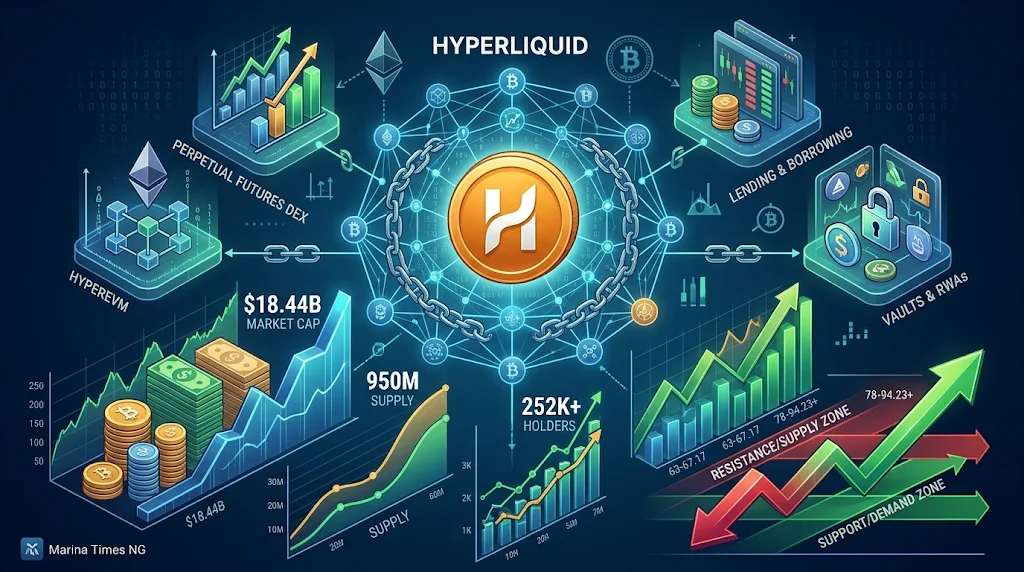
As of the latest available data referenced in this update, the token has approximately 252,000 holders, a market capitalization of US$18.44 billion, a total supply of 950 million tokens, and is ranked 10th on CoinMarketCap.
Hyperliquid became particularly well known for its perpetual futures DEX, allowing users to trade leveraged crypto positions on-chain. The ecosystem has expanded beyond perpetuals into spot trading, lending/borrowing, vaults, tokenized assets/RWAs and HyperEVM, which allows Ethereum-compatible applications to be built within the ecosystem.
The key idea behind Hyperliquid is to bring the speed and user experience of centralized exchanges (CEXs) closer to DeFi while maintaining the transparency and self-custody characteristics of a blockchain.
What Makes Hyperliquid Unique?
- High-performance on-chain trading: Hyperliquid is designed to deliver fast, efficient trading with an experience closer to centralized exchanges while remaining on-chain.
- Perpetual futures: Its flagship DEX supports on-chain perpetual futures, giving traders access to one of crypto’s largest trading markets transparently.
- HyperEVM: Its Ethereum-compatible environment allows developers to build DeFi applications and other blockchain projects.
- Growing DeFi ecosystem: Hyperliquid supports perpetuals, spot trading, lending, borrowing, vaults, RWAs and other DeFi applications.
- 1 billion maximum supply: HYPE has a capped maximum supply of 1 billion tokens, giving investors a clear framework for evaluating supply and future dilution.
Why investors may be interested in HYPE
The investment thesis around HYPE is largely connected to Hyperliquid’s growing role in decentralized financial markets.
If on-chain trading continues to gain market share from traditional centralized exchanges, a blockchain specifically optimized for trading could benefit from that trend.
The potential investment thesis can therefore be summarized as:
Trading → Users → Liquidity → Applications → Network activity → Ecosystem demand
If Hyperliquid continues attracting traders, developers and liquidity, the broader ecosystem could become increasingly important within DeFi.
In simple terms: Hyperliquid stands out by combining high-performance decentralized trading, a growing DeFi ecosystem, and its own Layer-1 blockchain, with HYPE serving as the native token of the network.
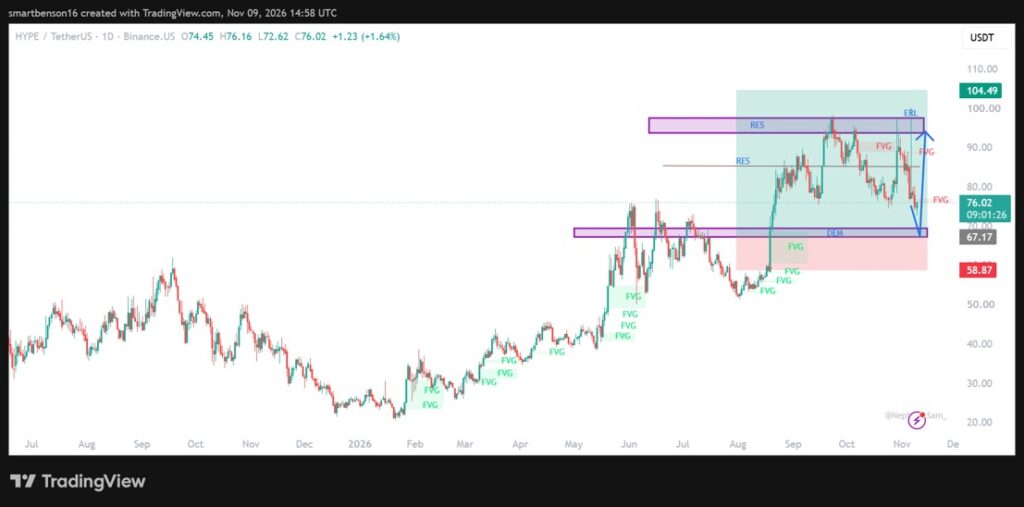
A look at the recent chart structure on the daily TF, showing previous months and years supply and demand zones entries on spot and futures trading.
Market Cap: US$18.44b
All Time High: 97.7
Total Supply 950m
Key Price Levels
Support/Demand; 67.17, 63
Resistance/Supply; 78, 84.60, 94.23….
Should Hype break above the supply level after rebounding at 78, the next resistance target with higher highs is expected. However, if it breaks below the demand at 63, it risks creating a lower low. 58 is expected to act as a stop-loss until price reclaims 63 and retests the first entry level.
Investor Note: Do not over leverage, Investors may consider applying Dollar-Cost Averaging (DCA) as a risk management approach rather than attempting to time market movements.