


Global financial markets navigated a transitional and policy-driven landscape during the review period, as domestic and global forces converged to shape cautious, yield-sensitive investor behaviour. The period witnessed the continued impact of the oil price volatility as well as macroeconomic updates. In Nigeria, the fixed income market traded within a narrow band, reflecting indecision amid shifting liquidity and rate expectations, while a mild bullish correction in Eurobonds signalled selective risk re-engagement rather than conviction. The backdrop was reinforced by a cooling headline inflation at 15.06%, though persistent short-term price pressures and regional disparities continue to cloud the disinflation narrative. Concurrently, proactive debt management strategies, resilient FX performance, and evolving market reforms, such as the transition to T+1 settlement, underline a system gradually repositioning to optimize efficiency and liquidity. However, elevated global yields, hawkish central bank posturing, and geopolitical uncertainties continued to anchor risk sentiment, leaving markets in a state of cautious equilibrium where opportunity existed but conviction remains measured. Globally, equities struggled on geopolitical tensions and macroeconomic data while commodities extended gains. Oil closed with Brent crude and West Texas Intermediate (WTI) at $112.06/bbl., and $97.70/bbl., with gold at $4,570/oz.
Interbank liquidity opened the week at a ₦6.78trn surplus, closed at a peak at ₦8.20trn mid-week, marking a week-to-date increase of 21.5%. Money market rates were relatively stable, with the Open Repo Rate (OPR) open and steady at 22.00%, while the Overnight rate (O/N) opened at 22.28% before closing at 22.21%. At the currency market, Naira traded between $/₦1,340.00 and $/₦1,365.35, closing at $/₦1,353.90 on Friday.
The secondary market traded flat through the short week, with yields within the 15.90%-16.30% range, most pronounced in the 2027–2035 maturities. In the money market, sentiment remained bearish, with demand across the curve and a selective preference for long-day bills. OMO instruments traded within the 19%–20% band, while NTBs maintained the mid-16% range, indicating a shift in investors’ appetite and uncertainty of the next trend regarding the effect of the global oil market volatility, thereby leading to trading in circles.
For the period March 13–17, 2026, Nigeria’s Eurobond market recorded a mild bullish correction, with yields easing modestly across the curve. The long end (2046–2051) declined from ~8.48% to ~8.39%, while mid-tenors (2029–2034) compressed slightly toward the 6.0%–7.6% range, reflecting selective bargain hunting. However, the move lacked strong momentum, indicating cautious positioning rather than a trend reversal, as yields continue to price in persistent external risks, including oil price volatility, U.S. yields, Nigeria’s macro outlook, and underlying sovereign risk premiums.
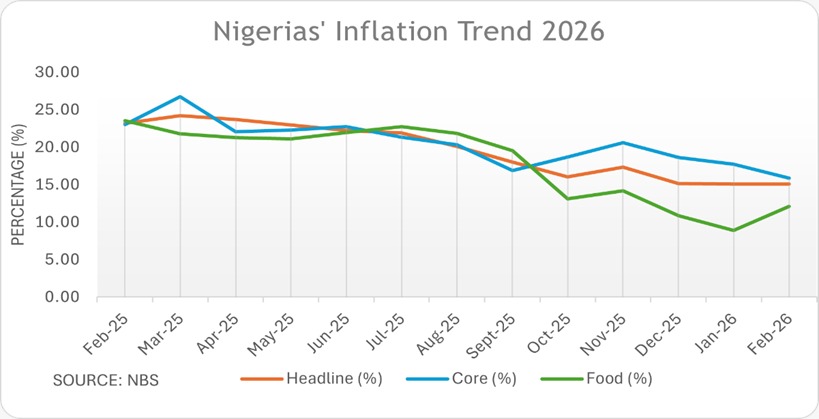
According to the National Bureau of Statistics (NBS), Nigeria’s inflation report for February 2026 revealed a “deceleration narrative” and the Consumer Price Index (CPI) which increased by 2.04% month on month (MoM) to 130 points, with the headline rate declining to 15.06%, down significantly from 26.27% year on year (YoY) and MoM by 0.04%, signifying that the aggressive monetary policy is successfully curbing long-term price growth. This cooling was further validated by a sharp decline in Core Inflation to 15.88% (from 25.66% in February 2025 and -10.38% MoM) and approx. 48% reduction in annual Food Inflation, which now stands at 12.12% (+36.33% MoM). Yet, the immediate concern lies in the monthly volatility, as a 2.01% headline rise and a substantial 4.69% monthly surge in food prices, driven by staples like beans, yams, and cassava; indicate that localized supply shocks are challenging the disinflationary trend. Notably, the urban-rural divergence highlights a widening gap, with urban inflation at 15.53% vs. rural at 13.93% indicative of persistent logistical and energy costs impacting city centers more severely than production hubs. The state-level disparity showed extreme variance between Kogi (23.57%) and Katsina (7.78%), suggesting that sub-national bottlenecks, security, and internal trade barriers remain the primary “unsolved” variables in the inflation equation.
The transition to a T+1 settlement cycle effective May 29, 2026 by the Central Securities Clearing System (CSCS), which is the securities depository and settlement arm of the Nigerian Exchange Group (NGX), marks a transformative leap in market swiftness, effectively halving the gap between trade execution and capital availability to enhance liquidity, aligning the Nigerian Exchange with global best practices. By shortening this window, the reform drastically reduces counterparty and systemic risks while demanding a higher standard of operational automation from brokers and custodians to manage the 24-hour turnaround. Thereby serving as a bridge toward eventual T+0 settlement, further positioning the NGX as a highly competitive, transparent, and modern destination for both domestic and international institutional capital. For investors, this shift acts as a liquidity catalyst, enabling faster capital recycling and potentially lowering the risk premium on equities, though market participants must prepare for a significant “double settlement” liquidity crunch on Monday, June 1, 2026, as the old T+2 and new T+1 cycles converge.
The Nigerian Treasury Bills (NTB) auction has always reflected strong investor demand, with a skewed favourite for the 1-year bill. The March 18, 2026, auction was no different, mirroring the previous auction with adequate demand for 91-day instruments, while the 182-day declined. The 364-day instrument attracted higher demand, receiving 5.33x its offer price, reflecting investors’ preference; although allotment remained conservative, signalling the DMO’s intent to manage borrowing costs. Across the board, the Bid-to-Cover ratio (BCR) was 1.00x, 1.39x, and 5.33x, respectively. The cleared rate was steady for the short-day while the mid- and long-day compressed mildly at 16.62 (-3bps) and 16.63% (-9bps). An indication of mild bullish bias on yields and a gradual expectation of a decline in rates. Notably, the yield curve is maintained at a normal positive.
AUCTION DATE | 18-03-2026 | 18-03-2026 | 18-03-2026 |
MATURITY DATE | 18-06-2026 | 17-09-2026 | 18-03-2027 |
TENOR | 91-DAY | 182-DAY | 364-DAY |
OFFER (₦) | 100,000,000,000 | 150,000,000,000 | 800,000,000,000 |
SUBSCRIPTION (₦) | 102,188,641,000 | 66,989,080,000 | 2,893,473,943,000 |
ALLOTMENT (₦) | 101,288,640,000 | 47,938,079,000 | 542,638,100,000 |
BID RANGE (%) | 15.0000 – 16.9500 | 15.0000 – 19.0000 | 15.5000 – 21.0000 |
STOP RATES (%) | 15.9500 | 16.6200 | 16.6300 |
PREVIOUS STOP RATES (%) | 15.9500 | 16.6500 | 16.7200 |
The Debt Management Office (DMO) is executing a tactical “play” for the March 2026 FGN Bond auction by maintaining the 3-paper issuance strategy and reducing the total offer to ₦750 billion (down by ₦50 billion from February). The move into reopened 5-, 7-, and 10-year tenors, specifically the 17.945% AUG 2030, 17.95% JUN 2032, and 19.89% MAY 2033, appeared deliberate to flatten the yield curve and capitalize on the current “hunt for duration” triggered by a cooling inflation print of 15.06%. Despite the combined lower offer volume, it remains substantial enough to drive significant bidding competition. Coupled with an additional NTB Dutch Auction with a total offer of ₦400 billion across the 91-, 182-, and 364-day bills with a split ratio of 1:1:2, summing the total March 2026 NTB auction offer at ₦3.35trn.
The Naira rebounded with a gain of 0.28% to ₦3.87 week to date, trading at $/₦1,357.77 and $/₦1,353.90 in the Nigerian Foreign Exchange Market (NFEM), and ₦12.33 (+0.90%) week-on-week, closing at ₦1,353.90 (from ₦1,366.23 the previous week). Intra-week movements reflected a resilient market despite FX pressures and a mild decline in external reserves.
Despite the upward momentum and a record of $50.03 billion by March 11, Nigeria’s foreign reserves declined mildly during the week, easing from $50.03 billion to $49.83 billion by March 17, 2026, with a month-to-date gross amount of approximately $136.29 million (-0.11%). Blocked funds increased from $697.95 million to $762.39 million (+6.80%), with an improved blocked reserve ratio of 1.53%, displaying improved FX liquidity, enhanced reserve management efficiency, and maintained progress in clearing outstanding obligations.
In the week ended March 18, 2026, the NGX All-Share Index traded in a cautious, selective bullish tone, supported by bargain hunting in fundamentally strong stocks. Market activity remained mixed, reflecting consolidation and yield-sensitive positioning, with top gainers including Premier Paints, John Holts, and ZenithBank, while Presco, Eterna, and Aradel led the losing pack, highlighting selective accumulation alongside profit-taking. The NGX ASI opened at 201,475.00 points on Monday, increasing to 202,559.57 on Tuesday, before easing to a close at 201,156.83 on Wednesday as a result of the public holiday declaration by the FG. Overall, the ASI recorded a decline of -0.16% week-to-date (-318.00 points) and a 1.39% week-on-week rise (+2749.53 points), lifting the year-to-date return to 29.27%.
Global financial markets remained tightly anchored to macroeconomic signals, with major equity benchmarks, including the S&P 500 and Nasdaq Composite, alongside Europe’s STOXX 600 and FTSE 100, and Asia’s Nikkei 225, trading carefully amidst tightening financial conditions and elevated geopolitical risk. The US Federal Reserve held rates steady at 3.50%–3.75%, reinforcing a higher-for-longer stance as inflation remains persistent, with recent data (including stronger producer prices) pushing US Treasury yields toward ~4.2% and strengthening the dollar. Similarly, the European Central Bank, Bank of England, and Bank of Japan maintained policy rates but adopted more hawkish tones, signalling prolonged policy restraint and, in some cases, potential tightening bias. This synchronized caution delayed global rate-cut expectations into 2027 in some markets, weighing on equity valuations, particularly rate-sensitive tech stocks, while supporting defensive positioning. The rise in China’s urban unemployment rate to 5.3% in February 2026, surpassing the 5.1% market expectation, highlights underlying challenges such as weak domestic consumption and strong exports. In FX, the US dollar remained firm on yield differentials and safe-haven demand, further tightening global liquidity conditions. Overall, the market landscape reflects a macro-dominated regime defined by restrictive monetary policy, elevated yields, cautious risk appetite, and heightened sensitivity to both inflation data and central bank forward guidance.
Gold markets came under sustained pressure between March 16–19, 2026, as macro forces overwhelmed safe-haven demand despite escalating geopolitical tensions. Prices eased on Monday to $5,000.53/oz (from $5,022.11), as a softer dollar and easing oil prices reduced immediate risk premiums. By Tuesday, gold remained range-bound at $4,996.72/oz, reflecting a balance between geopolitical support and cautious positioning ahead of key central bank decisions. The tone turned decisively bearish on Wednesday, with gold falling to $4,875.97/oz amid hotter-than-expected inflation data, rising US Treasury yields (~4.2%), and a stronger dollar, reinforcing expectations of prolonged monetary tightening. The sell-off accelerated on Thursday, with bullion plunging to $4,585.53/oz (over 5% daily decline), marking a sharp repricing as major central banks adopted a more hawkish stance and rate-cut expectations were pushed out, before closing at $4,570/oz. on Friday. Largely, the trend highlights a macro-driven correction, where rising real yields and policy rigidity have outweighed geopolitical support, signaling weakening near-term momentum despite gold’s still-strong year-to-date performance.
Crude oil markets remained highly volatile during the March 16–19, 2026 period, driven by shifting geopolitical risks and supply disruptions in the Middle East. Prices initially softened on Monday, with WTI falling to $94.73/bbl. and Brent to $101.28/bbl., as partial resumption of tanker traffic through the Strait of Hormuz eased immediate supply concerns. However, the decline proved short-lived, with prices rebounding on Tuesday to $95.63/bbl. (WTI) and $102.63/bbl. (Brent) amid renewed attacks on regional energy infrastructure. The rally intensified on Wednesday, with WTI climbing to $98.97/bbl. and Brent surging to $109.18/bbl. following strikes on Iran’s South Pars gas field, marking a major escalation in supply risk. By Thursday, prices extended gains, with WTI at $99.22/bbl. and Brent at $110.13/bbl., as continued attacks on critical energy assets, including LNG infrastructure in Qatar, heightened fears of prolonged disruption. By Friday, Brent and WTI closed at $112.06/bbl., and $97.70/bbl. respectively. Overall, oil prices have surged nearly 50% since the onset of the conflict, revealing a structurally tight market where geopolitical risk continues to dominate price action despite intermittent supply relief measures.
The near term is filled with expectations of intervention measures globally to mitigate risk in the market. In Nigeria, the additional scheduled NTB Dutch action with a total offer of ₦400bn, and high inflows of ₦2.96 trillion stemming from FGN Bond coupon payments and maturing (OMO and Treasury) bills into the system will lead to an exceedingly cash awashed system in the coming week, where there is an absence OMO auction. We expect continued firm control in rates against an environment of volatile oil price spike, which remains a crucial risk for an import-dependent economy.
Date | FGN Bond Coupon | OMO Maturity | NTB Maturity |
Mar. 24 | – | ₦2.05trn | – |
Mar. 26 | – | – | ₦745.80bn |
Mar. 27 | 12.50% Mar. 2035 ₦60.75bn 12.98% Mar. 2050 ₦103.54bn | – | – |
By: Sandra A. Aghaizu
The markets sit like a sky before rain,
Heavy with signals no one can ignore.
Voices from distant towers whisper caution,
And even the bold begin to step softly.
Interest rises like a guarded tide,
Pulling risk back from the shore.
The dollar stands tall like a lighthouse,
Drawing ships in, while others drift farther away.
Across the horizon, engines slow,
Not broken, just uncertain of the road ahead.
And so the world waits, quietly invested in tomorrow,
Watching the winds, before it dares to move again.





Subscribe now to keep reading and get access to the full archive.