September 2026, Edition 3
Dogecoin, also known as Doge, was created as a fork of Litecoin in December 2013 by Billy Markus and Jackson Palmer as a light-hearted alternative to Bitcoin.
Dogecoin 🪙 is an open-source, peer-to-peer cryptocurrency and the native asset of its own independent, decentralized Dogecoin blockchain. It was inspired by the popular Shiba Inu “Doge” internet meme. Although it started as a joke, Dogecoin developed into a large cryptocurrency network with an active global community. DOGE itself is native to the Dogecoin blockchain; the commonly referenced contract address on the BNB Smart Chain (BSC), 0xba2ae424d960c26247dd6c32edc70b295c744c43, represents a BEP-20 version of DOGE rather than the native DOGE asset.
As of the latest available market data referenced in this update, Dogecoin has more than 8 million holder addresses, a market capitalization of over US$14.69 billion, and more than 155 billion DOGE in circulating supply. CoinMarketCap ranks it 11th by market capitalization.
Why Dogecoin is considered decentralized
- No central company or CEO controls Dogecoin
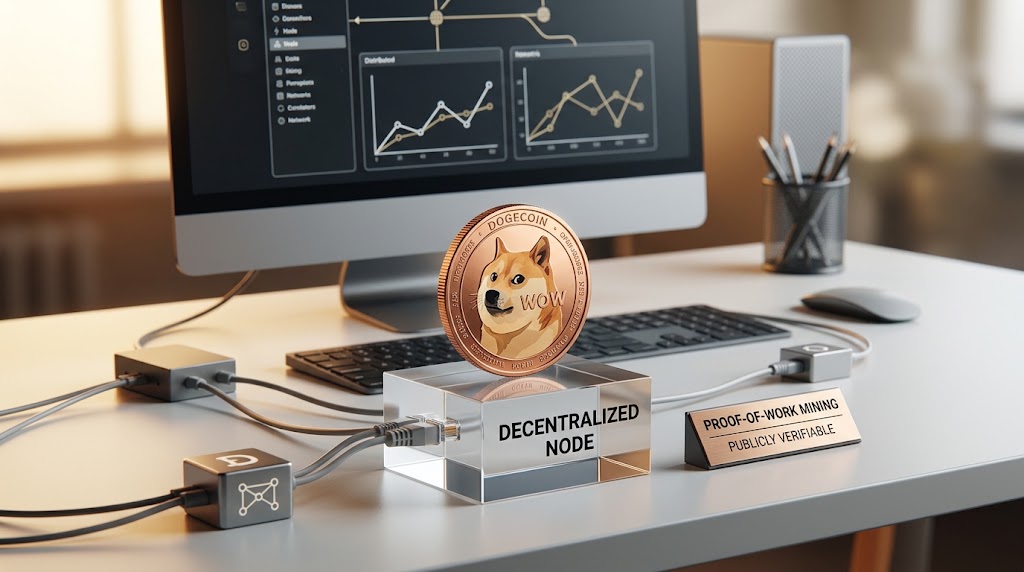
Dogecoin is not owned or operated by a company, bank, government, or individual. The network is open-source, permissionless, decentralized, and peer-to-peer. Anyone can participate by running a node, while the network operates through distributed participants rather than a central authority. - It uses Proof-of-Work mining
Dogecoin uses Scrypt-based Proof-of-Work (PoW). Miners use computing power to verify transactions and add new blocks to the blockchain. This means transaction validation is performed by network participants rather than a central institution. Dogecoin also uses an uncapped supply model, with new DOGE continuously issued through mining to maintain network operation. - Anyone can participate in the network
Because Dogecoin is open-source, users can independently run Dogecoin Core nodes and verify the blockchain. This makes the network different from a traditional payment system where a bank or company maintains a central database. - The blockchain is publicly verifiable
Transactions are recorded on the Dogecoin blockchain, allowing network participants to independently verify transaction history. Consensus is achieved through distributed nodes and miners rather than through a single administrator. - Elon Musk does not control DOGE
This distinction is important. Elon Musk has enormous influence over Dogecoin’s public image and market attention, but he does not own the Dogecoin network or have the technical ability to unilaterally change the blockchain. Dogecoin’s development is carried out through open-source contributors and maintainers.
Elon Musk has publicly supported Dogecoin since 2019, describing it as one of his preferred cryptocurrencies and later referring to it as “the people’s crypto.” His large following helped increase DOGE’s popularity and market attention, particularly during the 2020–2021 crypto bull market, when DOGE reached an all-time high of about $0.73 in May 2021. Tesla has also accepted DOGE for selected merchandise, further strengthening its real-world visibility.
The key investment consideration is that Musk’s influence should not be treated as a guarantee of DOGE’s future price performance. His statements can affect market sentiment, but DOGE’s long-term development and adoption depend on the network, developers, miners, users, businesses, and the broader cryptocurrency market, not on one individual alone.
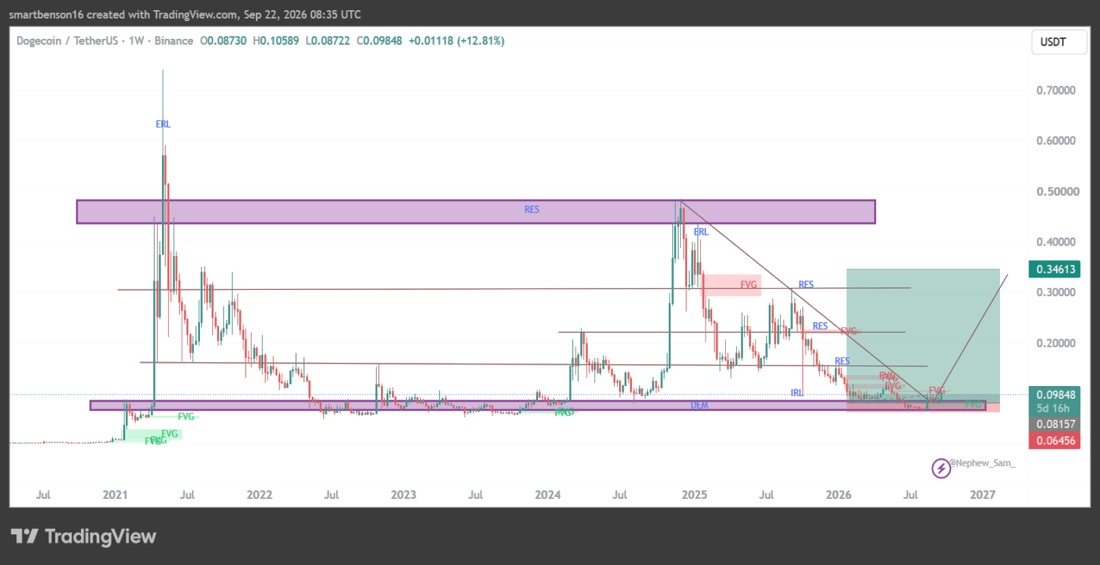
A look at the recent chart structure on the weekly timeframe (TF) shows previous months’ and years’ supply and demand zones, providing potential entry areas for both spot and futures trading.
Market Cap: US$16.90bn*
All-Time High: US$0.73
Total Supply: 171bn*
*Market data varies continuously; the figures above reference the September 18, 2026 CoinMarketCap snapshot.
Key Price Levels
Support/Demand (US$): 0.083400 – 0.08724, 0.09300
Resistance/Supply (US$): 0.12700, 0.15510, 0.22330, 0.30600…
Should DOGE break above the supply level after rebounding at US$0.12700, the next resistance target, accompanied by higher highs, could come into focus. However, a break below the 0.083400 demand zone risks creating a lower low. The US$0.06500 is identified as the key stop-loss level in this setup until price reclaims the level and retests the first entry level zone.
Investor Note: This is a long-term investment if you can hodl; do not over-leverage. Investors may consider applying Dollar-Cost Averaging (DCA) as a risk management approach rather than attempting to time market movements.