


July 2026, Edition 3
Nigeria’s financial markets demonstrated resilience during the week, supported by improving macroeconomic fundamentals, strong liquidity management, and sustained investor appetite for fixed income assets. Treasury bill yields eased to 18.47% on robust demand, while FGN bond average yields remained broadly stable at 18.10% (2028–2038 maturities) as investors maintained a selective stance. The Central Bank of Nigeria’s (CBN’s) aggressive liquidity mop-up through Open Market Operations (OMO) auctions, absorbing ₦3.68 trillion, alongside strong demand at the Nigeria Treasury Bill (NTB) auction, particularly the 7.18x subscription for the 364-day bill, highlighted confidence in Naira-denominated assets. Meanwhile, Nigeria’s external position strengthened as reserves rose to a 17-year high of $51.89 billion, the Naira was relatively steady, and crude oil output reached a 74-month high of 1.56 million barrels per day. However, global markets remained cautious amid escalating Middle East tensions, which pushed crude prices above $80/bbl. and reinforced expectations of prolonged monetary policy tightness. Overall, the week reflected improving domestic fundamentals amid a challenging global backdrop, with investors closely monitoring inflation, liquidity, and policy signals. Commodities closed week-on-week (WoW) higher, with Brent crude and West Texas Intermediate (WTI) at $88.10/bbl. (+15.91%) and $82.49/bbl. (+15.52%) respectively, while gold at $4,016.95/oz (-2.53%).
—
System liquidity remained robust through the week after opening at ₦4.98 trillion, peaking at ₦6.33 trillion before closing at ₦4.63 trillion on Friday (-6.90% WTD). Money market rates were stable, with the Open Repo Rate (OPR) at 22.00% and the Overnight (O/N) rate at 22.13% (WoW -10bps). In the Foreign Exchange (FX) market, the Naira traded within a range of $/₦1,378.00 and $/₦1,386.99, before closing at $/₦1,380.19 on Friday.
The fixed income market recorded a broadly positive week, driven by sustained demand in the Treasury bills segment amid ample system liquidity, while the FGN bond market remained relatively range-bound with intermittent profit-taking. Treasury bill yields declined consistently through the week, with the average yield easing from 18.53% to 18.47%, supported by strong buying interest across various maturities, particularly in the mid-to-long end of the curve. OMO bills held traded at high-19.00% to low-21.00% rates with recent bills on demand. In contrast, the bond market exhibited mixed sentiment as investors balanced demand for attractive yields against watchful positioning with the release of the July 2026 FGN Bond Auction Circular, with the average bond yield marginally at 18.10% for (2028-2038s) after buying interests in selected maturities were offset by sell pressure in others. Overall, the market tone suggests strong investor appetite for fixed income assets, although participants remain selective, awaiting further direction from liquidity conditions, inflation trends, and monetary policy signals.
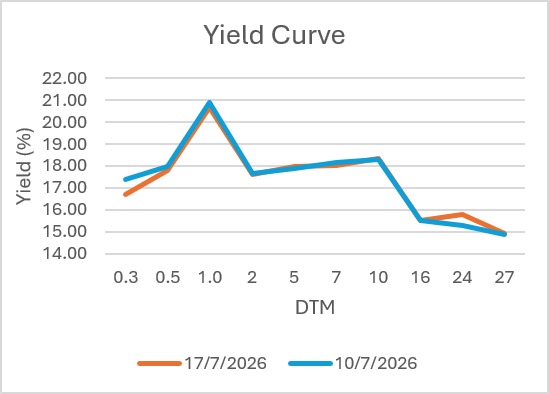
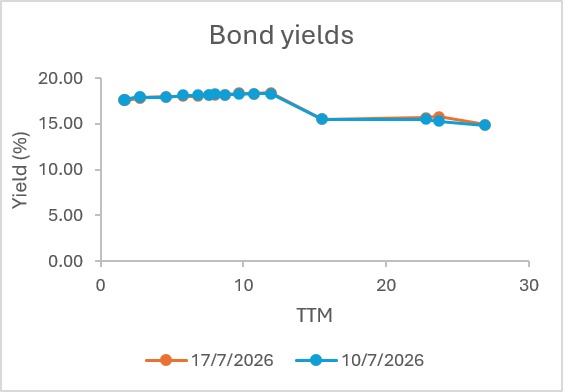
FX Liquidity Pulse: The CBN’s back-to-back OMO auctions on July 13 and 14, 2026 reflect a more assertive liquidity management strategy, as the apex bank partially absorbed excess liquidity while maintaining firm control over interest rates despite heightened global oil price volatility and the ₦2.97 trillion OMO maturity on July 14. Across both auctions, the CBN allotted a total of ₦3.68 trillion from subscriptions of ₦3.70 trillion against a combined offer of ₦1.20 trillion. On July 13, it sold ₦2.55 trillion against a ₦600 billion offer, driven by exceptional demand for the 127-day bill, which was oversubscribed 9.27x and accounted for 72.8% of total allotments. However, the July 14 total allotment moderated to ₦1.14 trillion from ₦1.15 trillion in subscriptions, reflecting more selective investor participation together with improved system liquidity. Short-term rates remained firm, with the 7-day yield rising by 1bp; in contrast, the 133-day bill attracted strong demand, with subscriptions reaching 4.47x the amount offered and clearing 2bps lower, reinforcing expectations that interest rates may have peaked. This combination of elevated short-end yields and robust long-end demand suggests an inverted yield curve, with investors adopting a barbell strategy by concentrating on short- and longer-dated securities while avoiding mid-tenor instruments. A highlight to note is the closely knit bid ranges (a minimum of 15bps), indicating that the market is likely comfortable with the rates and risk level. Effective yields were 21.99% (unchanged), 21.33% (-26bps), and 21.69% (+4bps) for the 8-, 99-, and 127-day bills on July 13, while the July 14 auction was 21.99% (steady), 21.65% (+4bps), 21.69% (steady), and 21.75% (+6bps) for the 7-, 70-, 126-, and 133-day tenors, respectively.
AUCTION DATE | TENOR | OFFER (₦‘B) | BIDS (₦‘B) | TOTAL SALE (₦‘B) | STOP RATES (%) | PREVIOUS TENOR RANGE STOP RATES (%) |
| 8-DAY | 200.00 | 229.58 | 228.90 | 21.8900 | 21.9000 |
99-DAY | 200.00 | 462.18 | 462.18 | 20.4900 | 20.4000 | |
127-DAY | 200.00 | 1,854.50 | 1,854.50 | 20.1700 | 20.0600 | |
| 7-DAY | 150.00 | 252.68 | 252.68 | 21.9000 | 20.8900 |
70-DAY | 150.00 | 134.00 | 119.00 | 20.7900 | 20.7500 | |
126-DAY | 150.00 | 94.53 | 94.53 | 20.1800 | 20.1700 | |
133-DAY | 150.00 | 671.60 | 671.60 | 20.1500 | 20.1700 |
Primary Issuance Brief: The July 15, 2026 Nigerian Treasury Bills (NTB) primary market auction reflected a pronounced investor preference for longer-duration securities, with the 364-day bill recording a robust subscription of 7.18x, compared with a muted demand of 0.95x and 0.68x for the 91-day and 182-day tenors, respectively. In response, the CBN allocated 89% of the total issuance to the 364-day paper and lowered its stop rate by 4 basis points, while the stop rates on the 91- and 182-day bills remained unchanged. Effective yields settled at 21.44% (-5bps) for the 364-day, 17.98% and 16.99% for the 182-, and 91-day bill correspondingly. Total allotment was 1.99 times the amount offered and 11.9% higher than the previous auction, reflecting sustained demand amid ample system liquidity. The modest decline in the long-tenor yield suggests that while investors remain willing to extend duration to secure attractive returns, the CBN continues to balance strong market demand with its objective of moderating domestic borrowing costs.
AUCTION DATE | 15-06-2026 | 15-06-2026 | 15-06-2026 |
MATURITY DATE | 15-10-2026 | 14-01-2027 | 15-07-2027 |
TENOR | 91-DAY | 182-DAY | 364-DAY |
OFFER (₦) | 100,000,000,000 | 100,000,000,000 | 400,000,000,000 |
SUBSCRIPTION (₦) | 94,958,300,000 | 68,027,128,000 | 2,871,921,009,000 |
ALLOTMENT (₦) | 80,840,915,000 | 48,178,649,000 | 1,061,775,148,000 |
BID RANGE (%) | 15.8000 – 18.0000 | 16.0500 – 17.5000 | 17.0000 – 21.5000 |
STOP RATES (%) | 16.3000 | 16.5000 | 17.6600 |
PREVIOUS STOP RATES (%) | 16.3000 | 16.5000 | 17.7000 |
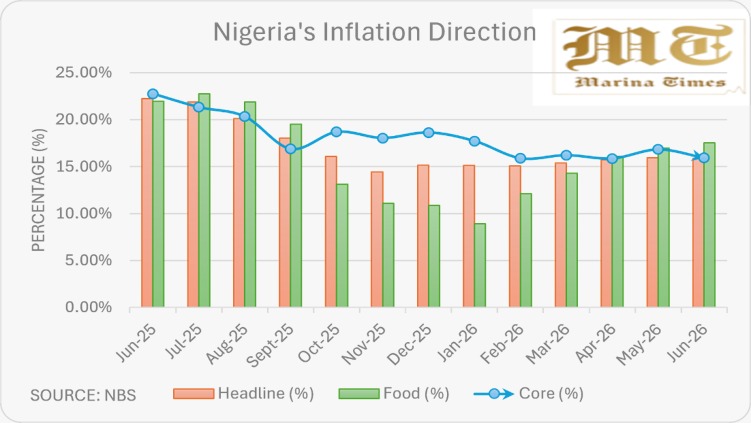
The National Bureau of Statistics (NBS) Consumer Price Index (CPI) report for June 2026 reveals a marginal cooling in Nigeria’s inflationary pressures, with the headline inflation rate dipping slightly to 15.91% year-on-year (YoY) from 15.93% in May 2026 and marking a significant drop from the 25.29% recorded in June 2025. On a month-on-month (MoM) basis, headline inflation also slowed from1.75% to 1.66%, pointing to a deceleration in the overall pace of price increases. However, a stark variation is evident in food and urban dynamics: while the core inflation rate (excluding volatile agricultural produce and energy) moderated to 15.92% YoY and 1.66% MoM (down from 1.94% in May), the food inflation rate spiked MoM from 2.98% to 3.75% despite easing to 17.52% YoY (down from 25.41% in June 2025). This localized food pressure, driven by rising costs of staples like crayfish, fresh tomatoes, and peppers, is mirrored in the urban-rural divide, where urban MoM inflation climbed to 2.13% while rural MoM inflation plummeted to 0.52%. Regionally, the report highlights structural differences, with YoY headline inflation peaking in Niger State at 42.23% and Kogi at 41.59%, compared to a low of just 19.47% in Imo State, signalling that despite an overall national disinflationary trend, localized supply-side constraints and high food costs continue to weigh heavily on consumer purchasing power.
The Naira appreciated mildly during the week in the Nigerian Foreign Exchange Market (NFEM), gaining ₦0.53 (+0.04%) week-to-date (WTD), and ₦0.56 (+0.04%) WoW, before closing at $/₦1,380.18 (WoW: ₦1,379.62). Foreign reserves increased its ascent to $51.92 billion (+0.33%) as of July 16, 2026 (highest level since January 2009), leading to a decline in blocked funds to $619.71 million (-2.13%) with a reduced blocked reserve ratio of 1.19% (-0.3bps), marking an improved foreign exchange condition despite external pressures.
Nigeria’s external reserves have risen to $51.86 billion, their highest level since January 2009 and about $800 million above the CBN’s full-year 2026 projection, highlighting a significant strengthening of the country’s external position. The sustained reserve accretion has been driven by stronger crude oil earnings, improved export performance, robust foreign portfolio inflows, and ongoing foreign exchange reforms that have boosted investor confidence and foreign currency liquidity. Beyond enhancing Nigeria’s capacity to meet external obligations and absorb global shocks, the higher reserves reinforce exchange rate stability, support the CBN’s FX management framework, and strengthen the case for maintaining a cautious monetary policy stance at the upcoming MPC meeting, as improving external buffers continue to complement broader macroeconomic stability.
The CBN’s introduction of the FX BDC Purchase Tracker (FXBT) marks a significant step toward strengthening transparency, compliance, and discipline in Nigeria’s retail foreign exchange market. By mandating real-time transaction reporting, enforcing a 24-hour resale requirement for unused official FX, and introducing centralized monitoring across all licensed Bureau De Change (BDC) operators, the apex bank is closing loopholes that previously enabled speculative hoarding, round-tripping, and multiple purchases across different banks. The framework complements the February 2026 decision restoring BDCs’ access to the official FX market, while preserving strict controls through weekly purchase limits of $150,000, a maximum 1% resale margin, enhanced know your customer (KYC) requirements, and firm sanctions for non-compliance. From a market perspective, these measures should improve retail FX liquidity, support price discovery, reduce arbitrage opportunities between the official and parallel markets, and reinforce the recent exchange rate stability, where the official-parallel market premium has narrowed to about 2.1%. If effectively enforced across Nigeria’s more than 1,700 licensed BDCs, the framework could further deepen confidence in the foreign exchange market and strengthen the CBN’s ongoing exchange rate reform agenda.
Nigeria’s recent macroeconomic developments point to strengthening economic fundamentals across key sectors. Pension assets surged 51% to ₦31.48 trillion ($22.8 billion) over two years, while pension contributors rose to 11.32 million, reflecting growing confidence in the contributory pension scheme, deeper domestic institutional capital, and improved retirement benefit administration. In the energy sector, crude oil production reached a 74-month high, averaging 1.56 million barrels per day (1.735 million bpd including condensates) in June, exceeding Nigeria’s OPEC quota by 4% for the first time in over six years, supported by improved operational stability and reduced pipeline disruptions. This higher production strengthens export earnings, fiscal revenues, and foreign exchange inflows, complementing the recent build-up in external reserves. Meanwhile, the launch of a $500 million agriculture investment fund for the Niger Delta signals a strategic shift toward diversifying growth beyond oil by attracting private capital into agriculture, boosting food production, enhancing mechanisation, and improving long-term food security. Collectively, these developments reinforce Nigeria’s improving macroeconomic outlook, strengthen external and fiscal buffers, deepen domestic capital formation, and support a more resilient medium-term growth trajectory.
The Federation Accounts and Allocation Committee (FAAC) disbursements have continued to strengthen, rising from ₦1.96 trillion in January 2026 to ₦2.55 trillion in June 2026, representing an increase of about ₦590 billion (+30.1%). The June distribution, supported by ₦4.5 trillion in gross federation revenue, highlights improving fiscal capacity driven by stronger tax collections, petroleum-related receipts, and VAT performance. Meanwhile, Nigeria’s capital market is rewriting its traditional pre-election playbook as investors increasingly price in reform momentum, macroeconomic stabilization, and improved policy credibility rather than election uncertainty. The combination of stronger government revenue flows and resilient equity market performance reinforces a more constructive investment outlook, although fiscal discipline, inflation management, and policy continuity remain crucial.
The Nigerian equities market ended the week on a negative note, with the Nigerian Exchange (NGX) ASI settling at 243,462.13 points (marking a +0.17% WTD and -0.20% WoW) and a year-to-date (YTD) return of 55.45% from 56.77%. On Monday, the index fell 0.84% to 241,749.11 points as a 3.28% drop in the Industrial Goods Index, led by BUACEMENT (-9.99%), compressed market breadth to 0.42x. Tuesday saw a near-flat uptick of +0.01% (241,761.23 points) as banking gains from FIRSTHOLDCO (+9.98%) and FCMB (+6.93%) offset consumer and energy losses, despite trade value surging 139.62% to NGN53.33bn. Momentum accelerated on Wednesday, with the ASI gaining 0.25% to 242,366.75 points, propelled by a 2.20% rally in the banking sector that pushed market breadth to a weekly high of 1.73x. However, the rally inched despite a 0.09% slip on Thursday, led by a loss in BUACEMENT (-9.99%), which dragged Industrial Goods down by 2.85%, completely eclipsing a robust 2.87% surge in the banking sector. Market capitalisation was within the range of ₦157.10 trillion – ₦157.65 trillion, although market breadth improved (0.42x to 1.81x), suggesting selective demand. Across key indices, performance was mixed WoW: Banking (+9.3%), Top 30 Index (+0.34%), Pension Index (+3.55%), Premium Index (+3.28%), Insurance (+0.25%), Main Board Index (-1.54%). Industrial Goods (-6.26%), Oil & Gas (-0.79%), and Consumer Goods (-0.15%).
The global financial market for the week ended July 17, 2026, was defined by a massive tech-to-value equity rotation driven by a severe global semiconductor rout, which dragged the Nikkei 225 down (-6.44% WoW) and Taiwan’s benchmark down by more than 6%, while a highly defensive sovereign fixed-income landscape took hold. While a cooler-than-expected US headline inflation print of 3.50% YoY (prev. 4.20%) with June Producer Price Index (PPI) dropping to -0.3% MoM against a baseline of 5.5% YoY (biggest drop in nearly 6 years) per Bureau of Labour Statistics (BLS) report for June 2026. Followed with an eased US 10-year Treasury yields to 4.56% and the 2-year yield to 4.14%; Federal Reserve Chair Kevin Warsh’s congressional testimony forcefully pushed back on early easing, citing persistent price pressures. This hawkish central bank resolve was mirrored globally, as the Bank of Canada held its rate steady at 2.25% due to housing strains, the Bank of Korea maintained its rate at 2.50% to defend capital outflows amidst a 4.255% Korean Treasury Bill (KTB) yield, and Eurozone yields surged (Germany’s 10-year Bund rising to 3.14% and France’s to 3.93%) on fears of energy-driven inflation that have money markets pricing in a 90% chance of a September ECB hike. Concurrently, UK 10-year Gilt yields held near a two-month high at 4.94%–4.95% as resilient May GDP growth (+0.1% MoM) solidified expectations of a November Bank of England rate hike. Meanwhile, China’s growth retraced with Q2 GDP moderating to 4.3% YoY and domestic retail sales sluggish at 0.2%, though its aggressive manufacturing export engine generated a massive $125.62 billion trade surplus. These macro realities left the DXY dollar index slightly softer at 100.52, the Japanese Yen flatlining at 162.22–162.39, the Euro at $1.1442, and the Sterling at $1.3466, while commodities were highly reactive.
Africa’s economic and geopolitical landscape is entering a period of heightened uncertainty and strategic realignment, as South Africa moves to rebuild its strategic crude oil reserves, De Beers prepares a two-year production halt at one of its key South African mines amid a prolonged diamond market downturn, and Ethiopia advances plans to acquire up to 50 new aircraft to strengthen the continent’s largest airline. Energy security has returned to the forefront, with Brent crude climbing above $85/bbl., amid renewed tensions surrounding Iranian shipping, while Mozambique pushes ahead with debt restructuring and gas development despite fiscal and tax challenges. Public health concerns are intensifying as Ebola fatalities continue to rise in the Democratic Republic of Congo, prompting the launch of the world’s first clinical trial targeting the Bundibugyo Ebola strain and renewed travel warnings from the United States. Across the continent, major capital market developments are unfolding, including Aliko Dangote’s planned $2.5 billion private share placement ahead of what could become Africa’s largest IPO, alongside governance tensions at South Africa’s Public Investment Corporation (PIC). Meanwhile, migration pressures, anti-immigrant unrest, shifting education destinations for African students, deepening AI cooperation with China, and evolving political disputes highlight a continent balancing economic opportunity with significant geopolitical, environmental and social risks.
Global commodity markets were dominated by heightened geopolitical tensions in the Middle East during the week, with the escalating US-Iran conflict driving significant volatility across energy and precious metals. Brent crude gained more than 10% over the week, trading between $80.87 and $87.77/bbl., while WTI crude advanced to $82.64/bbl., as renewed US military strikes on Iran, the re-imposition of a naval blockade targeting Iranian ports, threats to the Strait of Hormuz and potential disruptions to the Red Sea shipping route heightened supply risks. Although President Trump reversed plans to impose a 20% transit fee on cargo passing through Hormuz, concerns over reduced tanker traffic, attacks on regional energy infrastructure, and sustained military escalation kept oil prices near one-month highs despite OPEC lowering its 2026 oil demand growth forecast to 800,000 barrels per day and the US Energy Information Administration (EIA) report a 1.7 million-barrel decline in US crude inventories signalling tighter global supplies and providing immediate upward support for oil prices. In contrast, gold ended the week under pressure above $4,000 per ounce and lost more than 3%, as rising oil prices reinforced inflation concerns and supported expectations that the US Federal Reserve could maintain a restrictive monetary policy for longer. While softer-than-expected US CPI and PPI data reduced the likelihood of a July rate hike, markets continued to price a meaningful probability of a September tightening, limiting demand for the non-yielding precious metal despite persistent geopolitical uncertainty.
Markets are expected to remain optimistic, carefully supported by improving liquidity conditions and investor appetite, while yield movements, FX stability, and global risk factors remain key drivers of near-term direction. Expected inflows in the week are over ₦2.55trn (₦2.03trn and ₦378.43bn in OMO and NTB maturities, ₦141.61bn and $78.42bn for FGN Bond and Eurobond Coupons, respectively), with a scheduled July FGN Bond auction of ₦1.20 trillion and offer split evenly across the 3 tenors: 10-, 15-, and 20-year paper. The 306th Monetary Policy Meeting (MPC), expected during the week, is a key market direction driver, including the outcome of the FGN bond auction.
Improving macroeconomic conditions appear to support the case for maintaining the current monetary policy stance. While June 2026 inflation moderated marginally, underlying price pressures remain above the CBN’s comfort level despite stronger external reserves, relative exchange rate stability, easing global oil prices, and a resilient growth outlook. Against this backdrop, the MPC may consider preserving its cautious, data-dependent approach, with emphasis on consolidating recent gains in price and foreign exchange stability while maintaining an interest rate environment supportive of external capital inflows. Although the case for further policy tightening appears to have weakened, prevailing macroeconomic conditions may not yet provide sufficient confidence to warrant policy easing. Consequently, the Committee is likely to reiterate that durable disinflation and sustained macroeconomic stability remain important preconditions for any future adjustment to the policy rate.
The week ending July 17, 2026, marked a series of significant milestones for African entertainment. Afro-fusion superstar Burna Boy and Colombian icon Shakira reunited in rehearsals ahead of the first-ever FIFA World Cup Final halftime show on July 19, where they are expected to perform the tournament’s official anthem, “Dai Dai.” In film, Idris Elba’s 22Summers, Nile Media Entertainment Group, and the UK’s Action Xtreme announced a strategic partnership to develop a slate of high-budget West African action films, with production beginning in the fourth quarter of 2026. Meanwhile, Entertainment Week Africa officially opened registrations for its fifth edition, scheduled for November 17–22, 2026 in Lagos under the theme “Five Years of Closing The Gap.” The week also saw Ghanaian dancehall star Shatta Wale release his highly anticipated new album, African King, further highlighting the continued momentum of Africa’s creative industries.
By: Sandra A. Aghaizu
Stages rose like stock charts in the night,
Each spotlight trading darkness for value.
Songs became currencies crossing borders,
And stories turned into long-term assets.
When artists invest their voices in time,
The market of culture compounds quietly.
For the richest dividends are not always printed,
Sometimes they are sung, filmed, and remembered.





Subscribe now to keep reading and get access to the full archive.