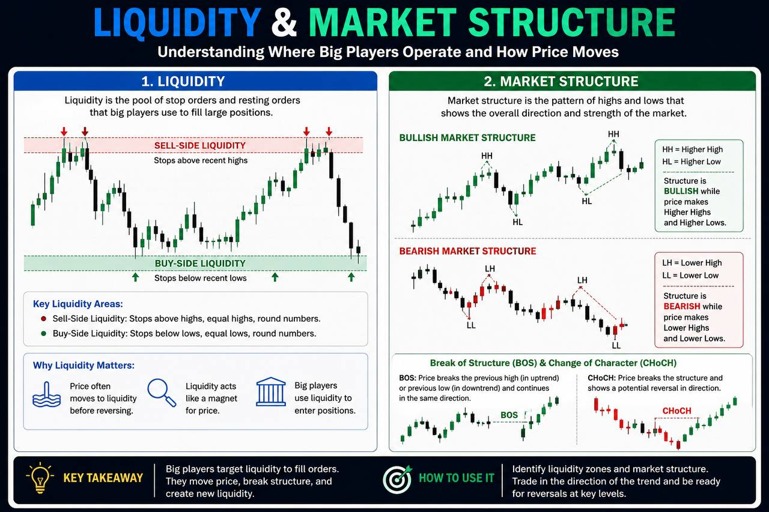
Market structure is one of the most important elements of smart-money analysis.
In a bullish market structure, traders may generally look for a sequence such as:
Higher High → Higher Low → Higher High → Higher Low
In a bearish market:
Lower Low → Lower High → Lower Low → Lower High
A significant change in this sequence may provide information about a potential change in market direction.
The objective is therefore not simply to buy because an indicator suggests that an asset is “oversold” or sell because it appears “overbought.” Instead, traders may examine price structure, liquidity, volume, order flow, and other market evidence before concluding.
Smart Money and Supply & Demand
Smart-money analysis is also closely connected to the study of supply and demand.
A demand zone represents an area where strong buying activity previously occurred, while a supply zone represents an area where significant selling activity previously happened.
A simplified market sequence may be represented as:
For example:
Supply → Price falls → Demand → Price rises
These zones may help traders organise price information and identify areas requiring further observation; traders may monitor these areas for evidence of institutional participation, but the zone itself does not guarantee a reversal.
On-Chain Data and Smart-Money Analysis
Cryptocurrency markets provide an additional analytical resource that is less visible in many traditional markets: on-chain data.
Depending on the blockchain and the quality of available data, analysts may monitor:
- Large wallet transactions
- Exchange inflows and outflows
- Token movements between wallets
- Changes in holder concentration
- Network activity
- Token supply movements
- Staking activity
- Stablecoin flows
- Token unlocks
- Realised and unrealised market metrics
These indicators can provide useful context, but they must be interpreted carefully.
A wallet address does not necessarily reveal the identity, ownership structure, or investment intention of the person or entity controlling it. Exchange wallets, custodial wallets, institutional wallets, smart contracts, and other operational addresses can generate large transactions that may be incorrectly interpreted as buying or selling decisions by a single investor.
Therefore, on-chain activity should be treated as evidence requiring interpretation rather than a direct window into institutional intentions.
Risk Management Remains Essential
Understanding smart-money activity does not remove the fundamental risks associated with cryptocurrency trading.
Digital assets can experience substantial price volatility, market illiquidity, leverage-related losses, technological failures, custody risks, fraud, cybersecurity incidents, regulatory changes, and other unexpected events.
Accordingly, traders should avoid treating whale movements, SMC patterns, on-chain signals, or institutional activity as standalone reasons to enter a position.
A sound trading process should consider:
Market Analysis + Position Sizing + Stop-Loss Discipline + Liquidity + Leverage Management + Portfolio Risk + Capital Preservation
The objective is not to predict every market movement but to develop a disciplined process for making decisions under uncertainty.
Regulatory and Investor-Protection Considerations
For Nigerian readers, cryptocurrency and digital-asset activities should also be considered within the applicable regulatory framework.
The Securities and Exchange Commission (SEC) has established rules covering areas including digital-asset issuance, digital-asset offering platforms, custody, Virtual Asset Service Providers (VASPs), and Digital Asset Exchanges.
The regulatory environment is also evolving. On 20 August 2026, the SEC published proposed rules covering digital and virtual asset operations, custody and markets, including activities such as trading, custody, transfer, and settlement, as well as investment, advisory, and related financial services.
Accordingly, it is crucial to verify the current regulatory status of any platform, service provider, or investment opportunity before committing funds.
Conclusion
Smart money in cryptocurrency is the capital and activity of sophisticated market participants whose large positions, knowledge, liquidity, and trading strategies can influence market behaviour.
Understanding smart-money concepts means learning to analyse:
Market Structure + Liquidity + Supply & Demand + Order Flow + Volume + On-Chain Data
The objective is not to predict exactly what institutions are doing, but to use observable market data to make better-informed trading decisions while maintaining proper risk management.