


August 2026, Edition 2
Financial markets this week tell a story of cautious optimism beneath the surface. While the banking sector continued to anchor the Nigerian equities market and fixed income investors selectively locked in attractive yields, the Central Bank’s latest Open Market Operation (OMO) auction and 2025 Annual Report offered fresh insights into the evolving liquidity and monetary policy environment. At the same time, the Naira remained broadly stable, foreign reserves strengthened, Nigeria unveiled a landmark tax framework for virtual assets, and global markets navigated shifting interest-rate expectations alongside renewed geopolitical tensions that reshaped commodity prices. Together, these developments provide valuable signals on where capital is flowing, how policy is evolving, and what investors should expect in the weeks ahead. Commodities closed lower Week-on-week (WoW), with West Texas Intermediate (WTI) and Brent crude at $78.10/bbl. (-7.76%) and $83.55/bbl. (-4.98%), respectively, while gold was at $4,343.43/oz (+7.43%).
System liquidity remained in surplus throughout the week, opening at ₦2.53 trillion. Despite significant outflows of ₦4.70 trillion during the period, liquidity was supported by inflows of ₦2.73 trillion, resulting in a net increase. Consequently, system liquidity closed the week at ₦4.08 trillion, representing a 61.31% week-to-date (WTD) increase from the opening level. Money market rates were stable, with the Open Repo Rate (OPR) at 22.00% and the Overnight (O/N) rate at 22.10% (WoW: -4 bps). In the Foreign Exchange (FX) market, the Naira traded within a range of $/₦1,361.00 and $/₦1,368.00, before closing at $/₦1,365.69 on Friday.
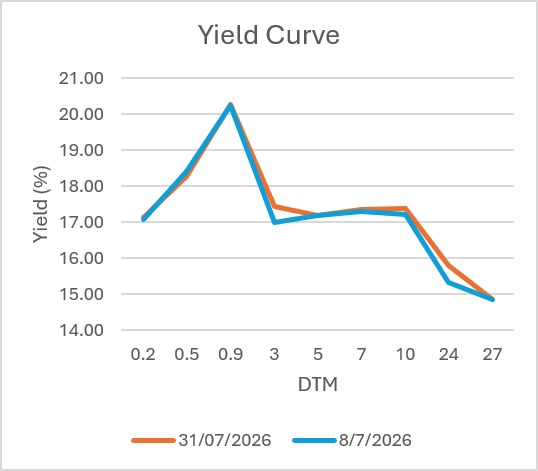
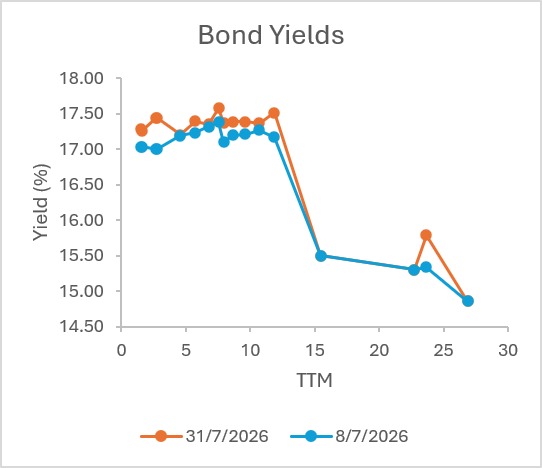
The fixed income secondary market traded bullishly at the beginning of the week, following the market reaction to the cancelled NTB auction, but steadied mildly mid-week after two consecutive OMO auctions. In the Treasury bills market, buying interest dominated the secondary market, driving the average yield to 18.20%. Strong demand was concentrated in the 15-Oct-2026, 29-Oct-2026, 21-Jan-2027, and 29-Jan-2027 maturities, suggesting investors continued to lock in attractive yields at the mid-to-long end of the NTB curve. Nonetheless, intermittent demand was evident in the 28-Jan-2027, 4-Feb-2027, and 3-Jun-2027 bills. OMO bills were at a low 21.00% yield range. Conversely, the FGN bond market average yield was at 16.80%, driven by aggressive trading in the short- to mid-tenor segment, highlighting sustained liquidity and investor preference for long-duration securities.
FX Liquidity Pulse: The outcome of the Central Bank of Nigeria (CBN) OMO auction held on August 3–4, 2026 emphasized robust investor appetite for long-dated tenors amid persistent liquidity management, with demand highlighting a clear market preference for medium-term yield lock-in over shorter paper. Despite a two consecutive day ₦600 billion total offer per day, appetite diverged sharply: shorter tenors lagged, resulting in no-sale of the 113-day bill and a muted 0.88 allotment on the 112-day tranche (clearing at 20.35% | 21.75% effective yield), whereas, the 141- and 133-day tenors saw strong oversubscription, clearing at 20.10% (21.79% effective yield) and 20.15% (21.71% effective yield), respectively. Tight bid-offer spreads of 6–24 bps indicated a strong market consensus and a likely crest in the yield cycle. Ultimately, these results signal that while investors remain eager to secure high-yielding short-term debt, the CBN comfortably steered marginal rates lower as broader system liquidity normalized amidst a total mop-up of ₦4.70trn (marking the highest level since the ₦4.73 trillion OMO sale recorded on June 2–3, 2026).
AUCTION DATE | TENOR | OFFER (₦‘ B) | BIDS (₦‘ B) | TOTAL SALE (₦‘ B) | STOP RATES (%) | PREVIOUS TENOR RANGE STOP RATES (%) |
03-08-2026 | 113-DAY | 300.00 | 444.50 | 0.00 | 0.00 | 20.2900 |
141-DAY | 300.00 | 2,527.55 | 2,523.00 | 20.1000 | 20.1500 | |
| 112-DAY | 300.00 | 263.10 | 263.10 | 20.3500 | 0.0000 |
133-DAY | 300.00 | 1,939.63 | 1,909.63 | 20.1500 | 20.1000 |
The CBN’s 2025 Annual Report shows that monetary reforms are yielding positive external buffers and fiscal discipline, though underlying balance sheet and banking sector risks persist. Headline gross external reserves expanded substantially to $45.75 billion (providing nearly 9 months of import cover), and claims on government debt securities, including Ways and Means advances, declined to ₦26.40 trillion, signalling enhanced fiscal governance. However, this growth is tempered by a 1.42% drop in Net Foreign Assets (to ₦31.51 trillion) driven by rising non-resident liabilities, alongside a 47.6% drop in Bank-level operating surplus to ₦86.81 billion (despite total Bank assets expanding 18.1% to ₦138.66 trillion). Overall, while consolidated Group performance improved and external liquidity expanded, the report highlights that true external asset buffers remain tighter than surface figures indicate, emphasizing the need for sustained vigilance around banking sector risk management and transparency standards.
The Naira depreciated mildly during the week in the Nigerian Foreign Exchange Market (NFEM), losing by ₦0.85 (+0.06%) WTD, and gaining ₦2.54 (-0.19%) WoW, closing at $/₦1,365.69 (WoW: ₦1,368.22). Foreign reserves rebounded mildly from $51.92 billion to $52.03 billion (+0.12%) as of August 06, 2026, with a decline in blocked funds to $578.05 million (-2.72%) and a reduced blocked reserve ratio of 1.11% (-0.4bps), reflecting an improved foreign exchange condition amidst external pressures.
Nigeria recorded several notable policy developments during the week. The National Insurance Commission (NAICOM) approved 43 insurance and reinsurance companies, comprising 23 non-life insurers, 10 life insurers, 8 composite insurers and 2 reinsurers, following the recapitalisation exercise, while the fate of 8 firms remains under review, strengthening the sector’s resilience. The Federal Executive Council (FEC) also approved a US$4.5 billion oil-backed financing facility to bolster external reserves and support fiscal liquidity. In the downstream petroleum sector, the Nigerian Midstream and Downstream Petroleum Regulatory Authority (NMDPRA) proposed regulations banning fuel price-fixing and other anti-competitive practices to deepen market competition.
The Nigeria Revenue Service (NRS) Guidelines on the Taxation of Virtual Assets establish Nigeria’s first comprehensive tax framework for cryptocurrencies, stablecoins, Non-Fungible Tokens (NFTs), decentralised finance (DeFi), and other digital assets, clarifying that virtual asset transactions are now fully integrated into the country’s tax regime. The guidelines classify virtual assets into six categories with distinct tax treatments, subjecting gains from disposals to income tax, imposing Value Added Tax (VAT) on related services (rather than the assets themselves), and introducing a 1.5% stamp duty on eligible fiat-to-token and token-to-fiat transfers, collected by Virtual Asset Service Providers (VASPs). Importantly, the framework adopts a USD-referenced gain computation to ensure only real economic gains, rather than gains arising solely from Naira depreciation, are taxed, while staking rewards, mining income, DeFi yields, airdrops, and NFT income are generally taxable upon receipt. Non-taxable events include merely holding assets, transfers between a taxpayer’s own wallets, staking lock-ups, NFT minting, tokenisation without a change in beneficial ownership, and Central Bank Digital Currencies (CBDCs) such as the eNaira. The guidelines also place extensive compliance obligations on VASPs and Peer-to-Peer (P2P) platforms, including tax withholding, VAT collection, reporting, record-keeping, and Tax ID verification, with significant penalties for non-compliance. Overall, the framework provides long-awaited regulatory certainty, strengthens tax administration for the digital asset ecosystem, and signals Nigeria’s intention to integrate virtual assets into its formal financial and tax system without discouraging innovation.
The equities market ended the week on a cautiously positive note despite delicate volatility, as gains in the banking sector offset persistent profit-taking in consumer goods and insurance stocks. The Nigerian Exchange (NGX) ASI closed at 245,573.60 points (WTD -0.07% and WoW +0.12%) and a year-to-date (YTD) return of 57.81% from 57.62%. Market capitalisation increased to ₦159.78 trillion. Investor sentiment remained mixed, with market breadth staying below 1.0x throughout the week, reflecting that decliners consistently outnumbered advancers. Banking stocks emerged as the key driver of market performance, supported by sustained buying interest in FIRSTHOLDCO, FCMB, ACCESSCORP, and ZENITHBANK, while trading activity weakened on Tuesday, following a strong start on Monday at 245,748.31 points. Overall, the market reflected selective interest in fundamentally strong banking names amid cautious positioning and continued sector rotation by investors. Across key indices, performance was mixed WoW: Top 30 (+0.27%), Banking (+2.33%), Pension (+0.73%), Premium (+1.6%), Consumer Goods (-1.75%), and Oil & Gas (-0.03%).
Global macroeconomic dynamics were driven by shifting rate expectations and energy-driven inflation risks across major sovereign bond markets. In fixed income, the U.S. 10-year Treasury yield hovered around 4.67%, supported late-week by elevated term premiums and rate-hike speculation. The U.S. labour market softened in July 2026 as Nonfarm Payrolls fell by 23,000, unemployment held steady at 4.1%, and downward revisions to May–June job gains reinforced signs of a gradual cooling in employment momentum. China’s manufacturing sector slipped back into contraction in July, with the Purchasing Managers’ Index (PMI) falling to 49.2 from 50.3, as weak domestic demand, property-sector weakness, weather disruptions and margin pressures weighed on industrial activity. Across the Atlantic, UK 10-year Gilt yields eased to hold near 4.90–4.95% after the Bank of England maintained a cautious policy stance and temporary relief in Middle Eastern energy shipping corridors reduced immediate pressure for further monetary tightening. Elsewhere, Ghana’s headline inflation eased to 5.9% in July from 6.3% in June, marking its first decline since March and signalling easing price pressures across the region. Overall, while global central banks largely reiterated data-dependent holds, persistent term premiums, commodity market fluctuations, and upcoming labour indicators kept both Treasury and Gilt curves elevated yet tightly range-bound. The equities market performance closed largely positive WoW: the Nasdaq Composite at 26,690.62 (+5.19%), S&P 500 at 7,757.64 (+3.60%), and the Dow Jones Industrial Average at 54,036.93 (+3.00%). Across Europe, Germany’s DAX 40 was at 26,319.45 (+2.69%), while the FTSE 100 was at 10,901.09 (+0.30%), and the Stoxx 600 at 660.25 (+1.70%). Asian markets were varied, with Japan’s Nikkei 225 at 65,606.71 (+1.93%), China’s Shanghai Composite Index at 3,940.04 (+2.81%), Hong Kong’s Hang Seng Index at 25,668.03 (-0.84%), and South Korea’s KOSPI at 6,258.77 (-5.10%).
Global commodity markets remained volatile during the week, driven largely by shifting geopolitical risks. WTI crude declined from $79.67/bbl. to a low of $75.24/bbl. before recovering to $77.81/bbl., while Brent crude fell from $84.05/bbl. to $79.37/bbl. over the same period before rebounding to $83.27/bbl. The initial selloff reflected easing geopolitical tensions and expectations of a reopening of the Strait of Hormuz, which improved the global supply outlook, while the late-week recovery was driven by renewed tensions in the waterway that revived concerns over potential supply disruptions. In contrast, gold maintained a strong upward trajectory, rising from $4,038.16/oz to $4,286.93/oz as softer US economic data, declining Treasury yields, expectations of a less aggressive Federal Reserve, sustained institutional and central bank demand, and renewed geopolitical uncertainty reinforced safe-haven buying.
The new week is expected to be an active week due to the expected US Inflation, Producer Price Index (PPI), and retail sales report for July. Domestically, the market is expected to receive inflows of ₦2.48 trillion in OMO maturities, providing ample liquidity to support continued demand for fixed-income securities. In addition to the scheduled 700bn NTB auction set to hold during the period, the release of the July 2026 Inflation report will influence the direction of the fixed-income market.
By: Sandra A. Aghaizu
Money waits beneath the surface,
like a tide before the shore.
₦2.48 trillion finds its way back,
opening another door.
The bills are placed, the yields are watched,
while inflation holds the key.
Across the ocean, numbers speak,
of what tomorrow’s rates may be.
The market pauses, listens, waits,
for signals yet unseen.
For in finance, as in the sea,
the tide decides the current’s course.





Subscribe now to keep reading and get access to the full archive.