


September 2026, Edition 4
Nigeria’s financial markets walked through a week of competing signals, as easing domestic inflation and a firmer Naira supported risk sentiment. At the same time, elevated global rates, oil-price volatility and renewed fixed-income supply tempered the broader rally. Nigeria’s inclusion in the J.P. Morgan GBI-EM Edge index and firm demand at the September FGN Bond auction strengthened the case for long-duration assets, with the 2038 bond’s stop rate falling 94bps to 16.85%; yet, the secondary fixed-income market remained resistant to sustained yield compression, with the late-week supply pushing average T-bill and bond yields higher, respectively. The macro backdrop improved marginally as August headline inflation eased to 15.39%, and reserves rose to $54.70 billion. However, the ₦2.34 trillion August Federation Account allocation highlighted continued fiscal-revenue pressure. Equities delivered a measured recovery, with the ASI gaining 2.78% to close at 249,804.60 points, supported by broader participation and rising turnover despite IPO-related liquidity pressures. Globally, markets remained defensive as the Middle East conflict sustained inflation and energy risks. Commodity markets added another layer of risk, with crude oil prices surging on heightened Middle East supply concerns, while gold remained supported by geopolitical uncertainty despite pressure from higher U.S. yields. In commodities, prices eased after an intra-week surge, closing Week-on-Week (WoW) at $100.30/bbl. (+0.25%) and $103.87/bbl. (-0.71%) for West Texas Intermediate (WTI) and Brent crude, respectively, while gold was at $4,350.36/oz. (+0.76%).
System liquidity opened at ₦2.56 trillion, peaked at ₦5.54 trillion on Tuesday, and closed at ₦2.86 trillion on Friday, marking a gain of 11.67% week-to-date (WtD). Money market rates were relatively stable, with the Open Repo Rate (OPR) at 22.00%, while the Overnight (O/N) rate peaked at 22.30% before wrapping at 22.24% (WoW: +9bps). In the Foreign Exchange (FX) market, the Naira traded within a range of $/₦1,324.00 and $/₦1,334.50, before closing at $/₦1,331.20 on Friday.
The fixed-income secondary-market trend points to a market that is firm but increasingly resistant to further yield compression, rather than one entering a strong rally. At the short end, OMO rates were relatively stable early in the week, with the 9-Feb.-27 OMO offered around 18.35%, before easing by 10bps to 18.25% on Friday; meanwhile, the 10-Nov.-2026 OMO moved to 19.25% (+10bps), showing that demand was not strong enough to consistently push short-end yields lower. The NTBs were similarly sticky, with the 8-Jul.-2027 bill moving from 16.80% to as high as 17.00%, while the 02/09-Sept.-2027 bills remained broadly around 16.50–16.65%. On the FGN bond end, the pattern was more telling: the 2035s bids moved from 16.90% on Monday to 17.05% on Thursday, easing by 20bps on Friday, while the 2037 and 2038 papers repeatedly traded around 16.75–17.05%, indicating resistance to the lower-yield levels that would normally accompany a decisive bullish move. In other words, despite the positive backdrop of Nigeria’s GBI-EM Edge inclusion and the strong demand at the FGN auction, the secondary market did not produce the expected broad-based downward run; instead, rates oscillated within established ranges, with sellers emerging as yields approached the 16.65–16.75% area in the belly/long end and buyers becoming more visible as yields moved toward 17.00% and above. The week’s data therefore suggest consolidation with a mild bearish tilt in price terms: investors are willing to buy at higher yields, but the market is yet to demonstrate sufficient demand to break decisively below existing yield floors.
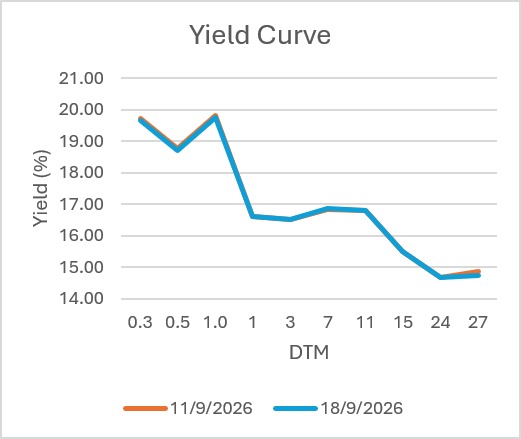
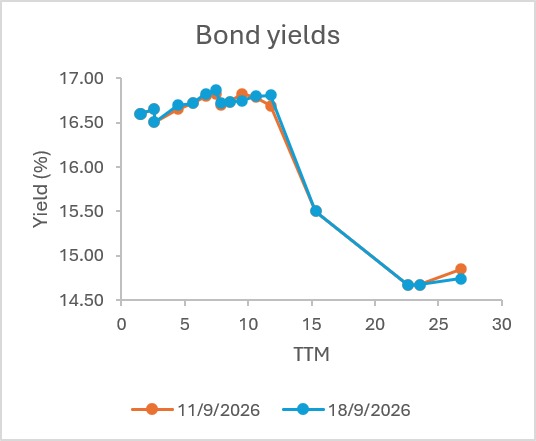
FGN Bond Issuance: The September 14, 2026, FGN Bond auction recorded firm demand across the offered instruments: a new 10-year issuance and a reopened 15-year bond. Competitive subscriptions reached 1.37x for the new September 2036 and 1.58x for the June 2038 bond, with bid-to-cover ratios of 1.89x and 2.06x, respectively, while the 2038 paper’s stop rate fell sharply by 94bps to 16.85% from 17.79% at the previous auction, signalling stronger demand for duration, in addition to a pull likely driven by the non-competitive bid. The new 10-year bond cleared at 16.79%, marking its coupon. The Debt Management Organisation (DMO) allotted 50.9% of total demand offered, excluding the total non-competitive bids of ₦850.00 billion, reflecting measured supply absorption at prevailing yields. The outcome points to firmer demand for longer-duration FGN securities and a more bullish secondary-market tone, supported by moderating inflation and expectations of less restrictive monetary conditions, although liquidity conditions and the pace of issuer supply remain key near-term drivers.
FGN Bond | 16.79% JAN 2036 | 15.45% JUN. 2038 |
Maturity Date | 16-09-2036 | 21-06-2038 |
Amount Offered (₦’B) | 400.00 | 600.00 |
Subscription (₦’B) | 546.90 | 947.83 |
Non-Competitive Bid (₦’B) | 600.00 | 250.00 |
Amount Allotted (₦’B) | 288.63 | 460.01 |
Stop Rates (%) | 16.7900 | 16.8500 |
Previous Stop Rates (%) | 00.0000 | 17.7900 |
Money Market Issuance: The September 16 OMO auction delivered a mixed signal for the fixed-income market, with demand remaining strong but short-end yields repricing higher. The 69- and 90-day bills stop rates cleared at 19.25% and 19.05% (-9bps vs prev. 84-day), respectively, showing marginal ease in the low-19% range, while the 153-day bill eased to 18.39% (-2bps vs prev. 153-day) despite attracting the strongest demand at 3.62x. Vertically, rates eased 15bps and 86bps compared to the 69-day bill. Effective yield was 19.98%, 19.99% (-3bps), and 19.93% (-3bps) for the 69-, 90-, and 153-day bills, respectively. Total demand stood at ₦3.03 trillion (-51.9%), while ₦2.52 trillion (-42.8%) was allotted compared to the previous auction, indicating substantial investor appetite but also a preference for higher yields at shorter tenors. The ripple effect of the auction outcome on the secondary market signals near-term movement pressure on short-dated bills; however, strong demand for the longer tenor and its marginally lower stop rate indicate that duration remains supported. Overall, the auction points to a selective yield repricing rather than broad-based, with liquidity conditions and further Central Bank of Nigeria (CBN) OMO supply likely to determine whether the short-end maintains the 19% level or becomes sustained.
AUCTION DATE | TENOR | OFFER (₦‘ B) | BIDS (₦‘ B) | TOTAL SALE (₦‘ B) | STOP RATES (%) | PREVIOUS TENOR RANGE STOP RATES (%) |
16-09-2026 | 69-DAY | 200.00 | 408.52 | 86.19 | 19.2500 | 00.0000 |
90-DAY | 200.00 | 450.94 | 419.73 | 19.0500 | 19.1400 | |
153-DAY | 400.00 | 2,174.53 | 2,010.53 | 18.3900 | 18.4100 |
The launch of the J.P. Morgan Global Bond Index Emerging Market (GBI-EM) Edge index strengthens Nigeria’s position in global local-currency debt markets, with the country receiving a 7.40% index weight, backed by US$17.47 billion across 16 eligible FGN securities and an average yield-to-maturity of 17.1%. For Nigeria’s secondary bond market, inclusion creates a structural channel for greater foreign participation in eligible benchmark securities, potentially improving liquidity, price discovery and demand for longer-duration bonds, while the relatively high carry enhances the market’s attractiveness. Yet, the opportunity remains closely tied to foreign exchange (FX) liquidity, repatriation, settlement efficiency and macroeconomic stability, as the Naira’s performance can materially affect foreign investors’ realised returns. With Frontier Africa accounting for 44.5% of EDGE, the index also broadens global access to African local-currency debt, but Nigeria’s ability to convert index inclusion into sustained capital inflows will depend on maintaining market accessibility, currency stability and sufficient liquidity in its benchmark FGN securities.
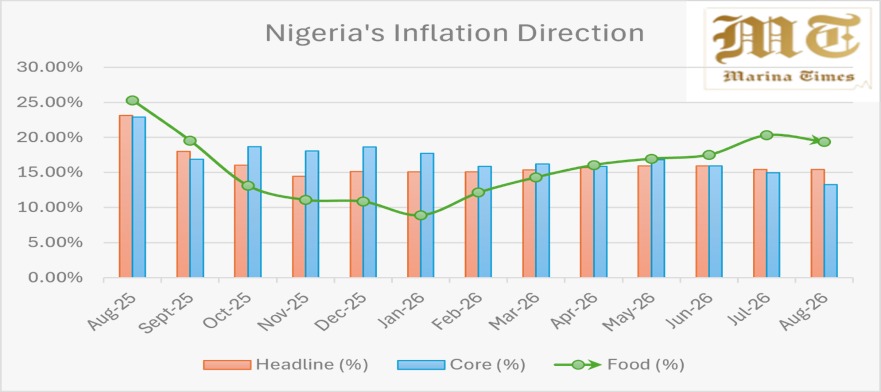
According to the National Bureau of Statistics (NBS) Consumer Price Index Report for August 2026, Nigeria’s inflation momentum continued to ease, with headline inflation declining marginally to 15.39% year-on-year (YoY) from 15.43% in July, while month-on-month (MoM) inflation fell sharply to 0.71% from 1.57%. Food inflation moderated to 19.57% YoY and 1.02% MoM, while core inflation eased to 13.29% YoY and -0.06% MoM, pointing to a broader moderation in price pressures. However, with food inflation still close to 20% annually, the data indicate slower price growth rather than outright deflation, while divergent rural and state-level movements remain a key risk.
Nigeria’s Federation Accounts Allocation Committee (FAAC) shared ₦2.34 trillion from the Federation Account for August 2026, sharply down by 22.2% from ₦3.01 trillion in July, reflecting a decline in statutory revenue despite stronger VAT collections. The distributable pool comprised ₦1.57 trillion in statutory revenue and ₦773.23 billion in VAT, with the Federal Government receiving ₦804.89 billion, States ₦794.31 billion, and Local Governments ₦555.14 billion, alongside ₦184.39 billion in derivation revenue. The decline was driven mainly by weaker statutory receipts, although increases in VAT, Petroleum Profit Tax and Hydrocarbon Tax provided some offset.
The Naira gained during the week in the Nigerian Foreign Exchange Market (NFEM), gaining ₦4.90 (+0.37%) WtD and ₦4.68 (+0.35%) WoW, closing at $/₦1,331.20 (WoW: $/₦1,326.52). Foreign reserves increased from $54.41 billion to $54.70 billion (+0.52%) as of September 17, 2026, while blocked funds eased to $513.22 million (-1.93%), with the blocked reserve ratio at 0.94% (-0.2 bps), indicating improved foreign exchange conditions and receipts amidst external pressures.
The Nigerian Exchange (NGX) staged a measured recovery through the week, with the ASI gaining 2.67 WtD and 2.78% WoW, closing at 249,804.60 points, while the year-to-date (YtD) return rose from 56.19% to 60.53%. The recovery broadened as the week progressed, as buying broadened beyond the initial selective gains, with market breadth improving from 1.13x on Tuesday to 1.91x on Friday, alongside a sharp increase in activity, as volume reached 3.20 billion shares from 428.94 million shares and value traded rose from ₦20.50 billion to ₦168.67 billion, signalling stronger market participation as market capitalisation also increased by approximately 2.67% to ₦163.50 trillion. The NGXGROUP provided an early boost, amid market sentiment around the ₦2.15 trillion Dangote Refinery and Petrochemicals FZE initial public offering (IPO), while subsequent gains in ARADEL, NB, BUACEMENT, FIRSTHOLDCO, MBENEFIT, among other large- and mid-cap stocks, helped sustain the advance. The key signal being that equities have absorbed the IPO-related liquidity pressure relatively well, with bargain hunting returning, although market breadth and sector participation remain uneven. Sector rotation was also evident, with Oil & Gas and Consumer Goods initially leading the recovery before momentum shifted toward Insurance, Banking and Industrial Goods later in the week. Despite persistent declines in individual stocks and some sector-level weakness, the progression from narrow gains on Monday to stronger breadth, volume and sector participation by the end of week indicates that buying pressure is gaining traction and that recovery was becoming more broadly supported rather than remaining confined to a few names. Key sectors were positive WoW: Banking (+4.43%), Insurance (+3.79%), Oil & Gas (+3.71%), Industrial Goods (+3.12%), and Consumer Goods (+0.52%).
In the week ended September 18, 2026, global financial markets saw heightened volatility and elevated borrowing costs as persistent Middle East conflict continued to drive surge-related inflationary pressures, prompting major central banks to adopt aggressive policy stances. Headline monetary tightening was initiated by the US Federal Reserve’s rate hike by 25bps to the 3.75%-4.00% range, its first since 2023, and the European Central Bank’s policy tightening, while in the UK, official data showed inflation accelerating to 3.1% in August from 2.9% in July, driven by a nearly 25% jump in fuel prices. In response to mounting price pressure, the Bank of England’s Monetary Policy Committee voted 6–3 to hold interest rates unchanged at 3.75%, warning that prolonged Middle East conflict could push inflation toward 4% early next year and necessitate upcoming rate hikes. Marking a historic shift in Asia, the Bank of Japan voted 7–2 on Friday to raise its benchmark interest rate by 25 basis points to 1.25%, marking a 31-year high, to counter imported inflation and steady the yen. To cushion sovereign debt markets against liquidity friction while winding down quantitative easing, Threadneedle Street concurrently revealed a surprise structural shift to sell £146bn of long-term UK government bonds (gilts) directly back to the Treasury, providing temporary relief to gilt yields and stabilizing the global sovereign debt market sentiment despite the hawkish rate outlook. The equities market performance closed mixed WoW following the effect of hawkish interest rate hikes and Middle East energy shocks despite a late-week rebound in AI chip stocks that cushioned broader losses: the Nasdaq Composite at 26,522.55 (+0.70%), S&P 500 at 7,650.50 (-0.10%), and the Dow Jones Industrial Average at 51,682.64 (-1.69%). Across Europe, Germany’s DAX 40 was at 25,304.06 (-1.03%), while the FTSE 100 was at 10,659.13 (+0.08%), and the Stoxx 600 at 635.45 (-0.57%). Asian markets were varied, with Japan’s Nikkei 225 at 65,018.95 (+1.57%), China’s Shanghai Composite Index at 3,911.87 (+0.61%), Hong Kong’s Hang Seng Index at 24,750.78 (-2.22%), and South Korea’s KOSPI at 6,894.23 (-0.23%).
Global commodities were volatile through the week, with crude oil prices initially surging on Middle East supply disruptions before easing as Saudi Arabia began rerouting exports and prospects of restoring its East-West pipeline improved. WTI traded in a range of roughly $99.87–$105.39/bbl,, rising above $104/bbl. early in the week before closing at $100.30/bbl. on Friday, while Brent moved between $102.50 and $108.25/bbl, peaking near $109.50/bbl. before retreating to close at $103.87/bbl. by Friday, as supply concerns moderated. Gold, meanwhile, traded between approximately $4,290.00 and $4,387.00/oz, initially pressured by a stronger dollar, elevated Treasury yields, and expectations of Fed tightening, but rebounded to close $4,383.45/oz as the dollar and bond yields eased and lower oil prices reduced inflation concerns. Overall, the week reflected a shift from geopolitical supply-risk premium in oil to easing supply pressures, while gold recovered as markets reassessed the implications of US monetary policy and declining yields.
Market direction remains highly sensitive to monetary-policy and liquidity signals, with the CBN’s September 2026 Monetary Policy Committee (MPC) decision expected to be a key catalyst for near-term risk appetite and asset-price momentum. Ahead of the scheduled ₦500.00 billion Nigeria Treasury Bill (NTB) auction, the market is expected to receive more than ₦2.24 trillion in liquidity inflows, comprising ₦2.27 trillion from OMO maturities, ₦28.04 billion from NTB maturities, ₦183.44 billion in FGN Bond coupon payments, and a $52.34 million Eurobond coupon on the 8.375% March 2029 bond. While these inflows could provide support for fixed-income demand, the MPC’s policy stance will determine how much of the liquidity translates into sustained market demand.
The MPC’s forthcoming decision will be a balancing act between maintaining a hold to defend the currency and anchor inflation against recent global oil price shocks, or ease to lower borrowing costs and stimulate domestic economic growth. A decision to maintain the MPR without recalibrating the asymmetric interest-rate corridor could limit the effectiveness of the liquidity injection and leave short-term money-market conditions relatively tight, making the MPC outcome a critical determinant of the direction of yields and broader asset-price momentum.
The FTSE Russel upgrade of Nigeria to Frontier Market status effective Monday, September 21, 2026, is expected to drive a surge in foreign portfolio investments (FPIs) and passive capital inflows into the liquid large-cap Nigerian equities market, boosting liquidity and investor confidence.
Scheduled dividends include; University Press Plc. expected to pay ₦0.18 per share on September 24, 2026, followed by Academy Press Plc, expected to pay ₦0.10 per share on September 25, 2026.
By: Sandra A. Aghaizu
The Naira found a little strength,
Inflation loosened its hold,
Bonds opened their doors to investors,
While caution guarded the gold.
Stocks climbed with measured steps,
As oil danced with the tide.
In markets, as in life,
Hope walks forward,
But risk walks beside.





Subscribe now to keep reading and get access to the full archive.