


September 2026, Edition 5
Nigeria’s financial markets entered a decisive repricing phase during the week as the Central Bank of Nigeria (CBN) Monetary Policy Committee’s (MPC) decision to reset the Monetary Policy Rate (MPR) by 350bps to 23.00% accelerated an already emerging bullish shift across fixed income, equities and foreign exchange (FX). Secondary-market yields compressed sharply across Open Market Operations (OMO) bills, Nigeria Treasury Bills (NTBs) and FGN bonds, while primary market auctions confirmed strong demand for duration and lower clearing rates, reinforcing expectations of further yield compression and supporting bond-price gains, albeit with rising reinvestment risk. The Naira also strengthened marginally, gaining ₦0.29, alongside higher reserves at $54.83 billion, while the NGX-ASI advanced by 0.78% week to date (WtD) to 252,113.43 points, lifting its year-to-date (YtD) gains to 62.01%, supported by renewed selective flows and broad-based sector positioning. Yet, beneath the headline rally, market signals remain increasingly picky: the fixed-income curve was skewed by uneven demand across tenors, while narrowing equity breadth and sector rotation point to a more discriminating risk-on environment. Globally, resilient U.S. and Eurozone activity, elevated long-end Treasury yields and divergent African monetary-policy responses continued to shape the external backdrop, leaving Nigerian assets at the intersection of falling domestic rates, improving FX liquidity and renewed foreign participation, while inflation, reinvestment risk and global duration pressures remained key variables for the next phase of the repricing. In commodities, prices eased after a volatile run following calls to return to an interim peace deal, closing Week-on-Week (WoW) at $92.41/bbl. (-7.87%) and $104.32/bbl. (+0.43%) for West Texas Intermediate (WTI) and Brent crude, respectively, while gold was at $4,285.00/oz. (-2.25%).
System liquidity opened at ₦3.99 trillion, peaked at ₦7.45 trillion on Wednesday, and closed at ₦5.98 trillion on Friday, marking a gain of 49.93% WtD. Money market rates eased mid-week in line with the MPC reset decision, with the Open Repo Rate (OPR) and Overnight (O/N) rate closing WoW at 20.40% (-160bps) and 20.77% (-147bps). In the Foreign Exchange (FX) market, the Naira traded within a range of $/₦1,325.00 and $/₦1,336.00, before closing at $/₦1,329.51 on Friday.
The fixed-income secondary market opened with a selective bullish bias trend that strengthened following the Central Bank of Nigeria (CBN) MPR reset decision, with yields gapping down by at least 50bps on Tuesday. The market generally recorded a decisive bullish repricing through the week, with yields compressing sharply across OMO, NTBs and FGN bonds as investors repositioned for further easing and declining primary-market issuance rates amidst jittery sentiment on direction. OMO bills yields led the move, with the 02-Feb-27 bid falling from 18.50% on Monday to 17.10% by Friday, while the 16-Feb.-27 bid eased from 18.30% to 17.16%; the 23-Feb.-27 bill moved below the 17.15% level on Friday. In the NTB space, the 23-Sept.-27 bill moved toward the 15.50%–15.60% bid range, while long tenor FGN bond securities saw broad yield compression, with the 15.45% Jun-2038 offer moving from 16.75% on Monday to 15.75% by Friday and the 16.79% Sept-2036 offer reaching 15.65%. This can be likened to the ripple effect of the policy rate reset, which impacted all existing fixed-income securities in the secondary market.
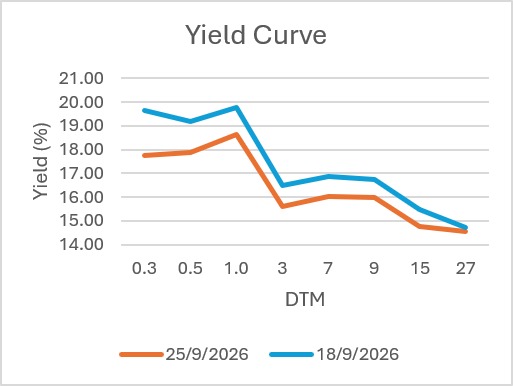
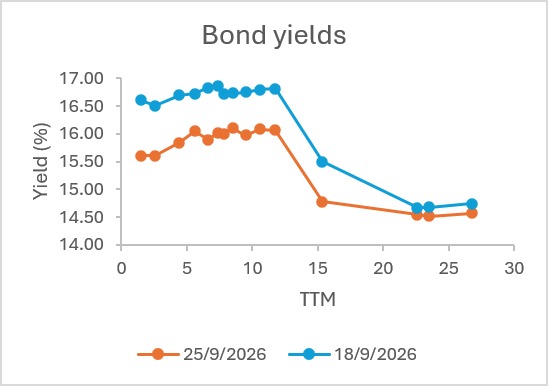
NTB Issuance: The 23 September 2026 NTB auction signals rising demand toward the longer end of the curve, with the 364-day bill recording 10.24x subscription against its offer, while the 91-day and 182-day bills attracted only 0.55x and 0.82x cover, respectively. Stop rates compressed by 80bps, 70bps, and 73bps across the three tenors to 15.50%, 15.80%, and 15.89%, for the 91-, 182-, and 364-day bill correspondingly, reflecting strong easing expectations and bullish bias in the market. Effective yield eased to 16.12% (-69bps), 17.15% (-83bps), and 18.88% (-104bps) for short-, mid-, and long-day bills, respectively. The divergence between weak short-tenor demand and exceptional long-tenor demand points to active curve repositioning rather than broad-based demand strength. With Nigeria offering a 7.61% positive real return, the auction reinforces expectations of further yield compression amidst strong demand; consequently, secondary-market yields could fall, and prices could rise, supporting mark-to-market gains on existing higher-yielding securities while increasing reinvestment risk.
AUCTION DATE | 23-09-2026 | 23-09-2026 | 23-09-2026 |
MATURITY DATE | 24-12-2026 | 25-03-2027 | 23-09-2027 |
TENOR | 91-DAY | 182-DAY | 364-DAY |
OFFER (₦) | 100,000,000,000 | 100,000,000,000 | 400,000,000,000 |
SUBSCRIPTION (₦) | 54,927,046,000 | 82,232,893,000 | 4,094,383,452,000 |
ALLOTMENT (₦) | 11,027,965,000 | 39,485,146,000 | 447,071,049,000 |
BID RANGE (%) | 15.3500 – 20.0000 | 15.4000 – 17.0000 | 15.5800 – 20.0000 |
STOP RATES (%) | 15.5000 | 15.8000 | 15.8900 |
PREVIOUS STOP RATES (%) | 16.3000 | 16.5000 | 16.6200 |
Money Market Issuance: The 24 September 2026 CBN OMO auction featured 68-, 152-, and 180-day bills, with the 180-day tenor marking the longest OMO tenor since the 354-day bill issued on 30 January 2026, which cleared at 17.25% with an effective yield of 20.72%. Demand was strong, with the 152- and 180-day bills recording 4.13x and 8.63x subscription and allotment of 2.09x and 2.92x, respectively, while the 68-day bill attracted 3.49x demand but received no allotment. The 152-day stop rate fell 110bps to 17.29%, while the new 180-day tenor cleared at 16.99%; effective yields stood at 18.63% (-130bps) and 18.54%, respectively. Despite total bids rising by 6.01x to ₦6.09 trillion, only 37.0% was allotted, down by 10.4% from the previous sale, highlighting strong liquidity but selective CBN absorption and an inverted yield curve. Overall, the auction reinforces downward yield pressure and a selective bullish bias in the secondary market.
Note: The 180-day OMO bill real yield is still higher than the 182-day T-bill by 139bps, marking an attractive premium for investors.
AUCTION DATE | TENOR | OFFER (₦‘ B) | BIDS (₦‘ B) | TOTAL SALE (₦‘ B) | STOP RATES (%) | PREVIOUS TENOR RANGE STOP RATES (%) |
24-09-2026 | 68-DAY | 100.00 | 348.58 | 0.00 | 0.0000 | 19.2500 |
152-DAY | 450.00 | 1,858.08 | 939.60 | 17.2900 | 18.3900 | |
180-DAY | 450.00 | 3,882.76 | 1,315.00 | 16.9900 | 00.0000 |
The Naira marginally gained during the week in the Nigerian Foreign Exchange Market (NFEM), gaining ₦0.29 (-0.02%) WtD and ₦1.69 (-0.13%) WoW, closing at $/₦1,329.51 (WoW: $/₦1,331.20). Foreign reserves increased from $54.70 billion to $54.86 billion (+0.30%) as of September 24, 2026, while blocked funds eased to $503.26 million (-1.94%), with the blocked reserve ratio at 0.92% (-0.2 bps), indicating improved foreign exchange conditions and receipts amidst external pressures.
Offshore inflows returned to the market following Nigeria’s official reinstatement into the FTSE Russell Frontier Market Index Series earlier in the week, including the benchmark interest rate reset. This structural upgrade compelled international benchmark tracker funds to re-engage with the Nigeria Exchange (NGX), driving foreign capital directly into highly liquid, large-cap equities. Nigerian equities extended their rally for a fourth consecutive session, closing marginally lower at 252,113.58 points on Friday, with the NGX ASI gaining 0.14%, 0.18%, 0.28% and 0.38% from Monday to Thursday, with 0.78% WtD and 0.92% WoW, while lifting the YtD return from 60.53% to 62.01%. Buying remained concentrated in large-cap banks and selected industrial, consumer and oil & gas names, with NAHCO, SEPLAT, FIDELITYBK, UBA, ZENITHBANK, GTCO, OANDO and CMFC among notable drivers. At the same time, market breadth peaked at 1.92x before closing at 1.81x, signalling a less broad-based advance by Friday. Trading activity remained elevated, with daily value traded ranging from ₦38.04 billion to ₦48.50 billion, while volume peaked at 1.59 billion shares on Wednesday before easing to 707.81 million at the week’s close. Sector leadership rotated, with banking and insurance driving earlier gains before Oil & Gas led Thursday’s advance at +1.71% on SEPLAT’s 7.33% surge, while the Banking Index slipped 0.29% on profit-taking and Q3 performance reports positioning. Overall, the week’s price action reflects persistent risk appetite and strong institutional interest. Still, the sector rotation suggests that the rally is becoming increasingly selective rather than uniformly market wide. Key NGX sector indices were positive WoW: Oil & Gas (+3.49%), Banking (+3.06%), Industrial Goods (+1.56%), and Consumer Goods (+0.62%), while Insurance (-0.52%) was negative
In the week ended September 25, 2026, global financial markets witnessed tightening yield curves amidst the ongoing United Nations General Assembly (UNGA 81), key technology releases, and major macroeconomic data: S&P Global released its September 2026 flash PMIs showing an unexpected private sector acceleration. This expansion was led by the U.S. Composite PMI jumping to 58.4, a 62-month high powered by a surge in the Services Business Activity Index (58.7) and a sharp acceleration in the headline Manufacturing PMI (57.0) (with its underlying Output Index hitting 56.7). Concurrently, Eurozone output hit a 41-month high, with its Composite PMI unexpectedly climbing to 53.1; in financial market infrastructure, the European Central Bank (ECB) launched Pontes, enabling wholesale tokenized financial asset transactions to settle directly in central bank money through distributed ledger technology (DLT); simultaneously, U.S. long-term borrowing costs surged, as the 30-year Treasury yield hit its highest level since 2004 amid an escalating sovereign bond selloff. Across Africa, Access Bank finalized full ownership of National Bank of Kenya, as select central banks’ monetary stances diverged sharply: the Central Bank of Nigeria instituted an aggressive 350-basis-point rate cut to lower its Monetary Policy Rate to 23.00% to bolster growth, whereas the South African Reserve Bank (SARB) unexpectedly tightened monetary policy by hiking its repo rate 25 basis points to 7.25% due to sticky services inflation and fuel cost pressures. Meanwhile, Bank Al-Maghrib in Morocco, the Bank of Ghana (BoG), and the Central Bank of Egypt all opted to hold their benchmark interest rates unchanged at 2.25%, 14.00%, and 19.00%, respectively, maintaining cautious stances amidst global volatility and energy market risks. Equities market performance closed largely positive WoW following the effect of Middle East energy shocks despite massive rallies in large-cap tech and Artificial Intelligence (AI) stocks that offset the pressure of surging multi-decade-high US Treasury yields: the Nasdaq Composite at 27,068.72 (+2.06%), S&P 500 at 7,743.41 (+1.21%), and the Dow Jones Industrial Average at 51,828.62 (+0.28%). Across Europe, Germany’s DAX 40 was at 25,408.64 (+0.41%), while the FTSE 100 was at 10,695.25 (+0.34%), and the Stoxx 600 at 638.65 (+0.50%). Asian markets were mixed, with Japan’s Nikkei 225 at 66,364.20 (+2.07%), China’s Shanghai Composite Index at 3,888.37 (-0.60%), Hong Kong’s Hang Seng Index at 24,510.09 (-0.97%), and South Korea’s KOSPI at 7,080.92 (+2.71%).
Global commodity markets ended the week with a widening divergence between gold and crude: gold fell from $4,350.35/oz on Monday to $4,285.00/oz on Friday, trading within roughly $4,270–$4,350/oz, as a stronger dollar, higher Treasury yields and expectations of further U.S. Federal Reserve tightening increased the opportunity cost of holding non-yielding bullion. WTI traded between $91.81/bbl.–$94.87/bbl., closing at $92.41/bbl., while Brent moved through a higher $99.20–$105.20/bbl. range before closing at $104.32/bbl., with Middle East tensions and uncertainty around the Strait of Hormuz keeping a substantial geopolitical premium in crude, amidst Iran’s call to return to the interim peace deal.
The market is expected to receive liquidity inflows of more than ₦2.59 trillion, comprising ₦2.43 trillion from OMO maturities, ₦164.29 billion in FGN Bond coupon payments, and a $145.15 million Eurobond coupon on the 6.125% Sept. 2028, 7.375% Sept. 2033, and 8.25% Sept. 2051 bonds. October 2026 is set to open with over ₦10.36 trillion in potential liquidity inflows, comprising ₦9.05 trillion from OMO maturities, ₦1.31 trillion from NTBs, ₦537.53 billion in FGN bonds, and ₦27.56 billion from FGN Sukuk coupon payments, creating a substantial liquidity pool that could influence money-market rates, asset allocation, and the direction of fixed-income yields.
By: Sandra A. Aghaizu
Money flows like a river,
Finding new paths as the old ones end.
Billions return to the market,
Seeking new places to lend.
October opens its gates wide,
With trillions waiting to flow.
Will yields rise or drift lower?
Only the market will show.





Subscribe now to keep reading and get access to the full archive.