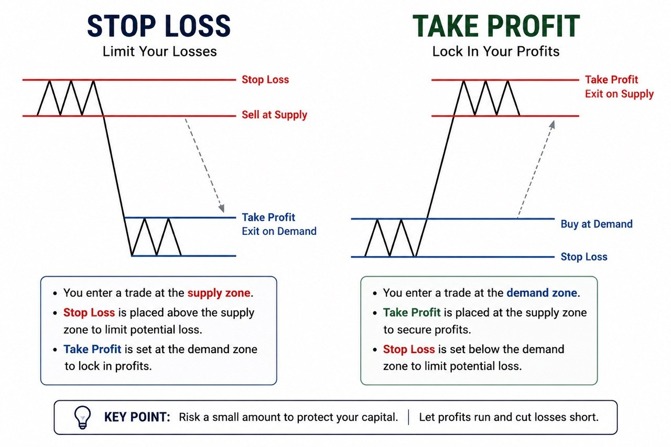
Risk management is the process of identifying, assessing, and controlling the risks associated with buying, holding, and trading assets (including digital assets). Given the highly volatile nature of cryptocurrency markets, effective risk management is essential for protecting capital, helping to reduce the impact of unexpected losses.
Successful trading is not determined solely by identifying profitable opportunities; it also depends on managing risk effectively. Without proper risk management, even a series of successful trades can be wiped out by a single significant loss.
Common risk management concepts:
- Entry Price
The entry price is the price at which a buy or sell order is executed. A well-planned entry helps traders manage risk and improve the probability of achieving their desired outcomes.
- Position Sizing
Position sizing refers to the amount of capital allocated to a particular trade. Traders are generally advised to risk only a small percentage of their total trading capital on any single trade, and avoid putting excess capital concentration into one asset or trade position.
- Stop Loss Order
A stop-loss order is an instruction to automatically close a trade when the price reaches a predetermined level. It is designed to limit losses and protect trading capital from significant losses or drawdowns. It is important to set a clearly defined stop-loss level for every targeted trade.
- Take Profit Order
A take-profit order automatically closes a trade once a specified profit target is reached. This helps traders lock in gains, avoid emotional decision-making, and maintain a disciplined exit strategy.
- Liquidation Price
The liquidation price is the level at which a leveraged position is automatically closed by the exchange because the trade’s losses have exceeded the available margin. Liquidation results in the loss of a significant portion, or all, of the capital used to borrow the position, or when the mark price hits the liquidation price given to you by your broker.
- Risk to Reward Ratio (R:R):
Risk-to-Reward ratio measures the amount a trader is willing to risk relative to the potential rewards. For example, a 1:3 risk-to-reward ratio means a trader is risking $1 to potentially earn $3. Consistently maintaining favourable risk-to-reward ratios can improve long-term trading performance.
- Leverage
Leverage allows traders to control larger/more sizable positions and make more profits. In many cases, you can control 10 to 20 times the amount required to open the position. The term ‘leverage’ refers to how much the position is increased; for instance, 100x (or 1:100) leverage will increase a $500 Bitcoin position to be as big and as profitable as a $50,000 Bitcoin position: $500*100=$50,000.
Using this same example, a trader’s initial investment ($500) is referred to as the ‘margin’ and is used as collateral if the asset’s market price were to move in the opposing direction. Leverage ranges from 1x to 125x depending on the broker and the asset you are trading. While leverage can increase profits, it also magnifies losses. Excessive leverage can result in liquidation, so it should be used cautiously.
- Emotional Control
Emotions such as fear, greed, panic, and the Fear of Missing Out (FOMO) often lead to poor trading decisions. Traders should adhere to a predefined trading or investment plan and avoid impulsive actions driven by market sentiments.
- Security Risk
Protecting digital assets is a critical aspect of risk management. Traders and investors should:
- Secure private keys and seed phrases,
- Use reputable wallets and exchanges,
- Enable two-factor authentication (2FA) where available,
- Remain vigilant against phishing attacks, fake websites, and fraudulent investments.
Examples of Position sizing calculations:
Assume you have $1,000 in trading capital and decide to risk 2% of your capital on a trade.
Maximum Risk per Trade:
$1,000 × 2% = $20
If your entry price is $100 and your stop-loss is $95, your risk per coin is:
$100 – $95 = $5.
Position Size Calculation:
Therefore: $20 ÷ $5 = 4 coins
Therefore, your position size would be 4 coins, rather than simply buying an arbitrary amount. This ensures that your maximum loss remains limited to $20 if the stop-loss is triggered.
Another illustration applying leverage on a trade (BTC/USDT)
Total capital in Trader’s Account = $100,000
Risk per Trade: 1% of capital = $1,000
Chosen leverage = 20x
Current Price of the Asset (Bitcoin) = $65,000
Using the above information, we will calculate the Position Size for this trade in terms of BTC
Formula = (RISK*LEVERAGE)/CURRENT PRICE OF THE ASSET (BITCOIN)
1000*20/65000 =0.308BTC
Position Size for this trade in terms of USDT
Formula = Risk * Leverage
Risk = 1% of capital: $1,000
Leverage = 20x
Position Size = $1,000 *20 = 20,000 USDT
Setting Stop-Loss (SL) and Take-Profit (TP) Levels
Your SL should be placed at a technical level where the original reason for entering the trade is no longer valid.
Common methods for determining SL and TP levels include:
- Moving Averages
- Support/Resistance levels
- Fibonacci Retracement Levels
- Swing Highs and Swing Lows
- External Range Liquidity (ERL) and Internal Range Liquidity (IRL)
Conclusion
The objective of risk management is not to eliminate losses but to ensure that losses remain controlled and manageable. A disciplined approach to risk management prevents a single trade from causing significant damage to trading capital and supports long-term sustainability in the market.
In cryptocurrency trading and investing, capital preservation should always take precedence over profit maximization.