
Weekly Market Review: Naira Strengthens, Fixed-Income Yields Ease and NGX Rebounds on FTSE Reclassification
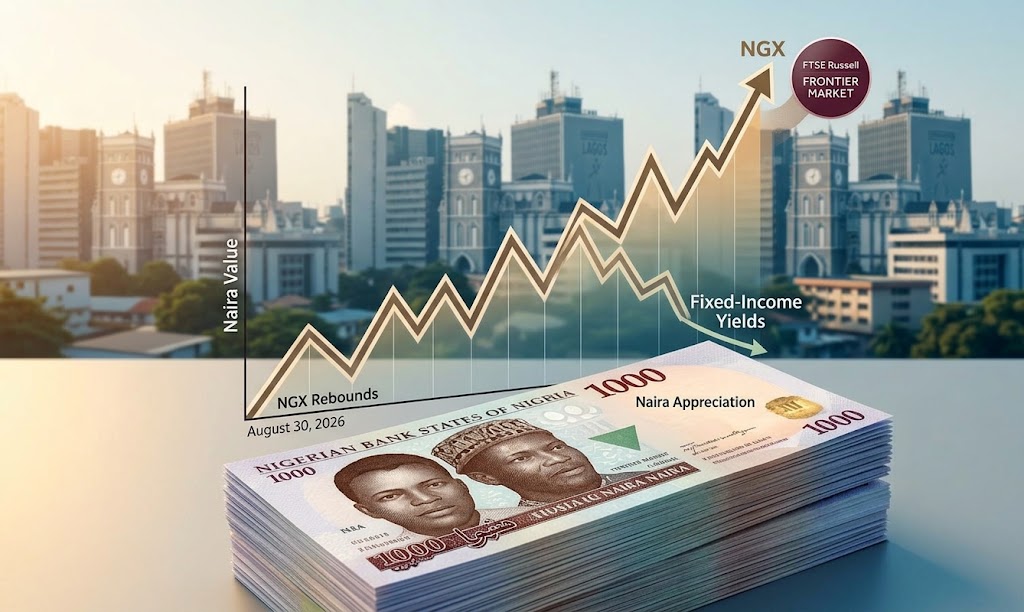
Nigerian markets saw a significant shift in August 2026. The Naira strengthened, while fixed-income yields eased on strong primary market demand. Concurrently, the equities market rebounded on news of Nigeria’s return to the FTSE Russell Frontier Market status. This combination of factors led to a more selective investor approach, moving towards defensive assets, liquidity, and yield in a cautious global environment.
Weekly Market Review: Fixed-Income Resilience Amid Easing Inflation and Global Risk Pressures

Nigeria’s domestic market showed cautiously constructive sentiment as easing headline inflation and strong FGN bond auction demand reinforced the case for gradual fixed-income yield compression. While food price acceleration and profit-taking in equities indicate an uneven recovery, improved foreign exchange stability and abundant liquidity provide a supportive foundation for local fixed-income assets amidst persistent global risks and oil price volatility.
Signals Beneath the Surface: Strong Demand Signals Yield Repricing, but Duration Risks Persist

Nigeria’s fixed-income market remained positive as heavy demand for short-term bills signaling a yield turning point and deep liquidity was evident. However, persistent duration risks linger at the long end, as highlighted by higher long-term NTB rates and increased FGN bond issuance. While short-term yields compress, the market remains cautious. Globally, soft US inflation data pushed down yields, supporting equities, despite mixed regional results and lingering geopolitical tensions.
Signals Beneath the Surface: Liquidity, Policy Shifts and Capital Flows Shape Nigeria’s Market Momentum

Nigeria’s financial markets show a story of cautious optimism. While the banking sector continues to anchor equities and fixed income investors lock in attractive yields, the Central Bank’s latest OMO auction and 2025 Annual Report provide fresh insights into the evolving liquidity and monetary policy environment. Simultaneously, the Naira remains broadly stable, foreign reserves strengthened, and a landmark tax framework for virtual assets was unveiled.
Markets in Transition: Liquidity Expansion, Yield Compression and Cautious Risk Repricing

Financial markets concluded July 2026 amid expanding domestic liquidity and resilient investor demand, despite global policy uncertainty. In Nigeria, fixed-income yields compressed following robust oversubscriptions at OMO and Treasury bill auctions. Equities posted mixed results despite strong H1 corporate earnings, while the Naira depreciated mildly. Globally, central banks held rates steady amid volatile commodity prices.
Market Pulse: Fixed Income Rally, Foreign Exchange (FX) Stability and Earnings Strength Drive Investor Confidence

Nigerian markets sustained a positive tone, driven by robust liquidity, a fixed income rally, foreign exchange stability, and strong corporate earnings. Meanwhile, the Central Bank of Nigeria maintained its disciplined monetary policy stance to anchor inflation. Evolving domestic fundamentals and external geopolitical risks continue to shape investor positioning and global market outlooks.
Market Pulse: Resilience Amid Policy Discipline and Global Headwinds

Nigeria’s financial markets demonstrated resilience, driven by improving macroeconomic fundamentals, robust liquidity management, and rising external reserves despite global headwinds. While headline inflation slowed marginally to 15.91 percent, crude oil output reached a long time high. Investors actively monitor inflation, liquidity, and upcoming central bank policy signals very closely now.
Market Pulse: Liquidity, Repricing and Risk Appetite Shape a Defining Week

During the week ending July 10, 2026, Nigeria’s financial markets showed optimism with easing fixed income yields and strong demand for government securities. The Naira strengthened, supported by stable foreign exchange reserves. The equities market rebounded, reflecting improved investor sentiment, while global economic conditions, particularly inflation and geopolitical risks, remained a concern.
Sovereign Supply, Surplus Liquidity Shape Q3 Market Mood

Despite reduced Friday trading due to the US holiday in observance of Independence Day, commodities closed week-on-week (WoW) at pre-war levels, with Brent crude and West Texas Intermediate (WTI) at $72.07/bbl. (+0.10%) and $68.73/bbl. (-0.73%) respectively, while gold at $4,088.99/oz (+0.04%)…
Yields Reset Higher Amid Cautious Positioning and Macro Uncertainty

Globally, sentiment was pressured by hawkish US data and tech-led equity sell-offs, even as signals from the World Economic Forum Summer Davos 2026 reinforced a shift toward execution-driven growth narratives, leaving markets anchored on elevated yields and cautious risk appetite…